Anthropic’s rapid deployment of advanced desktop integration features has fundamentally transformed how knowledge workers interact with artificial intelligence. At the forefront of this shift is Claude Cowork, a sophisticated operational mode that bridges the gap between conversational AI and autonomous local file execution. By combining desktop file access with modular instruction sets known as "skills," users can execute complex, multi-step workflows that transcend the limitations of traditional chat-based interfaces. This evolution culminates in Anthropic’s announced structural merger of Claude Chat, Cowork, Artifacts, and Design into a single, unified experience, designed to streamline user workflows and minimize context switching.

Understanding the Mechanics of Claude Skills
At its core, a Claude Skill functions as a modular, reusable instruction directory. Rather than relying on exhaustive, manually pasted prompts during every session, users can deploy structured folders containing predefined directives, supporting templates, scripts, and reference documents. Claude dynamically loads these skills only when contextually warranted, leveraging a mechanism known as progressive disclosure. This ensures that extensive brand guidelines, vast datasets, or technical utilities do not encumber everyday conversational memory.

Crucially, these skills are not siloed within a single application mode. Anthropic’s unified interface—rolling out initially across Pro, Max, and Team plans on web, desktop, and mobile devices—ensures that a skill developed for Claude Cowork is universally accessible across Claude Chat and Claude Code. This cross-surface functionality allows the AI to autonomously determine the appropriate toolset based on natural language queries, eliminating the friction of navigating multiple tabs or interface environments.
The Chronology and Architecture of the Unified Experience

The trajectory of AI workflow automation has accelerated significantly over recent years. Initially, users depended entirely on prompt engineering and static project folders to maintain conversational continuity. The introduction of local desktop execution via Cowork marked a major leap, allowing models to read, write, and manipulate files directly within specified local directories.
However, user feedback consistently highlighted the operational friction of transitioning between distinct interfaces for text generation, design, coding, and file management. Recognizing this bottleneck, Anthropic scheduled a comprehensive structural merger. Beginning in October 2026, the artificial intelligence ecosystem consolidates these disparate surfaces into an integrated workspace. Existing projects, connectors, tasks, and skills seamlessly carry over into the new environment, allowing Claude to autonomously orchestrate sub-agents, draft comprehensive documents, and manage multi-step procedures without manual tool selection.

Analyzing the Spectrum: Skills vs. Projects vs. Instructions vs. Memory
To maximize productivity within the unified Claude environment, professionals must understand the distinct operational parameters of its various customization features. Industry analysts often summarize the architecture through a simple workshop analogy: projects represent the workshop itself, while skills are the specialized tools residing within it.

- Claude Skills: Reusable, task-specific operational instruction folders loaded dynamically upon demand. They dictate how a specific multi-step workflow should be executed.
- Claude Projects: Dedicated container environments that group related documents, contextual files, and custom instructions around a broader domain or initiative.
- Custom Instructions: Persistent behavioral guidelines that shape how Claude responds across general interactions, dictating tone, formatting preferences, or operational constraints.
- Claude Memory: Persistent data retention capabilities that allow the model to remember specific user preferences, historical context, or ongoing project details across separate chat sessions.
When combined, these features create a highly tailored workspace. A user can operate within a specific project equipped with its own persistent memory and instructions, while dynamically invoking targeted skills to automate granular tasks.
Developing and Recording Workflows: A Practical Approach

Building effective skills begins with auditing recurring tasks. Professionals frequently identify high-value candidates by reviewing past chat logs, prompt libraries, or standardized operating procedures (SOPs). Ideal workflows involve repeatable, multi-step processes such as generating performance summaries, triaging inbound communications, or formatting technical documentation.
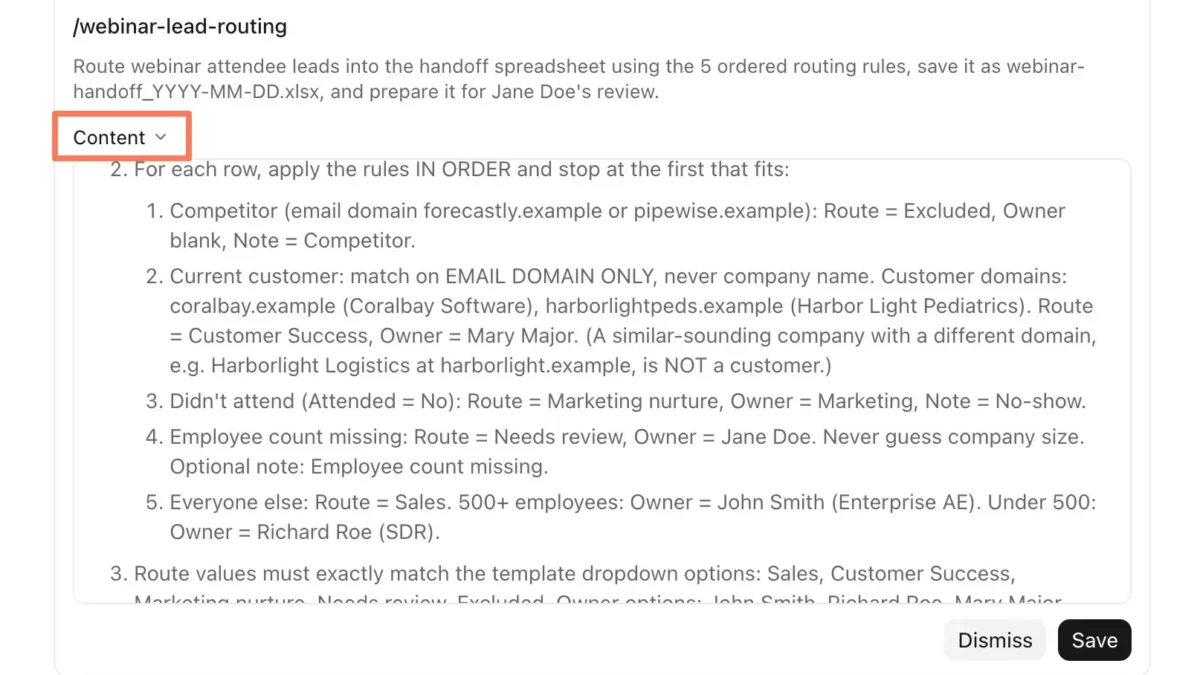
For macOS users subscribed to Pro, Max, or Team plans, Anthropic offers an advanced feature known as "Record a Skill." This tool bridges the gap between human execution and machine learning by capturing a live desktop screencast while the user verbally narrates a workflow.

To utilize this feature safely, practitioners must adhere to strict data hygiene standards. Because the recording software captures all visible screen activity, users are strongly advised to utilize dummy data, fictional contacts, and sanitized environments rather than sensitive proprietary information. Once the recording concludes, Claude autonomously processes the demonstration, drafts the underlying instruction code, and presents the resulting skill for review. Upon approval and saving, the skill integrates into the user’s library, ready to be paired with designated local folders for autonomous execution.
Practical Applications Across Revenue Teams

The true value of Claude Cowork skills lies in their cross-departmental adaptability, particularly within revenue-generating organizations spanning marketing, sales, and customer service.
Marketing teams frequently struggle with aggregating disparate channel metrics into executive-ready summaries. By deploying a performance-memo skill paired with a designated folder containing advertising exports, analytics reports, and campaign plans, marketers can automate the generation of structured executive briefs complete with key performance indicators, cost-per-lead evaluations, and strategic takeaways. Additional marketing applications include automated content localization and competitive landscape synthesis.

Sales organizations face prolonged deal cycles when reviewing complex legal redlines or contract modifications. A redline-triage skill can systematically cross-reference a prospect’s requested modifications against approved corporate fallback positions before the document reaches the legal department. This drastically reduces internal review latency while ensuring adherence to corporate risk parameters. Other high-impact sales workflows include automated pre-call intelligence briefings and systematic pipeline health audits.
Customer service and support departments benefit immensely through proactive readiness workflows. A release-briefing skill can ingest dense engineering release notes and translate them into digestible internal knowledge base updates or agent training summaries, ensuring support staff remain fully prepared for product updates prior to public deployment.

Security, Governance, and Ecosystem Integration
Granting an artificial intelligence system read, write, and modification access to local desktop directories introduces inherent governance and security challenges. Industry security frameworks frequently compare pointing an AI model to an unmanaged local directory to allowing an unvetted employee to rummage through a corporate filing cabinet. Best practices dictate establishing isolated, dedicated directories specifically for AI-assisted tasks, ensuring sensitive corporate files remain shielded from unintended modification.

Furthermore, integrating external application data is essential for transitioning skills from static time-savers to dynamic workflow accelerators. Native integrations, such as the official Model Context Protocol (MCP) connector for HubSpot, bridge the gap between static instructions and real-time customer relationship management data. Authorized via secure OAuth protocols and governed by strict administrator permissions, such connectors allow Claude to interact directly with CRM data—generating comprehensive pre-call briefs, logging meeting notes in standardized formats, and flagging stagnant pipeline opportunities without requiring manual tab-switching. Importantly, enterprise-grade connectors maintain strict privacy standards, ensuring shared CRM data is not utilized for underlying model training unless explicitly authorized.
Implications and Future Outlook

The convergence of autonomous desktop navigation, modular instruction sets, and secure enterprise connectors marks a maturing phase in artificial intelligence deployment. Rather than functioning as isolated conversational novelties, modern AI agents are rapidly embedding themselves into the foundational infrastructure of daily knowledge work.
By systematically standardizing recurring workflows into reusable skills and grounding them in verified enterprise data, organizations can transition from fragmented prompt engineering to cohesive, automated execution. As these unified interfaces continue to roll out across consumer and enterprise tiers, the competitive advantage will increasingly belong to organizations that master the disciplined design, rigorous quality assurance, and secure governance of their internal AI toolsets.