As the digital economy continues to expand at an unprecedented pace, the management of digital assets has transformed from a routine backend task into a core operational expense for modern enterprises. Modern web applications, driven by high-resolution media, extensive user-generated content, and complex data processing pipelines, grow larger by the day. This exponential growth in data volume carries a direct correlation to escalating infrastructure costs and increasing vendor complexity. For years, organizations have found themselves locked into legacy cloud storage ecosystems, facing unpredictable pricing models, complicated egress fees, and rigid architectures that make migrating or scaling burdensome.
In response to these compounding challenges, the cloud infrastructure landscape has seen the emergence of alternative storage providers aimed at democratizing object storage. Among the latest entrants making waves in the developer community is STRG, a modern cloud object storage platform engineered to provide a seamless, highly affordable, and fully S3-compatible alternative to industry heavyweights such as Amazon Web Services (AWS) S3, Google Cloud Storage, and Microsoft Azure Blob Storage. By combining native S3 compatibility with aggressive pricing structures and modern developer tooling, STRG addresses the primary friction points that developers and system administrators face when designing scalable web architectures.
The Evolution of Cloud Object Storage and Market Pressures
The demand for scalable object storage originated alongside the web 2.0 boom, when centralized cloud providers introduced utility computing. AWS S3, launched in 2006, set the benchmark for object storage, offering virtually limitless scalability, high durability, and availability. However, as the cloud market matured into an oligopoly dominated by a handful of hyperscalers, pricing transparency began to wane. Enterprises frequently report that data egress fees—the cost of moving data out of a cloud provider’s network—often rival or exceed the cost of storing the data itself. Furthermore, complex tiered pricing models for API requests, data retrieval, and cross-region replication have made accurate financial forecasting exceptionally difficult for growing organizations.
Industry analysts note that modern development teams are increasingly prioritizing architectural flexibility and cost predictability over brand loyalty to traditional hyperscalers. The rise of multi-cloud strategies and edge computing has created a fertile ground for specialized storage providers. These platforms focus on delivering core storage primitives with uncompromising performance, while stripping away the proprietary lock-ins and convoluted billing schemas historically associated with legacy cloud vendors. STRG enters this competitive ecosystem precisely at this inflection point, offering a streamlined operational model designed for efficiency.
Core Architecture and S3 Compatibility
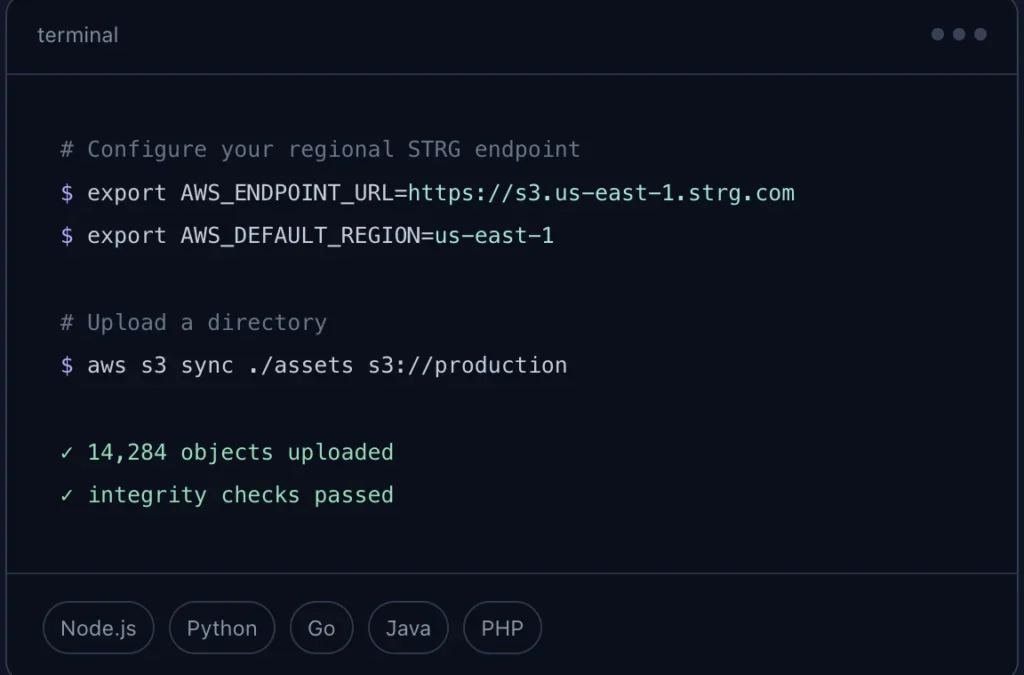
At the heart of STRG’s value proposition is its strict adherence to the Amazon S3 API standard. This compatibility is crucial for modern engineering teams, as it dictates whether a new storage service can be integrated into existing stacks without requiring massive code rewrites. Because STRG mirrors the S3 specification, applications currently utilizing AWS S3 can pivot their storage backend with minimal friction—often requiring little more than a change in the endpoint URL and credential configuration.
This architectural choice eliminates the migration friction that typically plagues alternative cloud services. Organizations do not need to retrain engineering teams on proprietary command-line interfaces or rewrite established data ingestion pipelines. Whether interacting with the storage layer via standard DevOps tooling or native application code, the transition is remarkably transparent.
Getting Started with STRG: Command-Line and Programmatic Integration
For system administrators and DevOps engineers accustomed to the AWS ecosystem, interacting with STRG via the command line feels immediately familiar. Configuration begins by establishing a dedicated profile within the standard AWS CLI environment. By defining the target endpoint as the STRG regional URL—such as https://s3.eu-central-1.strg.com—operators can execute standard bucket and object operations using familiar syntax.
# Configure your STRG upload settings
aws configure --profile strg

# Manage some assets!
aws s3 ls --profile strg --endpoint-url https://s3.eu-central-1.strg.com
aws s3 cp ./hello.txt s3://my-first-bucket/hello.txt --profile strg --endpoint-url https://s3.eu-central-1.strg.com
aws s3 ls s3://my-first-bucket/ --profile strg --endpoint-url https://s3.eu-central-1.strg.com
aws s3 cp s3://my-first-bucket/hello.txt ./hello-copy.txt --profile strg --endpoint-url https://s3.eu-central-1.strg.com
Beyond infrastructure management, application developers require robust programmatic access to handle asset generation, retrieval, and streaming directly from application runtimes. STRG supports standard SDKs, such as the JavaScript AWS SDK, allowing Node.js and browser-adjacent environments to interact with storage buckets natively.
import
  S3Client,
  PutObjectCommand,
  ListObjectsV2Command,
  GetObjectCommand,
 from "@aws-sdk/client-s3";

const s3 = new S3Client(
  endpoint: "https://s3.eu-central-1.strg.com",
  region: "eu-central-1",
);

await s3.send(
  new PutObjectCommand( Bucket: "my-first-bucket", Key: "hello.txt", Body: "Hello, STRG!" ),
);

const listing = await s3.send(new ListObjectsV2Command( Bucket: "my-first-bucket" ));
for (const object of listing.Contents ?? []) console.log(object.Key, object.Size);

const object = await s3.send(new GetObjectCommand( Bucket: "my-first-bucket", Key: "hello.txt" ));
console.log(await object.Body.transformToString());
This seamless integration ensures that software engineers can implement object persistence, content delivery, and media asset management without adopting an unfamiliar development paradigm.
Enterprise-Grade Capabilities: Lifecycle Policies, CORS, and Object Locks
While affordability and ease of integration serve as primary acquisition drivers, enterprise-grade workloads demand robust data governance, security, and lifecycle management features. STRG positions itself not merely as a basic file repository, but as a comprehensive storage platform capable of meeting stringent compliance and operational requirements.
The platform includes customizable lifecycle policies, allowing organizations to automate the transition of data across storage tiers or enforce automated deletion schedules for temporary assets. This capability is critical for managing operational expenditures, ensuring that ephemeral data does not incur unnecessary long-term storage costs. Additionally, built-in Cross-Origin Resource Sharing (CORS) rules facilitate secure, direct-to-storage browser uploads, reducing load on application servers and optimizing bandwidth utilization for media-heavy web applications.
Security and data integrity are further reinforced through object locking mechanisms. These features allow administrators to implement Write-Once-Read-Many (WORM) governance models, protecting critical records from accidental deletion or malicious tampering. Such capabilities are indispensable for organizations operating in regulated industries where data immutability and audit trails are mandatory compliance prerequisites.
AI Agent Integration and the Rise of Model Context Protocol (MCP)
As artificial intelligence and autonomous agents become deeply embedded in modern software engineering workflows, infrastructure platforms must evolve to support machine-to-service communication. STRG addresses this paradigm shift by incorporating native support for the Model Context Protocol (MCP), enabling AI agents to directly interact with cloud storage environments.
Through a straightforward configuration command, developers can integrate STRG into their AI tooling ecosystem:
claude mcp add --transport http strg https://mcp.strg.com/mcpThis integration allows AI assistants and automated agents to manage assets, inspect bucket contents, and execute storage-related workflows autonomously. Crucially, STRG enforces strict security boundaries by tethering the AI agent’s capabilities directly to the permissions assigned to the specific access key in use. Consequently, an autonomous agent can never perform operations exceeding the pre-configured authorization scope, mitigating risks associated with unintended data exposure or accidental resource deletion.
Broader Industry Implications and Future Outlook
The introduction and refinement of storage platforms like STRG signal a broader maturation of the cloud computing market. As organizations face macroeconomic pressures to optimize IT spending, the impetus to audit and rationalize cloud infrastructure has never been higher. Storage—often representing the largest and most persistent component of a company’s data footprint—remains a prime target for cost optimization.
By offering low-cost regional delivery, S3 compatibility, and forward-looking features like MCP integration, alternative storage providers challenge the hegemony of traditional hyperscalers. They demonstrate that high-performance, secure, and feature-rich object storage can be delivered without the prohibitive cost structures historically accepted as an unavoidable cost of doing business in the cloud.
For architects and engineering leaders designing the next generation of web applications, selecting the appropriate storage foundation from inception is paramount. As data volumes continue their upward trajectory, platforms that successfully balance economic efficiency, technical compatibility, and modern developer workflows will undoubtedly shape the future of digital asset management.