As global commerce and digital marketing rapidly approach the year 2027, forward-thinking brands are increasingly tasked with anticipating structural shifts in consumer behavior, technological capabilities, and workflow optimization. A recent comprehensive study conducted by customer engagement platform Emplifi offers a vital roadmap for these upcoming challenges, providing deep insights into how industry leaders plan to harness artificial intelligence, adapt to changing product discovery pathways, and refine their social media engagement strategies.
The study, which surveyed 405 marketing managers, directors, and executive-level decision-makers, sheds light on the priorities and operational philosophies guiding modern marketing departments. By evaluating these emerging trends, brands can better understand the intersection of automated efficiency and human creativity, preparing themselves for a marketplace defined by rapid innovation and heightened consumer expectations.
Background and Methodology of the Emplifi Study
The modern marketing landscape has undergone unprecedented transformation over the past several years, largely catalyzed by the mainstream adoption of generative artificial intelligence, shifting social media algorithms, and the decentralization of digital search. Recognizing the acute need for empirical data to help brands navigate this dynamic environment, Emplifi initiated a comprehensive research project targeting key stakeholders within the marketing sector.
Between late 2024 and early 2025, researchers polled 405 verified marketing professionals, ranging from mid-level managers to C-suite executives across various industries, including retail, business-to-business (B2B) technology, financial services, and healthcare. The objective was to capture a holistic view of institutional sentiment regarding three critical pillars:
- The integration of artificial intelligence into daily workflows and strategic planning.
- The evolution of product and brand discovery channels among modern consumers.
- The shifting paradigms of social media engagement and community management.
The findings from this cohort have been compiled into the State of Social Media Marketing Report, designed to serve as a strategic compass for organizations drafting their long-term business plans through 2027.
The Chronology of Digital Marketing Evolution: From Automation to Integration
To fully appreciate the significance of the 2027 projections outlined by Emplifi, it is essential to contextualize the recent timeline of marketing technology:
- 2022–2023 (The Generative AI Boom): The public launch of advanced generative AI tools sparked a gold rush among marketers. Initially, adoption was largely experimental, characterized by the rapid generation of ad copy, social media captions, and rudimentary image creation.
- 2024 (Operationalization and Compliance): As the novelty of AI faded, marketing departments faced the realities of workflow integration, data privacy regulations, and brand safety. Organizations began drafting internal governance frameworks while utilizing AI for data analysis, customer segmentation, and scaled content production.
- 2025–2026 (Predictive AI and Personalization): The focus shifted from basic content generation to sophisticated predictive modeling. Brands began leveraging AI to anticipate consumer intent, automate real-time customer service interactions, and hyper-personalize multi-channel digital campaigns.
- 2027 and Beyond (Autonomous Workflows and Immersive Discovery): As projected by current industry data, the forthcoming era will see AI embedded deeply into the core infrastructure of marketing teams, shifting human roles from execution to strategic oversight, curation, and creative direction.
Key Insights: Artificial Intelligence as a Workflow Catalyst
One of the most prominent themes emerging from the Emplifi survey data is the transition of artificial intelligence from a supplementary gadget to a foundational operational pillar. Marketing executives surveyed by the platform overwhelmingly indicate that surviving and thriving in the competitive climate leading up to 2027 will depend on effective AI implementation.
Historically, marketing teams struggled with bandwidth constraints, often forced to choose between creative vision and execution volume. The latest data suggests that AI-driven tools are effectively bridging this gap. Rather than replacing human marketers, these technologies are being deployed to optimize repetitive workflows—such as performance reporting, A/B testing, audience sentiment analysis, and localized translation of marketing assets.
However, industry analysts note that this technological leap is not without friction. Implementing enterprise-grade AI requires significant upskilling of existing personnel, robust cybersecurity protocols, and careful management of consumer trust. Brands that successfully navigate these hurdles by 2027 will likely experience dramatic reductions in operational costs and faster time-to-market for campaigns.
The Transformation of Product and Brand Discovery
Parallel to the rise of AI is a fundamental restructuring of how consumers discover products and engage with brands. Traditional search engine optimization (SEO) and legacy advertising funnels are increasingly competing with social commerce, algorithmic recommendation feeds, and conversational search platforms.
The Emplifi report highlights that modern consumers—particularly younger demographics—rarely follow a linear path from awareness to purchase. Instead, discovery frequently occurs organically within social media environments, short-form video feeds, and influencer-led communities. Consequently, marketing directors are restructuring their media spend, allocating greater resources to social-first discovery channels where intent can be captured and converted instantaneously.
This shift places immense pressure on brands to maintain a constant, authentic, and visually compelling digital footprint. Brands can no longer rely solely on top-of-funnel billboard advertising or static web pages; they must embed their products within the cultural and algorithmic streams where consumers spend their time.
Social Media Engagement Trends Heading Toward 2027
Social media remains the primary battleground for consumer attention, yet the rules of engagement are continuously evolving. According to the insights gathered from the 405 surveyed marketing professionals, community-centric engagement is superseding broad, scattershot audience acquisition.
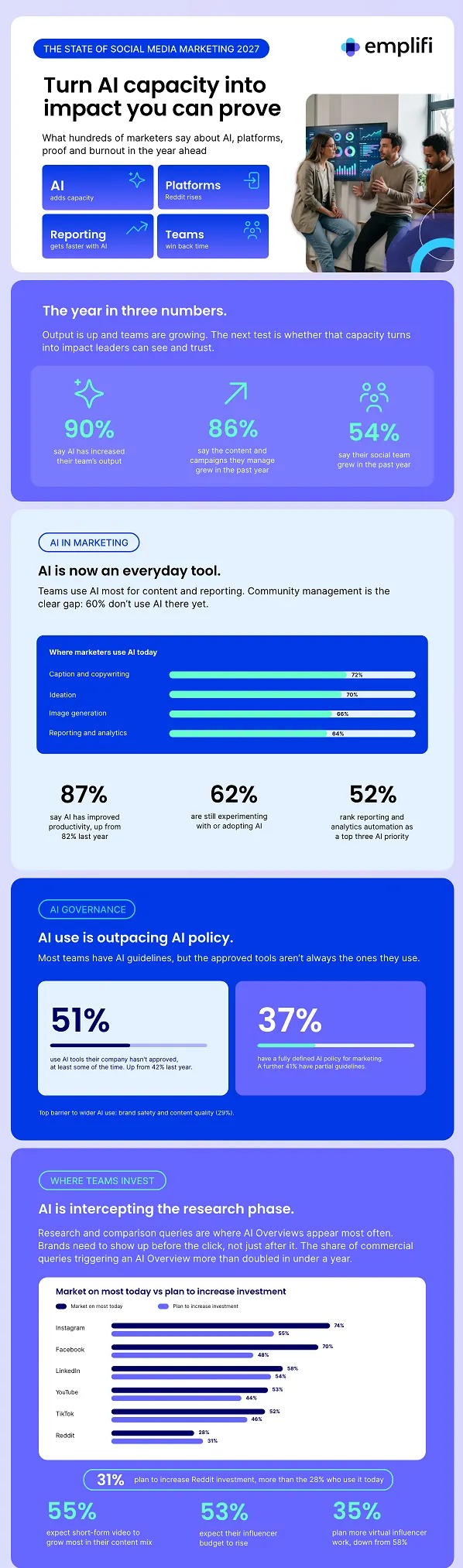
Key trends shaping social media strategies include:
- Micro-Communities and Niche Platforms: Brands are moving away from chasing aggregate follower counts on saturated networks, focusing instead on cultivating deeply engaged micro-communities where brand loyalty is stronger.
- Real-Time Responsiveness: Consumers increasingly expect instant, personalized interactions with brands via social channels, necessitating the use of AI-powered conversational agents backed by human oversight.
- Authenticity Over Perfection: Highly polished, traditional corporate advertising is steadily losing ground to user-generated content, creator partnerships, and transparent behind-the-scenes narratives.
Industry Reactions and Expert Analysis
Leading voices in the digital marketing ecosystem have responded to the release of the Emplifi findings with cautious optimism and urgent calls for strategic alignment.
Industry analysts point out that while the technological capabilities are advancing at an exponential rate, the human element of marketing remains irreplaceable. "Technology can predict what a consumer might want based on historical data, but it takes human empathy and cultural intuition to craft a narrative that truly resonates," noted a prominent digital strategy consultant. "The brands winning in 2027 will be those that master this symbiotic balance."
Furthermore, marketing directors participating in strategic forums have emphasized the importance of data governance. As privacy laws tighten globally and third-party cookies continue to phase out, brands must rely on first-party data strategies integrated with ethical AI tools to maintain consumer trust while delivering personalized experiences.
Broader Impact and Strategic Implications for Brands
The implications of the Emplifi report extend far beyond the marketing department, influencing corporate budgeting, talent acquisition, and overall business strategy. Organizations preparing for the 2027 landscape must evaluate several critical areas:
- Talent Acquisition and Upskilling: Marketing teams must recruit individuals who possess both creative competencies and technical literacy. Training existing staff on prompt engineering, data analytics, and ethical AI usage is no longer optional.
- Budget Reallocation: Financial investments must shift away from outdated outbound marketing channels toward agile, social-first content production, influencer partnerships, and advanced AI infrastructure.
- Agility and Adaptation: The pace of technological change guarantees that strategies drafted today will require continuous iteration. Establishing cross-functional agile teams will enable brands to pivot in response to algorithmic updates and emerging consumer behaviors.
As the business world moves closer to 2027, reports such as the one provided by Emplifi offer invaluable clarity. By understanding the intersection of artificial intelligence, shifting discovery pathways, and evolving social engagement, brands can build resilient, future-proof strategies capable of sustaining long-term growth in an increasingly competitive global marketplace.