In the race to integrate generative AI into enterprise workflows, many product teams have fallen into a common trap: they build features that technically function perfectly but fail to provide tangible value to the end user. A recent case study involving a large health insurance firm illustrates this disconnect. The company tasked its product team with developing an AI tool to draft written determinations for benefits appeals specialists. While the underlying model was accurate, the feature was met with widespread rejection. The specialists found that the time required to meticulously review and verify the AI-generated text for errors was equivalent to—or sometimes longer than—writing the determination from scratch. By automating a task the employees had already mastered, the software inadvertently increased their workload while creating a new, frustrating layer of verification.
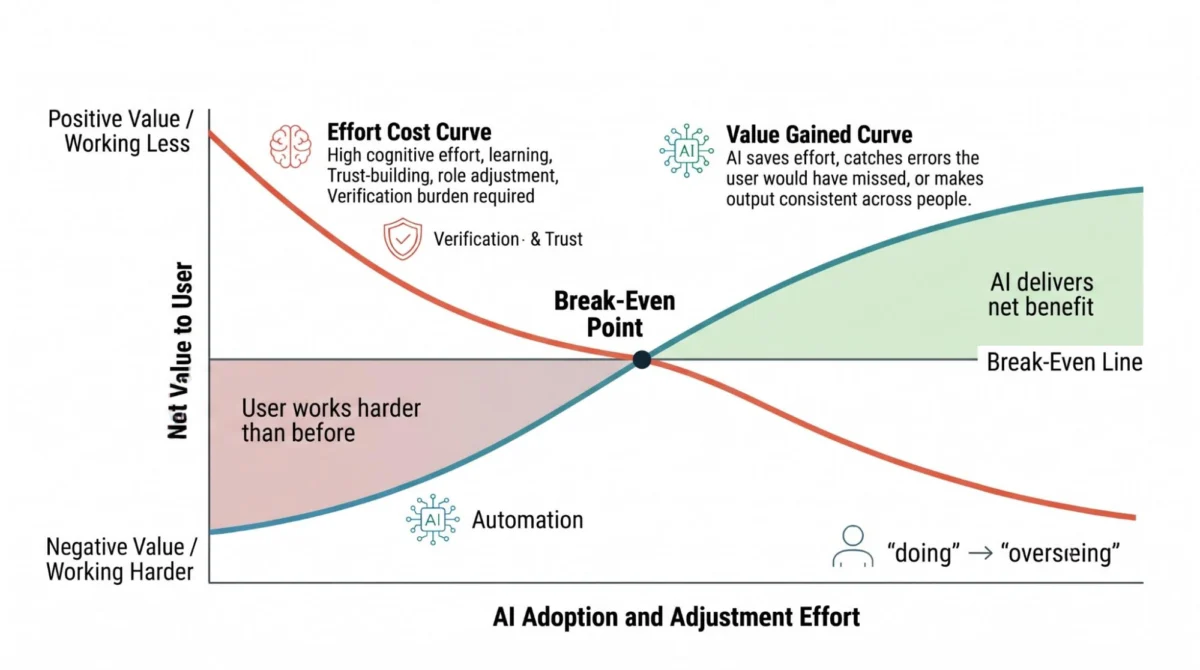
This phenomenon highlights a critical challenge in the modern software landscape: the break-even line. An AI feature only justifies its inclusion if the utility it provides exceeds the cognitive and operational cost the user incurs to manage, verify, and adapt to it. When an AI feature adds more work than it removes, it becomes a net negative, regardless of how sophisticated the underlying algorithm may be.
The Anatomy of User Cost and Cognitive Load
Every interface change imposes a "switching cost" on the user. According to landmark research on working memory capacity, most individuals can only hold about four items in their mental workspace simultaneously. When a product team introduces an AI tool, they are not just providing a new button; they are fundamentally altering the user’s workflow. The user must relearn how to navigate the system, build a mental model of the AI’s logic, and calibrate their level of trust in the output.
If the AI handles the synthesis of data, the user is relegated to the role of a checker. If the AI also provides a recommendation, the user’s job risks being reduced to a mere "sign-off" role. For high-skilled professionals, this shift can feel like a professional demotion. A 2025 study led by Sophia Ackerhans and colleagues at the University of Hamburg found that when physicians were tasked with reviewing AI-assisted diagnostic decisions, they reported a significant threat to their professional identity. Intriguingly, the study noted that providing explanations for the AI’s reasoning increased user trust but simultaneously exacerbated the sense of professional alienation, as the AI’s logic became more transparently competitive with the physician’s own expertise.
Defining the Break-Even Line
To determine if a feature will be a success, teams must identify the break-even line. Returns to the user generally fall into three categories: error reduction, speed of execution, and the ability to surface insights that would be impossible for a human to find manually. For instance, an AI-powered fraud detection system succeeds because it flags suspicious transactions an analyst would never have identified on their own. The cognitive cost of reviewing these flags is high, but the value of catching actual fraud justifies the effort.
Product teams can use a four-question audit framework to evaluate potential AI features before moving into the expensive design and engineering phases.
- Does this reduce the total effort the task takes for this user? Teams must calculate the total time and mental energy, including the "hidden" cost of verification. Reducing clicks is insufficient if it increases the burden of oversight.
- Does this beat the user’s current method? If a professional already has a highly optimized, practiced workflow for a specific task, AI may introduce unnecessary friction rather than efficiency.
- Can the user catch the errors? If an error is subtle or "invisible"—such as a trip planner suggesting a closed museum—and the consequence is high, the feature is dangerous.
- Will the user maintain their skills over time? If a professional stops performing a critical task because the AI does it for them, their ability to audit the AI’s output will eventually degrade, leading to long-term systemic risk.
The Case of the Health Insurer: A Pivot Toward Success
The health insurance firm’s initial failure provided a blueprint for how to pivot correctly. By re-evaluating their approach, the team realized that the specialists did not need an AI to draft entire documents; they needed an AI to act as a research assistant. In the second iteration, the tool was modified to surface relevant policy provisions and prior decisions related to each appeal, while leaving the writing process entirely to the human specialist.
The result was immediate and measurable. The search step was effectively eliminated, the review time dropped, and the specialists felt empowered rather than sidelined. The technology remained identical, but the point of intervention shifted from the final output (writing) to the preparation (information retrieval). This shift saved time and respected the professional’s core competency.
The Risks of Automation Bias and Skill Atrophy
One of the most persistent dangers in AI implementation is automation bias—the tendency for humans to defer to computer-generated suggestions even when they are incorrect. Research by Raja Parasuraman and Dietrich Manzey has shown that this bias manifests across diverse fields, from aviation to medicine. Once trust in an automated system is established, it often becomes a subconscious habit, leading users to lower their guard.

This leads to the long-term risk of skill atrophy. A 2023 experiment by Thomas Dratsch and colleagues involving radiologists demonstrated that even highly experienced professionals saw their diagnostic accuracy drop when they were forced to rely on faulty AI suggestions. Over a 12-month period, if a worker delegates their judgment to an AI without maintaining the practice of independent analysis, they lose the ability to catch errors. To mitigate this, successful product teams are now building "verification mechanisms" into the workflow, such as periodic blind reviews or rotating case assignments where the AI is disabled, ensuring that human judgment remains sharp.
Strategic Implications for Product Roadmap Planning
The "pro-innovation bias," a term coined by Everett Rogers in his 2003 seminal work on the diffusion of innovations, suggests that organizations often assume any new technology is inherently beneficial. In today’s competitive environment, this bias is often exacerbated by market pressure to release "AI-first" features. However, roadmap reviews should prioritize evidence-based design over speed-to-market.
Product managers should view the four-question audit not as a barrier to innovation, but as a mechanism for quality control. When presenting these findings to stakeholders, the focus should remain on the "design conditions." For example, if a feature is determined to be helpful for junior employees but redundant for senior staff, the product team should scope the release to the junior segment and provide an "exit" for the seniors.
By establishing a clear, evidence-based break-even line, organizations can avoid the pitfalls of superficial automation. The goal of enterprise AI should not be to replace the human element, but to intelligently augment it. When the technology handles the heavy lifting of information retrieval and pattern recognition, while the professional retains control over the final judgment and creative synthesis, the result is a more resilient and efficient organization. Future developments in this space will likely move away from "black-box" automation toward "human-in-the-loop" systems, where the success of a feature is measured not by how much of the work the AI does, but by how much more capable the user becomes with the tool at their disposal.