Maintaining a unified brand voice across an increasingly fragmented digital landscape has become one of the foremost operational challenges for modern marketing organizations. As companies expand their digital footprints across platforms like LinkedIn, Instagram, TikTok, and X, the risk of fragmented messaging multiplies exponentially. To combat brand

drift, marketing executives and social media managers are increasingly turning to a comprehensive operational asset: the social media style guide. Far from an arbitrary set of administrative restrictions, a well-constructed style guide functions as a centralized source of truth designed to remove ambiguity, streamline cross-functional workflows, and protect long-term enterprise equity.
Industry data underscores the commercial necessity of such alignment. According to market research compiled by Marq and Demand Metric, enterprise brand consistency contributes a minimum of 10% to overall revenue growth. In an ecosystem where consumers make rapid purchasing decisions based on perceived reliability and corporate identity, uniform messaging acts as a critical trust-building mechanism. When an organization’s visual assets, editorial voice, and behavioral norms remain stable regardless of which team member or regional branch publishes a post, the enterprise secures a measurable competitive advantage.

Defining the Scope and Purpose of Modern Social Media Guidelines
A social media style guide is a foundational document that dictates how a brand looks, sounds, and interacts across every digital touchpoint. Traditionally limited to core marketing departments, contemporary guidelines now govern a much broader ecosystem of content creators. This expanded oversight encompasses content generated by artificial intelligence tools, contributions from external creative agencies, decentralized regional teams, and even employee advocacy programs.
The primary utility of a style guide lies in its ability to eliminate constant micro-decisions. By establishing pre-approved parameters for punctuation, terminology, hashtag deployment, and visual hierarchy, content creators spend less time second-guessing editorial choices and more time executing strategic campaigns. This operational efficiency drastically reduces the time required to onboard new personnel and onboard freelancers, ensuring that institutional knowledge is preserved even as internal teams fluctuate.
Anatomy of a Comprehensive Style Guide: The Ten Core Elements

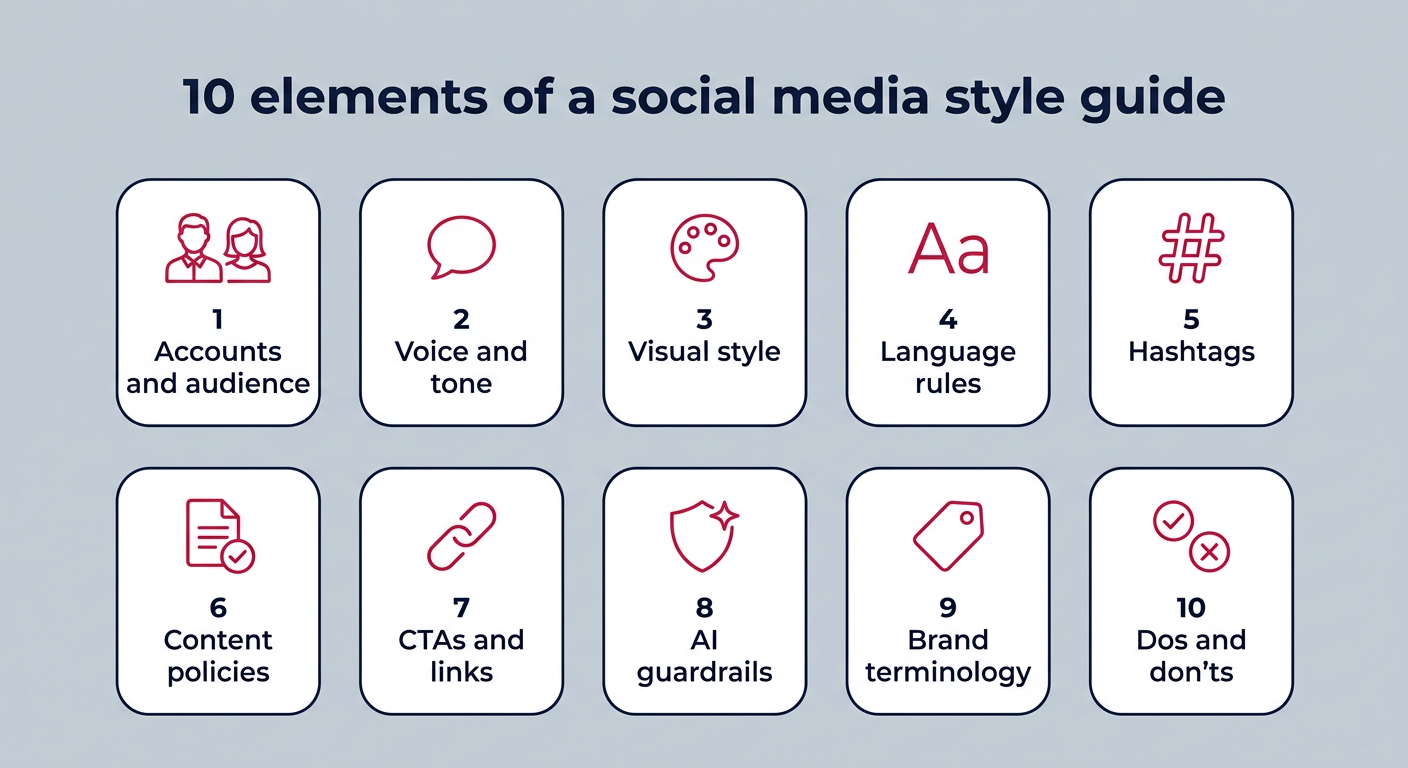
To be effective, a social media style guide must address both macro-level brand identity and micro-level execution. Industry standards suggest that an exhaustive guide should integrate ten distinct elements.
The foundation begins with a detailed inventory of active social accounts alongside explicit target audience personas. Without a precise understanding of who is consuming the content and where it is being published, creative decisions lack strategic context. Following this, the guide must explicitly define the brand voice—its permanent, underlying personality—and the brand tone, which represents how that personality modulates depending on the specific situation or crisis at hand.
Visual style and asset management form the third pillar, dictating color palettes, typography, aspect ratios, and the secure repository locations for approved imagery. Subsequent sections address granular language and grammar rules, often anchoring themselves to an established external reference such as the Associated Press Stylebook while noting brand-specific deviations.
Hashtag conventions, third-party content curation policies, and user-generated content (UGC) protocols constitute the next critical layer. Because UGC serves as powerful social proof, clear guidelines regarding legal permissions, copyright attribution, and ethical sharing are indispensable. Furthermore, structured rules for calls to action (CTAs), link placement strategies—such as handling single-link constraints on Instagram and TikTok—and proprietary brand terminology ensure that product names and trademarked phrases are deployed accurately.
Navigating the Integration of Artificial Intelligence and Platform Diversification
One of the most pressing additions to contemporary style guides is the establishment of artificial intelligence guardrails. As generative tools become standard in content creation workflows, organizations must define acceptable use cases. A robust AI policy clarifies which platforms are approved for drafting, mandates human editorial review before publication, and outlines protocols for fact-checking and brand alignment. This ensures that AI-generated efficiencies do not dilute the unique human nuances of the brand’s voice.
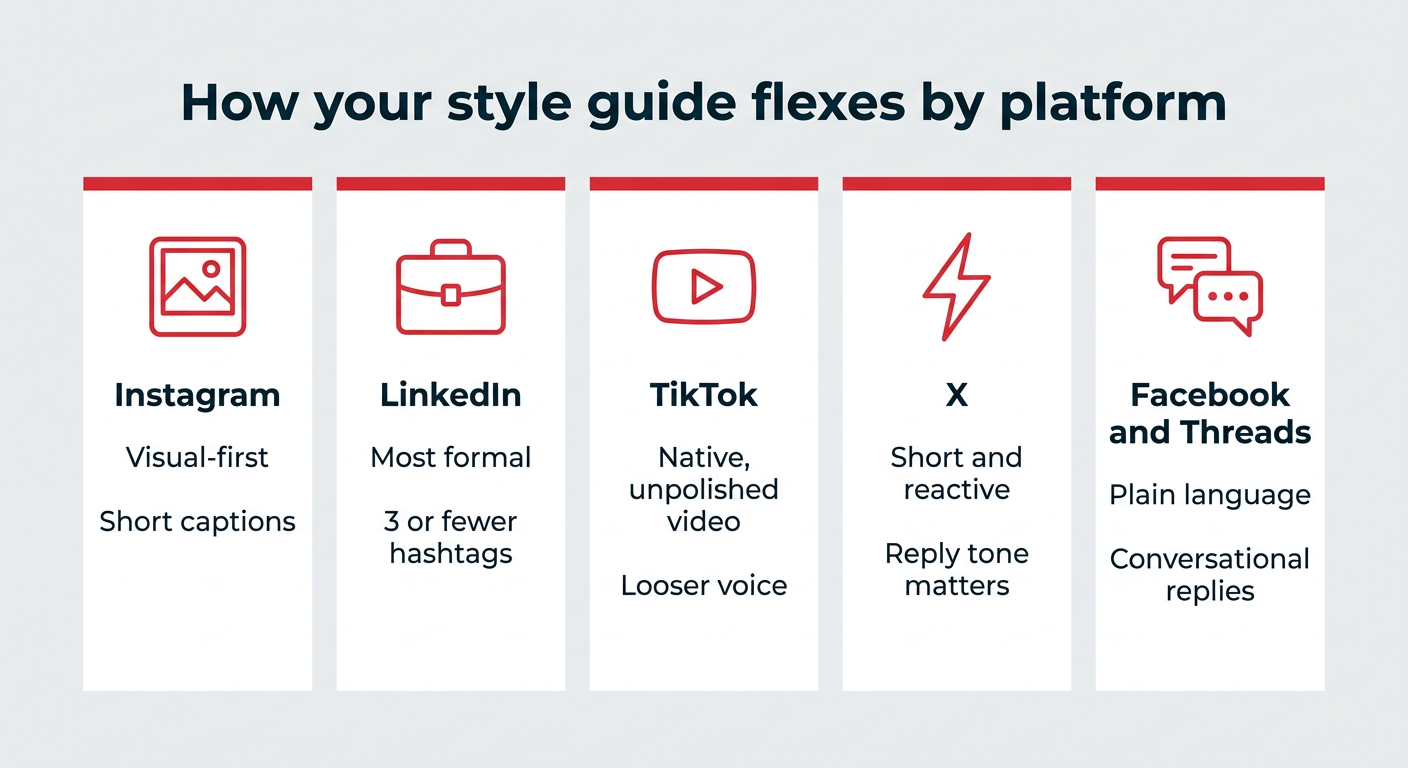
Moreover, a sophisticated style guide acknowledges that cross-posting identical content across every platform is an ineffective strategy. While core brand identity elements remain immutable, platform-specific adjustments must be codified. For instance, professional B2B insights shared on LinkedIn require a different structural approach, tone, and pacing than short-form, culturally reactive video content published on TikTok or fast-paced conversational updates on X.
Community Management and Engagement Protocols
Publishing rules govern only half of an organization’s social media footprint; the remainder occurs within comment sections, direct messages, and real-time customer service interactions. Consequently, a comprehensive style guide must extend its mandate into community management.
Effective engagement guidelines establish strict parameters for reply tone, maximum response times, and moderation standards for abusive or spam content. Crucially, they must outline clear escalation pathways and crisis management protocols. When a public relations issue arises or a customer complaint escalates, front-line community managers require immediate, unambiguous instructions on when to handle an inquiry independently and when to route the matter to legal or executive communications teams.
Maintenance, Evolution, and Enterprise Case Studies
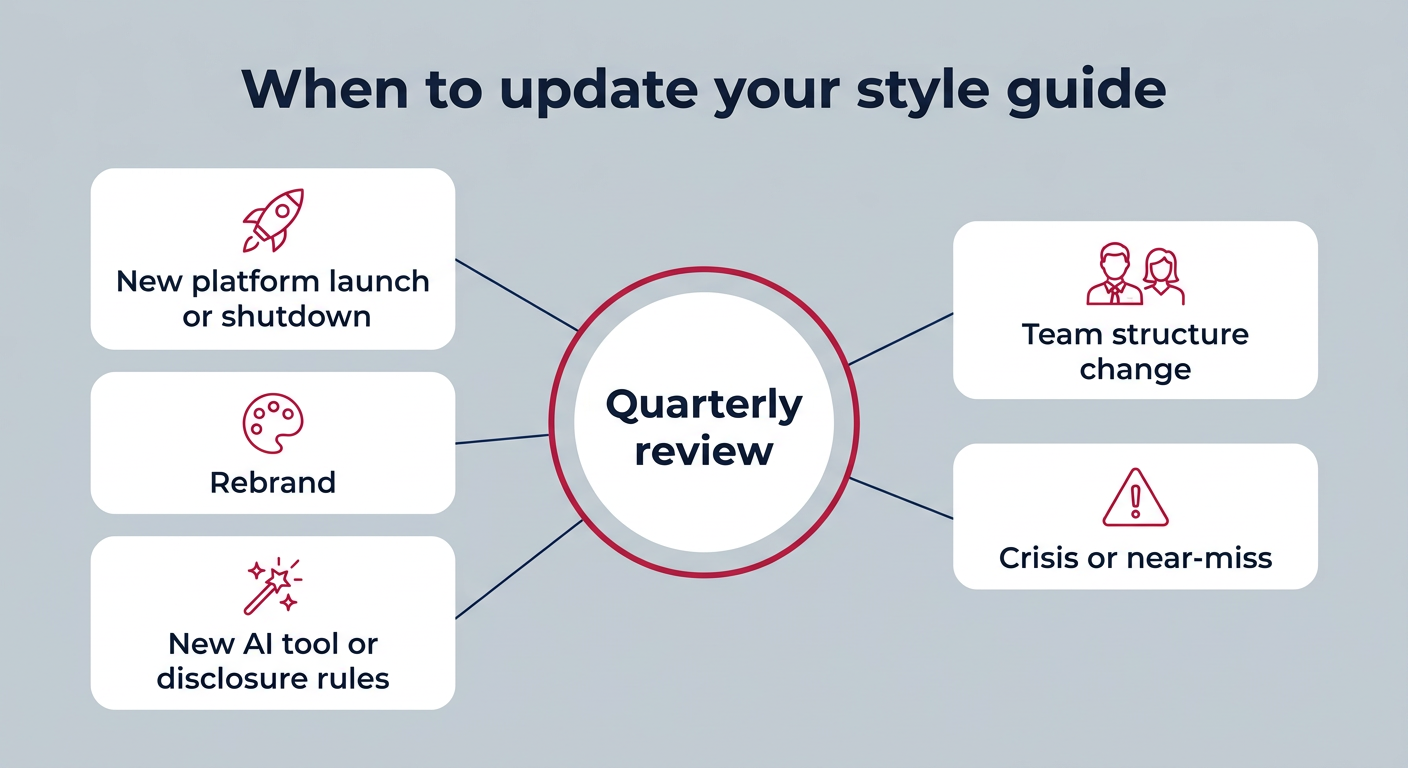
Establishing a social media style guide is not a static, one-time project; it requires continuous governance. Industry best practices recommend conducting a formal review of the document on a quarterly basis, evaluating past performance data against shifting digital trends. However, off-cycle updates are necessary whenever an organization undergoes a rebrand, launches on an emerging social platform, or experiences significant shifts in internal team structure.

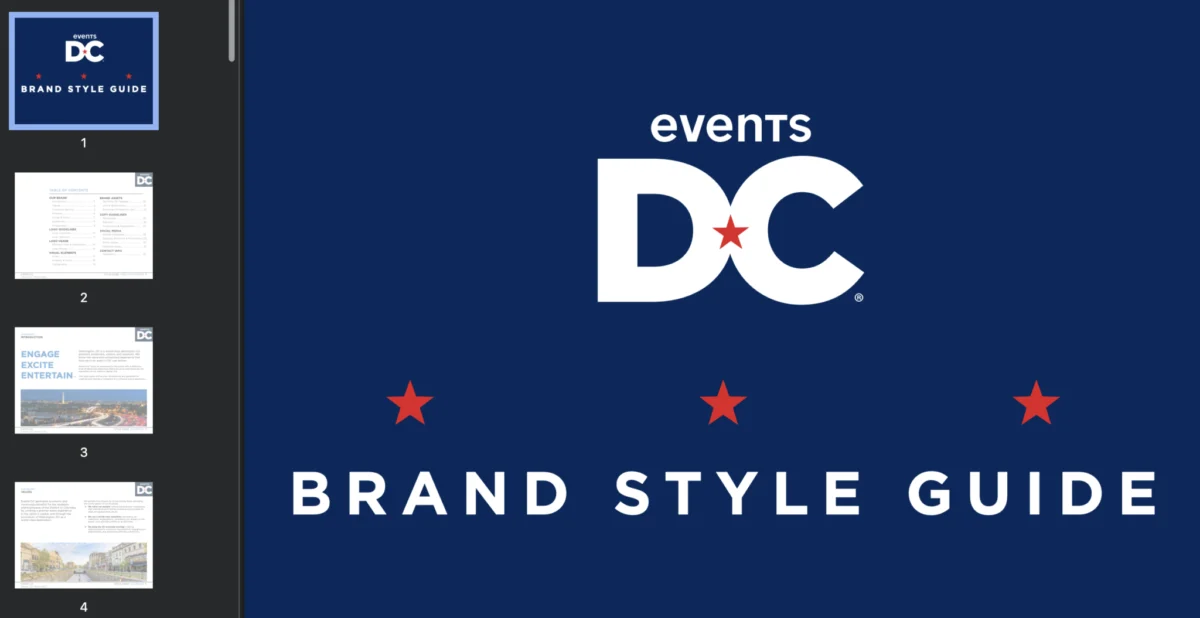
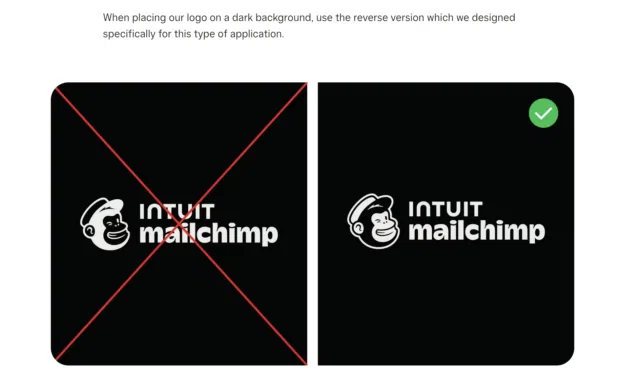
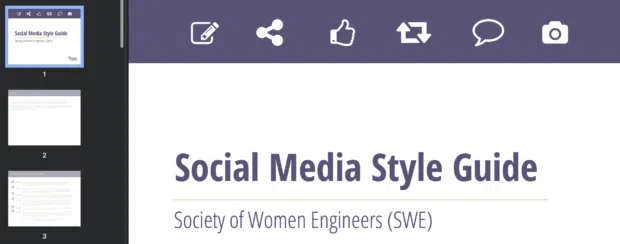
Numerous global organizations have successfully institutionalized this approach. Mailchimp maintains a widely recognized public style guide that details strategic intent, account naming conventions, and tagging protocols, serving as a benchmark for corporate communications. Similarly, organizations like Events DC and the Society of Women Engineers integrate platform-specific instructions directly into broader brand frameworks, ensuring seamless continuity across diverse public-facing initiatives.
Ultimately, integrating a well-structured social media style guide into daily operations transforms chaotic digital outreach into a disciplined, revenue-driving machine. By centralizing rules, embracing technological guardrails, and enforcing consistent brand behaviors, enterprises can safeguard their reputation, engage audiences authentically, and achieve sustained long-term growth.