The traditional lifecycle of a corporate website is governed by a paradox: a site is at its absolute peak the moment it is deployed, after which it enters a state of inevitable, slow-motion decay. This phenomenon, often referred to by web developers as "digital entropy," is not typically the result of technical failure or catastrophic coding errors. Rather, it stems from the widening gap between the fast-paced evolution of business operations, market shifts, and competitive landscapes, and the static nature of a published web property. As digital teams move on to new projects, the original site becomes a relic—functionally intact but messaging-obsolete.
Emerging technologies in autonomous web management, pioneered by platforms such as Fimo, are challenging this status quo. By leveraging artificial intelligence to continuously optimize digital assets, these systems promise to bridge the gap between launch-day perfection and long-term relevance. However, the integration of autonomous agents into professional web workflows has revealed a significant psychological and operational hurdle: a deep-seated resistance among stakeholders to relinquishing control over their digital presence.
The Anatomy of Digital Decay
In the current web development paradigm, the "launch date" is the climax of a project. Months of strategic planning, design iteration, and engineering culminate in a deployment that represents the company’s best thinking at a single point in time. Yet, the moment the site goes live, the clock begins ticking.
Industry analysis suggests that without continuous, proactive intervention, a website’s efficacy declines by an estimated 15% to 20% annually in terms of messaging accuracy, SEO alignment, and technical performance benchmarks. This decay is rarely caused by broken links or server outages, which are easily monitored by standard uptime checkers. Instead, it is the subtle drift—outdated pricing, unoptimized imagery, neglected accessibility standards, and messaging that no longer reflects the company’s current value proposition—that erodes brand equity.
For years, the industry accepted this decay as an unavoidable cost of doing business. The alternative was a continuous cycle of expensive "refresh" projects, usually occurring every 18 to 24 months, which often resulted in a chaotic scramble to catch up to years of accumulated technical and content debt.
Chronology of the Shift Toward Autonomy
The move toward autonomous web management began as a response to the exhaustion of creative and engineering teams. The timeline of this shift can be categorized into three distinct phases:
- The Era of Static Maintenance (Pre-2020): Organizations relied on manual updates, content management systems (CMS), and infrequent design overhauls. Maintenance was treated as a reactive chore rather than a strategic imperative.
- The Automation of Tasks (2020–2023): With the rise of CI/CD (Continuous Integration and Continuous Deployment) pipelines, developers began automating technical aspects such as image compression, security patching, and automated testing. However, the content and design layers remained firmly under manual control.
- The Autonomous Agent Paradigm (2024–Present): Companies like Fimo began deploying agents capable of understanding context, brand style, and layout logic. This shift moved the focus from simple task-based automation to goal-based optimization, where the agent acts as an autonomous participant in the site’s ongoing lifecycle.
Distinguishing Chores from Judgment
The primary resistance to autonomous systems stems from a misunderstanding of what is being automated. Pierre Burgy, lead architect at Fimo, notes that the hesitation often arises because stakeholders fear that an AI agent will make "taste-based" decisions—such as changing brand colors or reformatting hero copy—without human approval.
In practice, the work involved in maintaining a website can be categorized into three distinct tiers:
- The Regulatory and Technical Chores (The 80%): This encompasses the bulk of web maintenance. It includes ensuring accessibility compliance (WCAG), propagating design system updates, correcting metadata, and optimizing image delivery. This is work that requires adherence to strict, objective rules. These tasks are the ideal candidates for autonomous agents because they are repetitive, joyless, and prone to human error.
- The Strategic Judgment (The 5%): This is the core work of designers and brand strategists. It involves high-level decisions about how a brand should feel, the tone of voice, and the aesthetic impact of a new campaign. This is the domain where human intervention remains not just preferred, but essential.
- The Variable Boundary (The 15%): This is the most complex tier, where the definition of "chore" versus "judgment" varies by role. For a developer, a configuration change like enabling dark mode might be a standard technical implementation. For a brand designer, it is a significant shift in the user’s visual experience. Because the "line" between what can be delegated and what must be manual is subjective, a one-size-fits-all autonomous solution is inherently flawed.
The Operational Impact of AI Agents
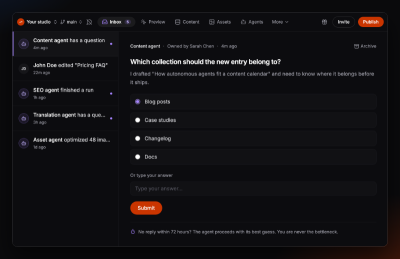
The implementation of autonomous agents shifts the role of the web team from "maintainers" to "supervisors." Instead of manually updating a component on every page, a team might set an agent to monitor the design system for updates. When a change is detected, the agent applies it across the site, then logs the changes for human review.
Data from early adopters of autonomous web platforms indicates that teams save an average of 10 to 15 hours per week on routine maintenance. More importantly, the frequency of "unseen" errors—such as broken links or deprecated assets—drops by nearly 90% within the first quarter of deployment.
However, the transition requires a cultural shift. Organizations must move from a "set and forget" mentality to a "monitor and refine" approach. This involves building custom agents for specific organizational needs. For example, a content team might trust an agent to fix broken formatting but require a mandatory "human-in-the-loop" gate for any changes to landing page headlines.
Broader Implications for Digital Strategy
The move toward autonomous websites has significant implications for how businesses value their digital presence.
First, it forces organizations to define their brand guidelines and technical standards with unprecedented clarity. An autonomous agent cannot follow a "gut feeling"; it requires a set of explicit, machine-readable rules. This often leads to a "clean-up" of legacy assets, as companies are forced to formalize their design tokens and content hierarchies to enable agent performance.
Second, it challenges the traditional agency-client model. Many digital agencies currently rely on the "refresh" cycle to generate revenue. As websites become self-maintaining, the focus of the client-agency relationship may shift from project-based delivery to long-term strategic partnership, where agencies build and tune the autonomous agents that manage the client’s brand.
Finally, the risk of "the frozen site" becomes a competitive disadvantage. In an age where user expectations for real-time information are higher than ever, a site that is allowed to decay is effectively losing its ability to communicate with the market. As autonomous tools become more robust, the competitive gap between firms that leverage these technologies and those that rely on traditional, manual maintenance will likely widen.
Conclusion: Redefining the Role of the Human
The objective of autonomy is not to remove humans from the loop, but to reclaim their time for work that requires genuine innovation. When repetitive maintenance is delegated to agents, the human web team is freed to focus on high-impact projects that actually require human judgment.
The future of the web is not a static, finished product, but a living, breathing digital entity that evolves alongside the company it represents. By drawing a clear line between the rules that govern the machine and the judgment that guides the brand, organizations can finally solve the problem of digital decay, ensuring that their website is as relevant, effective, and sharp on its thousandth day as it was on its first.