On a quiet Thursday morning in the San Francisco Bay Area, a routine day at autonomous truck developer PlusAI took a bizarre and unexpected turn. A high-ranking executive at the cutting-edge firm received a casual, congratulatory text message from an acquaintance working nearby. The sender wrote that they were proud of the executive’s continued success and adventure at PlusAI, casually mentioning that they had just spotted two of the company’s signature semi-trailers parked near their office building in Newark, California.
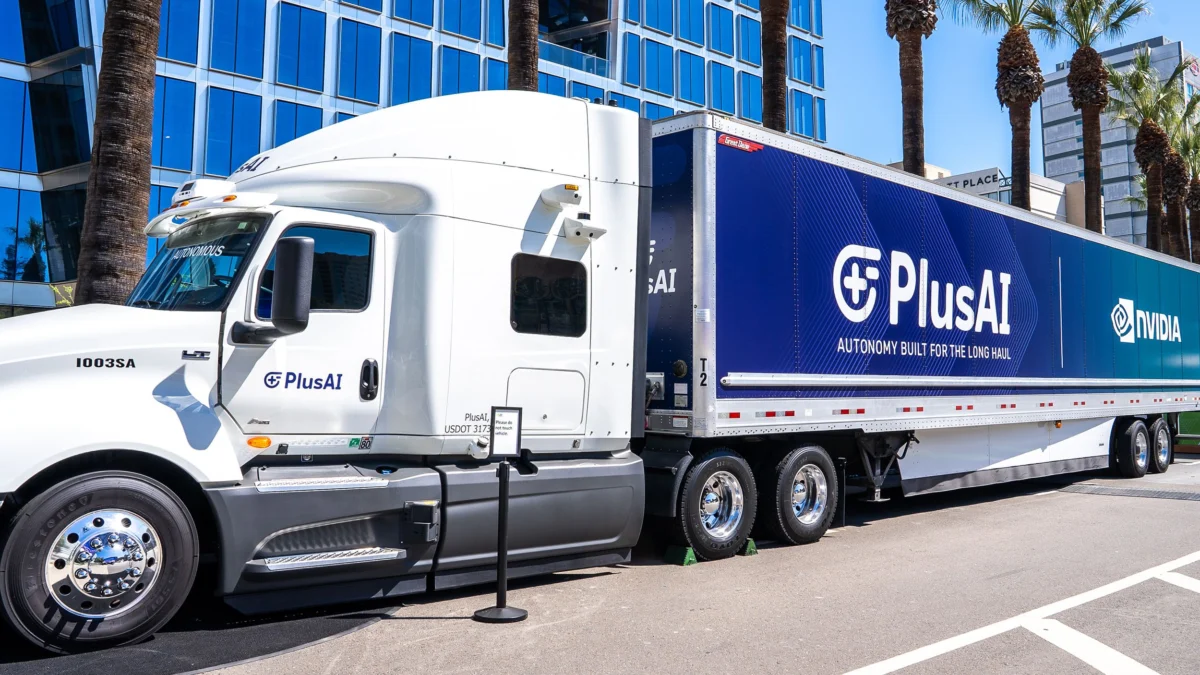
For the executive, however, the message brought immediate confusion rather than pride. According to company logistics and inventory logs, those specific trailers had no business being in Newark. As far as PlusAI management knew, the high-profile trailers—emblazoned prominently with corporate logos for both PlusAI and Nvidia, the tech giant currently recognized as the most valuable company in the world—were securely docked outside their primary warehouse facility in Fremont, California, located a crucial half-mile away.
Realizing that an unauthorized movement of company assets had taken place, corporate leadership immediately contacted local authorities. Within hours, according to official statements released by law enforcement, officers with the Fremont Police Department were dispatched to the scene in Newark to investigate the abandoned property and coordinate the recovery of the missing trailers.
What officers and company representatives discovered upon inspecting the scene added a layer of profound irony to the unfolding crime. Whoever had hooked up their own independent tractor cabs to the PlusAI trailers, driven them away from the Fremont warehouse, and broken the manual security locks had ultimately abandoned the operation after realizing the true nature of their bounty. Rather than housing millions of dollars in advanced artificial intelligence processors, high-performance graphics cards, or sensitive hardware components associated with the Nvidia partnership, each of the targeted trailers was stuffed to maximum capacity with approximately 20,000 pounds of ordinary construction sand.
The Anatomy of a Miscalculated Crime: Research, Simulation, and Heavy Loads
To understand how two multi-ton trailers filled with sand became the unwitting targets of a sophisticated cargo theft operation, one must examine the rigorous behind-the-scenes research and development processes utilized by developers of autonomous commercial vehicles.
In the high-stakes world of autonomous trucking, software engineers and hardware developers cannot simply test their vehicles under pristine, empty-weight conditions. Commercial semi-trucks behave fundamentally differently when pulling a dead weight compared to when they are hauling tens of thousands of pounds of real freight. Braking distances, acceleration curves, torque distribution, and aerodynamic drag are all critically influenced by the payload resting within the trailer.
To safely and accurately replicate the real-world physics of commercial freight hauling without risking actual consumer goods or expensive electronics during early testing phases, PlusAI utilizes simulated loads. In this case, the company routinely loads its trailers with heavy, non-perishable aggregate materials—specifically, fine sand—to test how its autonomous driving software systems and tech-enabled truck cabs respond to heavy resistance and varying weight distributions.
Lauren Kwan, a corporate spokesperson for PlusAI, elaborated on the utility of the unconventional cargo during subsequent interviews with law enforcement and the media. "PlusAI uses simulated loads in its trailers to assist with research and development testing," Kwan explained, confirming that despite the unauthorized cross-city excursion, the company successfully recovered both containers with their heavy contents completely untouched. "The trailers were recovered with 40,000 pounds of sand intact."
Furthermore, Kwan clarified that the physical truck cabs—the highly sophisticated, tech-enabled nerve centers where safety drivers typically sit to monitor and control the vehicle’s autonomous systems—were safely parked inside the Fremont warehouse at the time of the incident and were never compromised or stolen. The perpetrators had bypassed the stationary cabs entirely, choosing instead to target the unmotorized trailers parked outside on the property, utilizing brute force to snap the manual hand locks securing the rear doors.
Chronology of the Incident: From Warehouse to Newark
While the formal police investigation remains ongoing, preliminary timelines established by law enforcement and corporate security paint a clearer picture of how the bizarre caper unfolded over the course of less than 24 hours.
The timeline of events highlights a swift discovery phase triggered entirely by coincidence:
- Wednesday Night or Early Thursday: Unidentified suspects access the secure exterior loading docks of the PlusAI warehouse facility in Fremont, California. Utilizing their own independent tractor cabs, the perpetrators couple to two branded PlusAI-Nvidia trailers. The suspects break the manual hand locks securing the cargo bay doors, likely anticipating high-value technological equipment or microchips inside.
- Thursday Morning (Approx. 9:00 AM): The suspects transport the massive trailers roughly half a mile away to an industrial area in neighboring Newark, California. Upon opening the doors and discovering that the interior holds only heavy aggregate sand rather than exportable electronics, the thieves abandon the trailers on site.
- Thursday Morning (Approx. 10:30 AM): A PlusAI executive receives an unexpected text message from an acquaintance who happened to spot the distinctive company-branded trailers parked near their Newark workplace. The executive alerts internal security, verifying that the trailers are missing from the Fremont warehouse.
- Thursday Midday: Management contacts the Fremont Police Department. Officers are dispatched to the Newark location to secure the scene, document the forced entry, and initiate recovery procedures.
- Thursday Afternoon: The Fremont Police Department officially confirms that both trailers, complete with their 40,000 combined pounds of sand, have been safely returned to PlusAI custody.
As of late Thursday, Amy Gee, a spokesperson for the Fremont Police Department, confirmed that the case remains an active and open investigation, with local detectives reviewing nearby surveillance footage and physical evidence from the scene. Authorities stated that no arrests have been made thus far. Meanwhile, representatives for Nvidia did not immediately respond to public requests for comment regarding the security breach involving the co-branded assets.
The Broader Context: A Wave of High-Stakes Cargo Theft Targeting Silicon Valley
Although the PlusAI trailer heist ultimately ended with the harmless recovery of construction-grade sand, the incident underscores a much more sinister and alarming trend sweeping across California and the broader United States logistics sector: an unprecedented surge in targeted cargo theft aimed specifically at high-value technology, microchips, data center equipment, and industrial hardware.
In recent years, the exponential growth of artificial intelligence has turned certain supply chains into primary targets for organized criminal networks. Data center components, specialized enterprise-grade networking switches, and advanced graphics processing units (GPUs) command astronomical black-market values, rivaling precious metals and luxury goods in profitability per cubic foot.
The sophistication of these criminal operations has escalated dramatically. Rather than engaging in opportunistic crimes of convenience, modern cargo thieves are increasingly employing industrial espionage, inside information, and violent tactics to intercept shipments before they ever reach their commercial destinations.
In August of this year, investigative reports revealed a disturbing pattern of violent cargo heists in California. In at least two separate incidents, criminal syndicates deliberately rammed the vehicles of specialized security escorts—private security details hired to trail high-value tech shipments to ensure safe passage. Once the escort vehicles were disabled or forced off the road, the primary semi-trucks carrying millions of dollars in sensitive data center equipment were hijacked and driven to undisclosed secondary locations. Months after those initial summer heists, significant portions of the stolen hardware remain unrecovered, highlighting the proficiency and international reach of the underground networks coordinating the thefts.
Beyond data center electronics and AI infrastructure components, cargo analytics firms have documented a widespread diversification in high-tech targeting. Over the past twelve months, thieves across the United States have repeatedly targeted bulk shipments of Tesla vehicle batteries, commercial bitcoin mining hardware, specialty industrial metals, and sensitive telecommunications infrastructure.
According to data compiled by Verisk CargoNet, a leading analytics, risk assessment, and supply chain security firm, enterprise-grade computer and networking equipment, along with high-value metals, consistently rank among the most frequently targeted categories of cargo theft nationwide. The combination of high resale value, relative ease of concealment, and global demand has made the technology sector a lucrative hunting ground for organized theft rings.
Implications for Autonomous Vehicle Developers and Supply Chain Security
The attempted heist of the PlusAI trailers serves as a cautionary tale for the burgeoning autonomous vehicle and robotics industries, highlighting vulnerabilities that extend far beyond software safety and on-road testing regulations.
As autonomous trucking companies scale their operations, establish large physical footprints, and partner with some of the most influential technology firms in the world—such as PlusAI’s high-profile collaboration with Nvidia—they inadvertently project an aura of immense wealth and technological accumulation. Corporate branding, while effective for marketing, public relations, and investor relations, can unfortunately double as a beacon for criminal enterprises scanning industrial parks for high-value targets.
Security analysts point out several key operational takeaways from the Fremont-Newark incident for companies operating in the logistics and autonomous freight sectors:
- Enhanced Perimeter Security: Exterior storage yards and loading docks housing branded assets must maintain robust, active surveillance systems, motion-activated lighting, and electronic access controls that go beyond traditional manual hand locks.
- Asset Tracking and Telematics: While the trailers in this case were eventually located via a casual text message, industry experts emphasize that every commercial trailer—regardless of whether it contains live cargo or simulated test weights—should be outfitted with independent, tamper-proof GPS tracking units to ensure real-time visibility.
- Information Management: The ease with which criminals identified the location of the PlusAI trailers suggests that corporate asset storage patterns are sometimes too predictable, necessitating greater operational security regarding where research vehicles and test trailers are parked overnight.
Fortunately for PlusAI, the perpetrators of last week’s caper fell victim to their own assumptions, choosing to abandon a massive haul of heavy aggregate materials rather than risk capture for a load of worthless sand. However, as the economic value of artificial intelligence hardware continues to skyrocket, law enforcement agencies and corporate security directors alike recognize that the next truck targeted in the Silicon Valley industrial corridor may not be carrying sand—and the consequences for the industry could be vastly more severe.