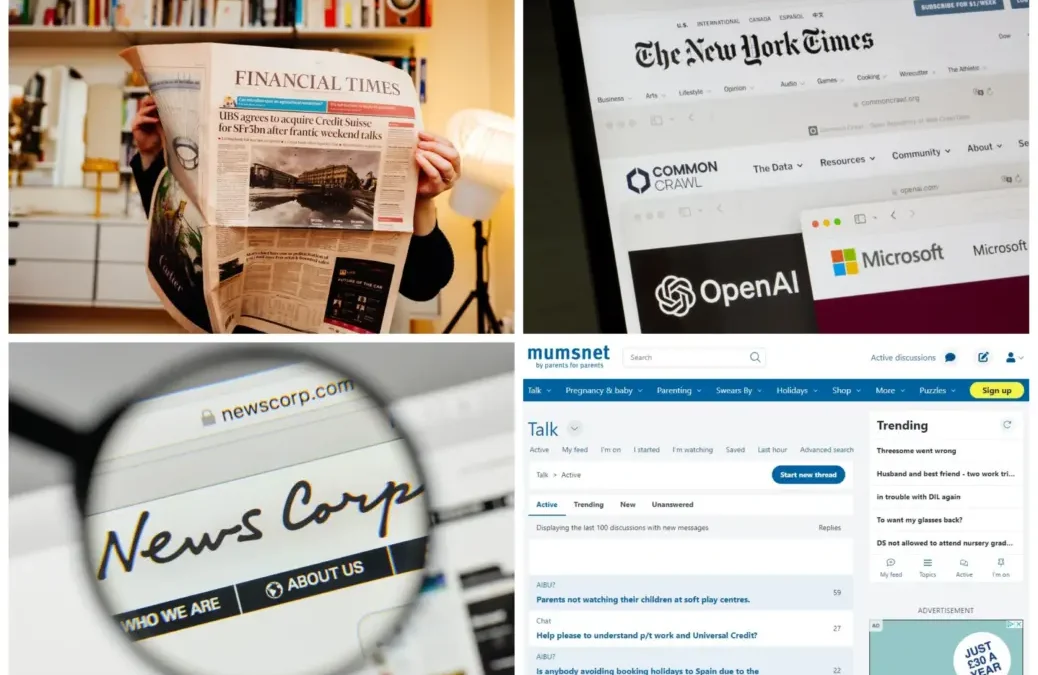
The intersection of artificial intelligence and media publishing has evolved into one of the most contentious legal and economic battlegrounds of the digital age. As generative AI models require vast troves of high-quality, human-generated text, images, and video to train their large language models (LLMs) and power real-time retrieval systems, media organizations worldwide find themselves at a historic crossroads. The core conflict centers on intellectual property rights, fair compensation, and the existential threat that automated, AI-driven answer engines pose to traditional web traffic and advertising revenues.
While a growing faction of major media conglomerates has forged lucrative commercial partnerships with tech giants like OpenAI, Google, Microsoft, and Amazon, an equally formidable coalition of publishers is taking legal action. These lawsuits accuse technology companies of industrial-scale copyright infringement, unauthorized web scraping, and unfair competition. The unfolding legal landscape will likely define the parameters of fair use, digital monetization, and the economic sustainability of independent journalism for decades to come.
The Chronology of Conflict: From Early Warnings to Global Litigation
The friction between publishers and AI developers began intensifying notably in late 2023, setting off a cascading wave of legal challenges and commercial agreements.
December 2023 marked a watershed moment when The New York Times filed a landmark lawsuit against OpenAI and Microsoft in a New York federal court. The publication sought billions in statutory and actual damages, alongside an order for the destruction of any LLMs trained on its copyrighted work. This aggressive stance shattered months of private negotiations and signaled that legacy media would not quietly surrender its archives. Around the same period, German publisher Axel Springer took a contrasting path, striking a pioneering global partnership with OpenAI to integrate its journalism into ChatGPT while permitting model training under controlled, compensated terms.
Throughout 2024, the litigation wave expanded rapidly. In April, eight daily newspapers owned by Alden Global Capital—including the New York Daily News and the Chicago Tribune—filed suit against OpenAI and Microsoft, highlighting egregious AI "hallucinations" that falsely attributed fabricated medical advice to reputable publications. Major non-profit investigative outfits, such as The Center for Investigative Reporting (publisher of Mother Jones and Reveal), joined the fray in June 2024, followed by international coalitions. By late 2024, prominent Canadian publishers, including the CBC and The Globe and Mail, launched coordinated legal actions, asserting that cross-border scraping violated national copyright laws.
Concurrently, tech platforms began diversifying their legal defense strategies by pairing litigation defense with aggressive deal-making. OpenAI secured high-profile licensing agreements with News Corp (valued at over $250 million across five years), Time, Condé Nast, Dotdash Meredith, and the Financial Times. These multi-million-dollar pacts typically guaranteed real-time content display with explicit attribution and links, attempting to establish a viable blueprint for coexistence.
The conflict further escalated in 2025 and 2026. Perplexity AI emerged as a primary target alongside OpenAI and Microsoft, facing lawsuits from Dow Jones, News Corp, the Chicago Tribune, Encyclopedia Britannica, Merriam-Webster, CNN, and The New York Times over real-time retrieval-augmented generation (RAG) scraping that allegedly bypasses paywalls. Notably, international resistance solidified with actions from the Danish media body DPCMO, Japan’s Yomiuri Shimbun, and Argentina’s Editorial Perfil, proving that the copyright crisis is a truly global phenomenon.
Anatomy of the Legal Claims: Fair Use Versus Unlicensed Appropriation
The core legal arguments in these multi-district litigations hinge upon narrow judicial interpretations of copyright law, specifically the doctrine of "fair use."
Plaintiffs—representing thousands of independent, local, and international news brands—argue that tech companies engage in systematic, willful, and unauthorized scraping of paywalled and open-access content. They contend that generative AI tools like ChatGPT, Microsoft Copilot, and Perplexity’s answer engine do not merely index the internet in the manner of traditional search engines; instead, they ingest raw journalistic output, memorize it, and synthesize it into direct answers. This mechanism, publishers argue, deprives users of the necessity to visit original news websites, thereby eviscerating referral traffic, digital advertising impressions, and subscription conversions. Furthermore, plaintiffs emphasize the immense financial disparity: while tech corporations attain multi-trillion-dollar valuations fueled in part by high-value journalism, local and investigative newsrooms face declining revenues and staff layoffs.
Conversely, defendants invoke the fair use doctrine, asserting that training LLMs on publicly available internet data constitutes a transformative use. OpenAI, Microsoft, and other AI developers maintain that their systems analyze data to recognize linguistic patterns, scientific facts, and historical contexts rather than displaying copyrighted text for expressive consumption. Moreover, tech firms frequently argue that plaintiffs utilize aggressive, deceptive prompting or exploit software bugs to force models into regurgitating verbatim paragraphs—an outcome they claim does not reflect normal user behavior.
The Evolution of Licensing Models and Revenue-Sharing Agreements
As the legal battles stall or proceed slowly through federal courts, a parallel market for AI content licensing has matured rapidly. Media organizations and tech developers have tested several distinct financial models to ensure sustainable cooperation:
- Fixed-Fee Multi-Year Licensing: Exemplified by News Corp’s deals with Meta and OpenAI, and Condé Nast’s agreements, these contracts provide lump-sum annual payments (ranging from tens of millions to over $50 million per year) in exchange for archival training rights and real-time content integration.
- Usage-Based and Proportional Compensation Models: Emerging platforms like Prorata.ai, alongside agreements signed by UK publisher Reach with Amazon’s Nova AI, utilize proprietary algorithms to measure the exact value and frequency of publisher content used in generative responses, allocating proportional ad revenue back to the creators.
- Tech-For-Content Barter and Grants: Initiatives such as OpenAI’s partnership with The Lenfest Institute for Journalism and agreements with Village Media and Axios involve a mix of direct funding, API credits, technical support, and grants to empower local newsrooms to build proprietary AI tools while granting citation rights in ChatGPT.
- Pilot and Commercial Settlements: Several disputes have successfully transitioned from the courtroom to the boardroom. Notably, Brazilian media group Folha settled its lawsuit against OpenAI by signing a commercial licensing agreement that grants its Portuguese-language real-time feed to ChatGPT while providing the publisher with advanced enterprise tools and API access.
Broader Implications for the Information Ecosystem
The outcome of these ongoing legal battles and licensing trends will fundamentally reshape the global information ecosystem. If courts adopt a broad view of fair use that protects mass-scale AI scraping without compensation, independent journalism faces an existential threat. Investigative reporting, local accountability journalism, and deep-dive editorial analysis—which require extensive human labor, verification, and legal protection—cannot survive in an economy where tech intermediaries siphon the economic value of reported facts without contributing to their production costs.
Conversely, if courts rule in favor of publishers, AI developers will be forced to restructure their foundational training pipelines entirely around licensed content libraries. This shift would likely consolidate the AI market further, favoring heavily capitalized tech monopolies capable of affording universal licensing fees while potentially freezing out smaller, independent publishers who lack the legal leverage to negotiate favorable terms.
Ultimately, the fragile truce currently being brokered through multi-million-dollar licensing agreements suggests a transitional phase. Both media enterprises and artificial intelligence developers are recognizing an interdependent reality: advanced AI models require authoritative, fact-checked, real-time human journalism to remain accurate and relevant, while publishers increasingly require structured technological integration to reach audiences in an era dominated by conversational search.