Effective communication within digital product teams relies heavily on a shared vocabulary. The language chosen to define user interface (UI) components, design tokens, and CSS variables shapes the internal mental models of developers, designers, and product managers. When naming conventions are inconsistent or poorly defined, teams often find themselves speaking different "dialects," leading to significant technical debt, reduced accessibility, and lower feature adoption rates. Recent industry research suggests that ambiguous nomenclature is a primary driver of friction in collaborative design environments, as teams struggle to reconcile the divide between visual aesthetics and functional code.

The challenge of naming stems from a classic balancing act: names must be specific enough to be meaningful but generic enough to allow for reuse across an entire product ecosystem. Overly generic names—such as "box" or "item"—fail to convey intent, while excessively specific names—such as "blue-submit-button-large"—preclude the flexibility required for scaling or rebranding. Establishing a robust taxonomy is not merely an exercise in semantics; it is a fundamental requirement for building scalable design systems that can evolve alongside complex digital products.
The Evolution of Design Taxonomies
Historically, the lack of standardized naming conventions in web development led to the "Wild West" era of CSS, where developers relied on ad-hoc class naming. As design systems became the industry standard over the last decade, the focus shifted toward more rigorous, tokenized architectures. A design token is essentially a named entity that stores a design decision, such as a color value, spacing increment, or font weight. By decoupling these values from hard-coded CSS, teams can manage multi-brand and multi-themed applications from a single source of truth.

The current industry standard, heavily influenced by the work of experts like Nathan Curtis, involves a tiered approach to tokenization. Primitives (the base values) are mapped to semantic tokens (their purpose), which are then mapped to component-specific tokens. This hierarchy ensures that if a brand color changes, it only needs to be updated at the root level, propagating automatically through the entire system.
Resource Frameworks for Standardizing Language
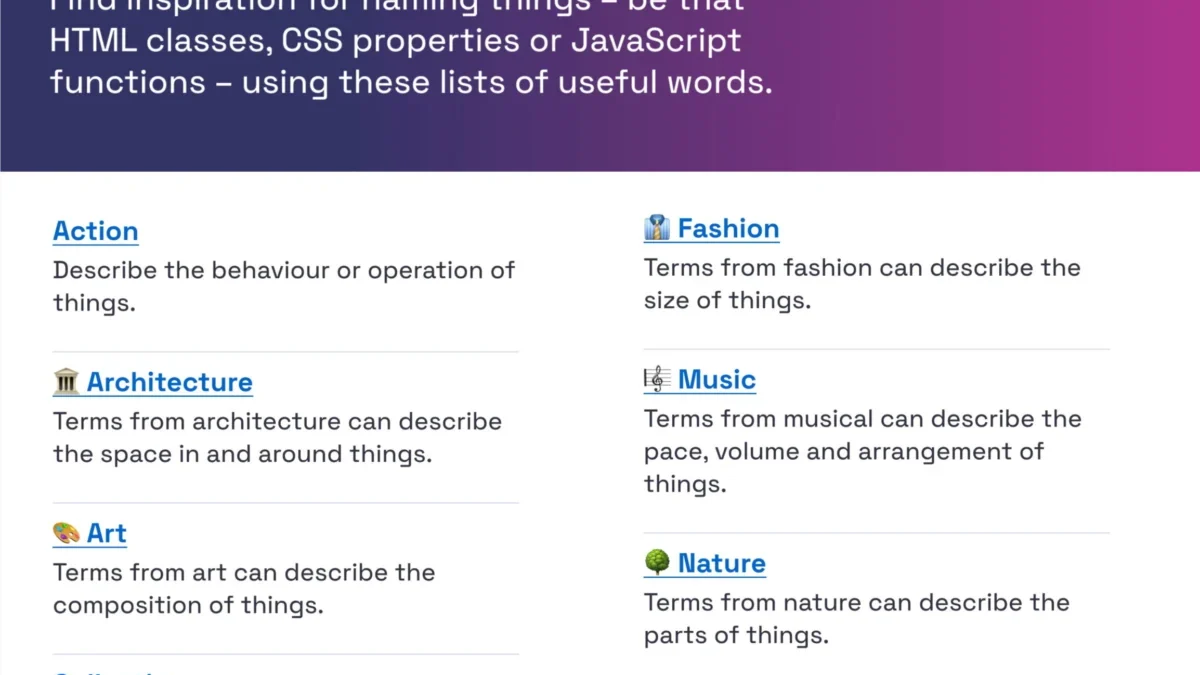
Several high-profile projects have recently emerged to assist teams in navigating the complexities of nomenclature. For developers and designers seeking inspiration, platforms like Classnames (classnames.paulrobertlloyd.com) offer thematically grouped lists of terms. These collections move beyond technical jargon, drawing from fields as diverse as architecture, music, and publishing to provide vocabulary for behavior, grouping, and hierarchy.

For color systems, the repository maintained by David Aerne (color.pizza) has become an essential reference. Containing over 30,000 unique color names, this resource demonstrates the importance of moving away from numbered identifiers (like "gray-100") toward more descriptive or thematic naming patterns that improve readability in codebases.
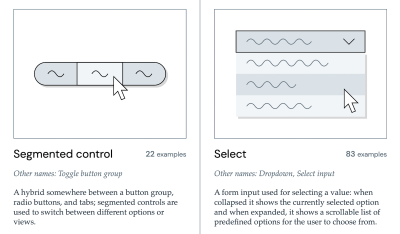
In the realm of UI components, the Component Gallery (component.gallery) provides a comprehensive audit of how major design systems label common elements. By analyzing how industry leaders name their components—from accordions to breadcrumbs—teams can adopt established conventions, reducing the cognitive load on new contributors who might otherwise be confused by proprietary, non-standard terminology.

The Impact of Naming on Feature Adoption
The consequences of poor naming extend beyond the development team; they directly affect the end-user experience. Research indicates that features with intuitive, benefit-oriented names see significantly higher adoption rates than those labeled with internal, jargon-heavy descriptors.
A critical takeaway from UX research is that naming should be driven by "Jobs-to-be-Done" (JTBD) theory. When a feature is named based on the outcome it provides for the user rather than its technical function, the user is more likely to discover, understand, and integrate that feature into their existing workflow. For instance, naming a feature "Data Export" is functional, but "Generate Monthly Report" is benefit-driven. If a feature is failing to gain traction, product teams are advised to audit the language used in the interface against the vocabulary customers use to describe their own problems.

Case Studies in Enterprise Scalability
Large-scale organizations often face the most extreme version of these naming challenges. The Intuit design team, responsible for a portfolio that includes Mailchimp, QuickBooks, and TurboTax, recently addressed this by developing a flexible, multi-product token taxonomy. The objective was to create a system that could accommodate brand-specific themes while maintaining a shared foundation. By formalizing their taxonomy, they reduced the redundancy that previously plagued their multi-brand environment.
Similarly, the Vodafone UK Design System team has utilized a "Variables Taxonomy Map" to govern their complex digital ecosystem. By categorizing tokens into four distinct collections—ranging from brand primitives to page-level semantics—they established a clear lineage for every design decision. This transparency ensures that any developer, regardless of their tenure, can understand the provenance and intent of a variable simply by its name.
Strategic Implications for Design Operations
The economic cost of poor naming is often hidden in the form of "meetings about meetings." When teams must clarify what a "primary button" vs. a "main action" refers to, they lose velocity. A standardized lexicon acts as a force multiplier, enabling faster onboarding and fewer implementation errors.
To implement a successful naming strategy, organizations should consider the following:

- Auditing Current State: Map out existing naming conflicts in current design files and code repositories.
- Establishing Governance: Create a "source of truth" document or tool (such as the Design Token Naming Guide by Romina Kavcic) that defines the structure for all new assets.
- Cross-Functional Collaboration: Ensure that developers, designers, and product managers agree on the definitions. The "dialect" of each group must be bridged to create a single, unified language.
- Maintenance: Treat naming conventions as a living part of the design system that requires regular updates, deprecation of old terms, and additions for new features.
Conclusion
As digital products grow in complexity, the importance of clear, consistent, and scalable naming conventions cannot be overstated. The tools and frameworks mentioned—ranging from color name repositories to enterprise-grade token maps—provide the scaffolding necessary for teams to build coherent interfaces.
Ultimately, the goal of a robust taxonomy is to eliminate the ambiguity that breeds frustration. When team members can speak with precision, they spend less time debating semantics and more time building functional, accessible, and user-centric experiences. Whether a team is a small startup or a global corporation, the investment in defining a language for their digital components is a prerequisite for long-term technical and operational success. By prioritizing clear communication through thoughtful, research-backed naming, organizations can effectively reduce friction, improve design system adoption, and ensure that the digital products they build remain understandable and maintainable for years to come.