KPMG Secures Elite OpenAI Partnership Following Successful Internal Deployment for the AI Giant

The global professional services firm KPMG has officially ascended to the status of an OpenAI Elite Partner, marking the highest tier within the artificial intelligence laboratory’s partner network. This milestone follows a unique "client-zero" engagement in which OpenAI hired KPMG to design and implement its own internal Supply Chain & Fulfillment Orchestration platform. This AI-native workflow system, originally built to manage the complex logistics of the world’s leading AI research lab, now serves as the blueprint for a new enterprise-grade deployment model that KPMG and OpenAI are taking to the broader global market.
The partnership signals a transition in the corporate world from the phase of isolated AI experimentation to large-scale, structural enterprise deployment. By serving as both a consultant and a primary contractor for OpenAI’s internal operations, KPMG has validated a "headless" software architecture that aims to decouple the experience of work from traditional software interfaces. This collaboration is set to redefine how multinational corporations interact with their existing systems of record, moving away from manual data entry and navigation toward an agentic layer driven by natural language and intent.
The Client-Zero Strategy and Elite Partner Designation
The path to the Elite Partner designation began with an unconventional role reversal. Before KPMG began marketing its AI-deployment frameworks to its Fortune 500 client base, it acted as a service provider for OpenAI itself. The task was to build a Supply Chain & Fulfillment Orchestration platform capable of handling the high-velocity demands of a frontier AI lab. This "client-zero" deployment allowed KPMG to test its theories on AI-native workflows in one of the most technologically demanding environments in the world.
Colleen Kapase, Vice President of Strategic Global Partnerships and Ecosystems at OpenAI, noted that the Elite Partner status is an exclusive category reserved for a limited group of global organizations. According to Kapase, these partners must possess the international reach, operational scale, and technical delivery capabilities necessary to support the complexities of enterprise AI adoption on a global scale. The partnership is not merely a reseller agreement but a co-innovation alliance where both firms bring distinct strengths: OpenAI provides the frontier intelligence models, while KPMG provides the governance, industry-specific knowledge, and implementation expertise.
Chad Seiler, KPMG’s U.S. industry leader for technology, media, and telecommunications, emphasized that the alliance is built on the realization that the "experimentation" phase of generative AI is concluding. The focus has shifted to how these models can be integrated into the core fabric of business operations to drive measurable ROI and operational resilience.
The Rise of Headless Enterprise Software
A central component of the KPMG-OpenAI go-to-market strategy is the concept of "headless" enterprise software. For decades, the standard for corporate productivity has been the Software-as-a-Service (SaaS) model, characterized by complex User Interfaces (UIs) and siloed modules. Employees typically spend a significant portion of their workday navigating screens, logging into various Enterprise Resource Planning (ERP) or Customer Relationship Management (CRM) systems, and manually moving data between them.
KPMG’s vision, as implemented for OpenAI, involves "decoupling" the work experience from these underlying screens. In this new paradigm, the existing software—whether it be SAP, Oracle, or Salesforce—remains the "system of record" or the underlying database. However, the user no longer interacts with the software’s "clumsy" UI. Instead, an "intelligent agentic layer" sits on top of these systems.
Under this model, work becomes a series of conversations. Employees describe their intent—such as "reallocate inventory to the Northeast region to meet a sudden spike in demand"—and AI agents interpret that intent, coordinate across multiple backend systems, and execute the necessary actions. Seiler predicts that over time, voice will replace typing as the primary interface for enterprise systems. This "headless" approach allows for a "new work surface" where the complexity of the underlying infrastructure is hidden from the user, allowing them to focus on outcomes rather than software navigation.
Theoretical Framework: The Decide, Execute, Deliver Sandwich
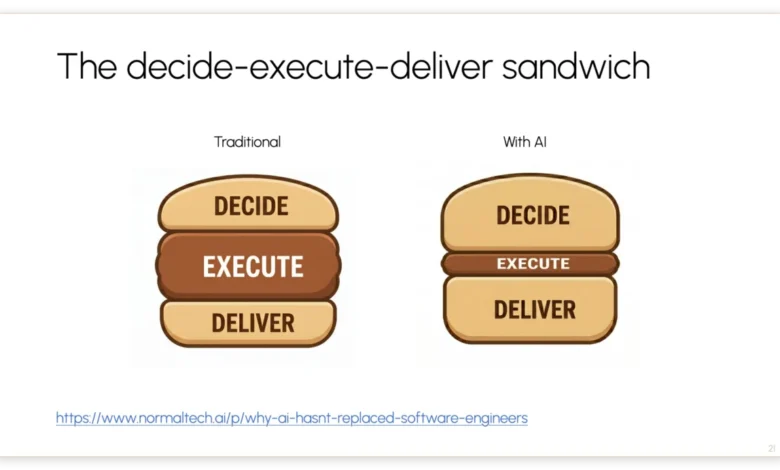
To explain the impact of this shift on the workforce, the partnership references a framework developed by Arvind Narayanan, a researcher at Princeton University. Narayanan’s "AI as Normal Technology" thesis breaks professional work into three distinct layers: the "decide" layer (judgment and goal setting), the "execute" layer (the actual labor of performing a task), and the "deliver" layer (accountability and verification).

Narayanan argues that AI primarily compresses the "execute" layer—the middle of the sandwich. However, KPMG’s real-world observations suggest a more complex evolution. While the execution layer shrinks as AI agents take over routine tasks, the "decide" layer may actually expand. Workers will spend less time learning the "geography" of software and more time defining high-level specifications and desired outcomes.
Furthermore, the "deliver" layer—the bottom bun of the sandwich—faces new pressures. The sheer speed of AI-driven execution creates a higher burden for human verification. As systems move faster, the risk of automated errors increases, requiring humans to exercise more rigorous judgment and accountability. Narayanan has warned that while AI moves the "floor" of productivity up, it also raises the "ceiling" of project complexity. Organizations are likely to use their newfound efficiency to take on more ambitious projects, meaning the total cognitive load on humans may not decrease, but rather shift toward higher-order decision-making.
Chronology of the KPMG and OpenAI Relationship
The formalization of the Elite Partnership is the culmination of several years of incremental integration and collaboration:
- 2023: Internal Integration: KPMG began integrating OpenAI’s capabilities into its internal operations through a proprietary tool called aIQ Chat. This allowed KPMG’s global workforce to use generative AI for daily advisory and administrative tasks.
- Late 2023 – Early 2024: Development of Codex Use Cases: KPMG’s advisory teams began identifying specific use cases for Codex, OpenAI’s model for code generation, to build AI-enabled capabilities for enterprise clients.
- 2024: The "Client-Zero" Project: OpenAI engaged KPMG to build its internal Supply Chain & Fulfillment Orchestration platform, serving as a high-stakes pilot for AI-native enterprise architecture.
- July 2026: Official Alliance and Product Launch: The companies announced the Elite Partner status and the joint go-to-market strategy for the Supply Chain platform. Reports from this period indicate that OpenAI’s Sol model showed a 54% increase in token efficiency for agentic coding tasks, providing the technical backbone for the partnership’s newest offerings.
Strategic Implications and the Consulting Value Proposition
The partnership raises questions about the future of management consulting in an era where AI can generate strategies and write code. Chad Seiler argues that the commoditization of AI models actually increases the value of firms like KPMG. While frontier models are becoming more accessible, they lack "institutional knowledge."
KPMG’s value proposition rests on its deep understanding of a client’s specific business model, culture, data silos, and internal politics—nuances that a generalized AI model cannot perceive. In highly regulated sectors like the public sector, healthcare, and finance, the "governance" of AI is as important as the technology itself. Products like "Daybreak Cyber," developed by KPMG, focus on the intersection of AI and cybersecurity, ensuring that agentic deployments do not create new vulnerabilities.
Furthermore, KPMG is positioning itself as a neutral orchestrator in a multi-model world. While the OpenAI partnership is a cornerstone of their strategy, KPMG maintains parallel alliances with other labs, including Anthropic. Seiler noted that many large enterprises are adopting a "portfolio approach," using different models for different tasks based on cost, resilience, and specific performance metrics. Some clients are even utilizing open-source models from various regions, including China, as a hedge against vendor lock-in.
Risks and Long-Term Outlook: The Problem of "Lock-in"
Despite the optimism surrounding the partnership, independent experts like Narayanan have raised concerns regarding "vendor lock-in." As AI agents become the primary repository for an organization’s "tacit knowledge"—the informal, unwritten way things get done—the agent effectively becomes a coworker that is impossible to replace. If a company builds its entire operational workflow on a specific agentic layer, switching providers could mean losing years of accumulated organizational know-how.
KPMG’s leadership acknowledges these challenges, framing AI adoption as a "portfolio of business decisions" rather than a simple technology migration. The firm cautions that not every workflow requires a radical overhaul; in many cases, existing processes remain the most efficient fit.
The transition to an AI-native enterprise is expected to be a decades-long process, comparable to the electrification of factories in the early 20th century. While the "shock" of AI is more urgent than most technological shifts, the structural reinvention of how corporations function requires a deliberate, multi-year strategy. Through the OpenAI Elite Partnership, KPMG is betting that the companies that succeed will be those that view AI not as a replacement for human judgment, but as a "headless" infrastructure that allows human decision-makers to operate at a higher level of abstraction and scale.