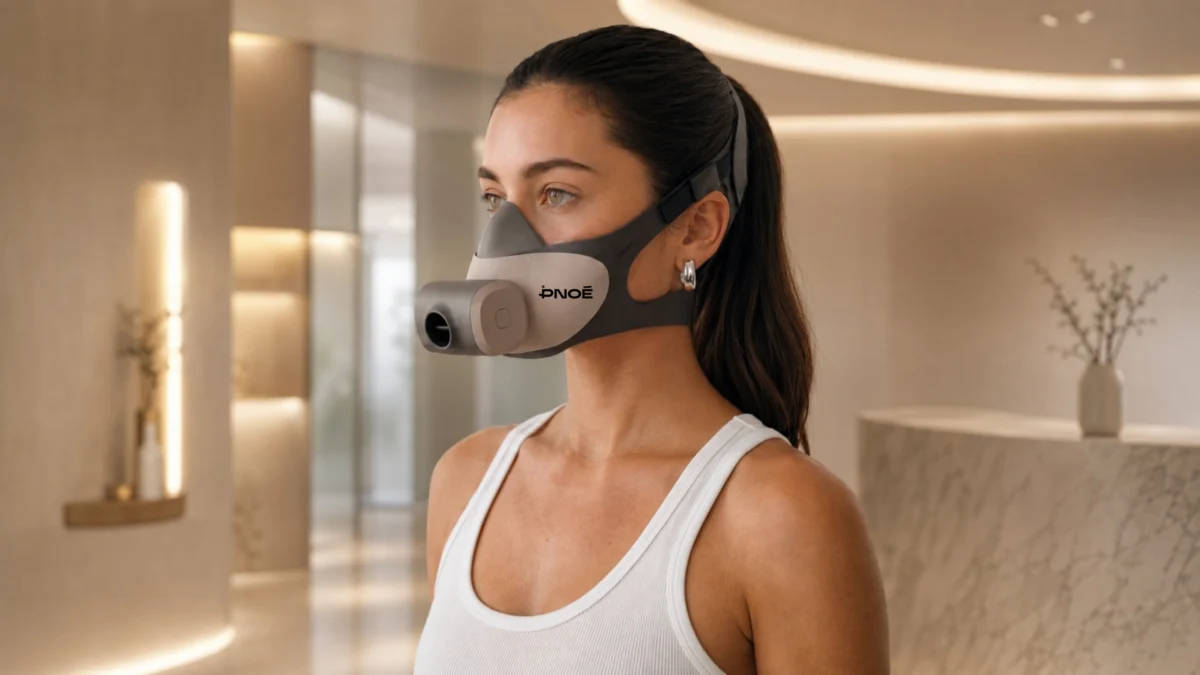
At first glance, the newest hardware from PNOE looks like something pulled from the set of a high-budget superhero film, specifically echoing the formidable aesthetic of the villainous Bane. The device, a specialized mask that secures over the nose and mouth, is designed to capture the nuanced chemistry of human respiration. While its appearance is striking, its function is purely analytical: it measures oxygen consumption and carbon dioxide exhalation to provide a granular roadmap for nutrition, exercise, and long-term health optimization. On October 1, the Malden, Massachusetts-based company will launch the PNOE 2.0, a significant iteration of its technology that moves the gold standard of metabolic testing from the restricted environment of sports science labs into the hands of the general public.
The Evolution of Metabolic Assessment
Metabolic testing has been a staple of clinical research for over a century. By analyzing the gas exchange in a subject’s breath, researchers can determine the exact efficiency with which the body converts fuel—fat and carbohydrates—into energy. Historically, this required bulky, expensive metabolic carts typically found only in specialized sports medicine facilities or hospitals. These systems were primarily reserved for elite athletes aiming to optimize their performance or for clinical patients requiring precise metabolic monitoring.
The barrier to entry for this data has always been twofold: cost and complexity. Traditional systems require trained technicians to calibrate the equipment, manage the breathing apparatus, and interpret the resulting data. This has effectively sidelined metabolic testing as a routine health metric, leaving the average individual to rely on generalized calorie-tracking apps or estimated VO2 max readings from consumer-grade smartwatches—estimates that often lack the precision of direct gas-exchange measurement.
A Technological Leap in Accessibility
The PNOE 2.0 represents a pivotal shift in this accessibility. By redesigning the interface to be user-friendly, the company aims to move metabolic health out of the hospital and into the gym, the wellness center, and potentially even the local pharmacy. Co-founder and CEO Apostolos Atsalakis describes the user experience as remarkably simple: an individual enters a facility, wears the mask, pushes a button, and breathes normally for eight minutes. This eight-minute session generates a comprehensive profile of 23 distinct biomarkers.
The shift to a self-serve model is made possible by the hardware’s streamlined, compact design. Developed in collaboration with the Milan-based Design Group Italia, the device underwent numerous iterations to ensure that the hardware remained robust while becoming intuitive enough for non-experts to operate. By decoupling the sophisticated electronics from the silicone mask and head straps, PNOE has also addressed hygiene concerns prevalent in the post-pandemic era. Users can now share the core hardware—the expensive diagnostic component—while maintaining personal ownership of the contact-ready masks.
The Longevity Boom and the Value of Data
The launch of PNOE 2.0 coincides with a significant cultural pivot toward "longevity" as a primary health objective. VO2 max, once a niche term known only to exercise physiologists, has entered the mainstream lexicon as a primary predictor of all-cause mortality. Research consistently demonstrates that higher cardiorespiratory fitness correlates with a lower risk of chronic disease and extended life expectancy.
Atsalakis views the PNOE device as a "scorecard" for this new era of proactive wellness. Beyond VO2 max, the device measures resting metabolic rate—the baseline energy expenditure required to sustain life—and metabolic flexibility, which is the body’s ability to transition efficiently between burning glucose and stored fat. These metrics provide data that standard blood panels cannot, such as the exact caloric needs of an individual based on their unique physiology rather than generic population averages.
A Decade of Growth and Strategic Expansion
The origins of PNOE trace back to the PhD research of Apostolos Atsalakis at the University of Cambridge. Immersed in the early days of the wearables revolution, Atsalakis became fascinated by the untapped potential of breath analysis as a non-invasive diagnostic tool. Alongside childhood friend and current Chief Product Officer Panos Papadiamantis, he set out to bridge the gap between clinical-grade accuracy and portable technology.
The startup’s trajectory gained significant momentum when it participated in the Winter 2019 batch of the startup accelerator Y Combinator. Since then, the company has successfully raised approximately $22 million in funding, with an $11 million round recently finalized. Notable investors include 50 Years and Lars Rasmussen, the co-founder of Google Maps.
Currently, the company employs a workforce of 110 people across its Massachusetts headquarters and its operations hub in Athens, Greece. The business model is strictly B2B; PNOE sells its "business in a box" solution to gyms, med-spas, and health systems. These clients, including high-profile names like Equinox, Four Seasons, and the NBA, pay a monthly subscription fee for the hardware, software, and training materials. This model allows fitness facilities to offer high-end testing as part of their membership value proposition, creating a bridge between wellness coaching and clinical health.
Regulatory Landscape and Future Horizons
Despite its sophisticated capabilities, PNOE maintains a cautious stance regarding its clinical status. The device is not currently cleared by the U.S. Food and Drug Administration (FDA), and the company is careful to categorize its offering as a wellness tool rather than a diagnostic medical device. "We do not provide medical recommendations," Atsalakis emphasizes, noting that the results should be treated similarly to body composition scales or other fitness trackers—useful for guidance, but not for medical prescription.
However, the company’s long-term vision may eventually move toward clinical diagnosis. The field of "breathomics"—the study of volatile organic compounds in human breath—is an emerging frontier in medical science. Researchers have long explored whether specific patterns in exhaled gases could serve as early warning signs for conditions such as cancer or metabolic syndrome. While Atsalakis acknowledges that such applications are still years away due to the significant regulatory hurdles involved in medical device certification, the company is effectively building a vast repository of data that could one day form the foundation for diagnostic software.
The Competitive Landscape
The market for health and performance data is increasingly crowded. Major tech players like Apple and Garmin have integrated VO2 max estimations into their consumer wearables, and niche competitors like Lumen focus specifically on metabolic tracking via breath. PNOE’s strategy to distinguish itself lies in the "middle ground" of its offering: more accurate than a standard smartwatch, yet more accessible and less intimidating than a clinical metabolic cart.
As the company looks toward its Series B funding round in the coming months, the focus remains on scaling its footprint. With 85% of its current business concentrated in the United States, PNOE is now aggressively expanding into European, Latin American, and Asian markets. By positioning its technology as a fundamental tool for longevity, the company is betting that the demand for "quantified self" data will continue to grow, making its mask a common fixture in the fitness landscape.
As PNOE 2.0 hits the market, it carries with it the promise of bringing professional-level health insights to the public, potentially changing how individuals approach their daily training and nutrition. Whether or not it eventually evolves into a diagnostic tool, its current role as a bridge between high-end performance science and everyday wellness represents a significant shift in the consumer health technology landscape.