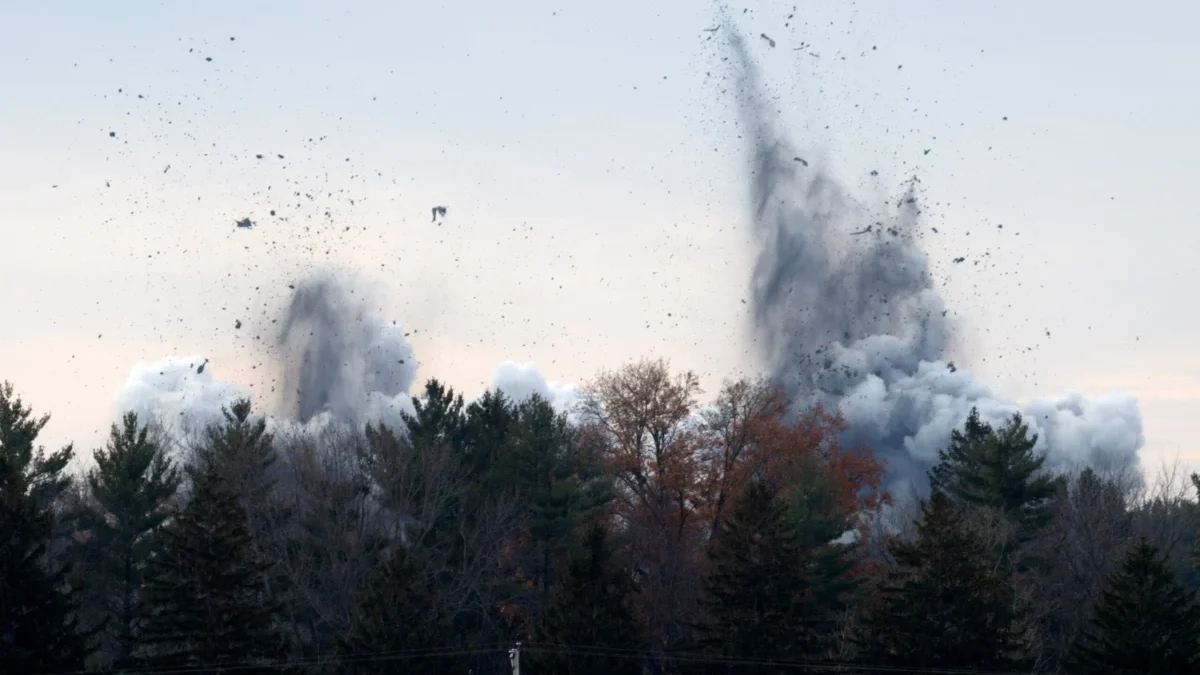
The United States Army detonated nearly five tons of degraded lead azide on Wednesday morning outside Middletown, Iowa, marking the culmination of a tense multi-agency operation that has drawn intense scrutiny from environmental regulators, independent academic researchers, and local residents. The controlled explosion, executed at a military installation that has housed the volatile chemical compound for decades, prompted a massive, multi-pronged data collection effort designed to evaluate potential environmental fallout across the region.
Environmental Protection Agency (EPA) Administrator Lee Zeldin stated shortly after the morning blast that preliminary air monitoring conducted at the site detected no immediate presence of lead in the surrounding atmosphere. However, federal, academic, and independent scientific coalitions emphasize that the full environmental picture will remain unclear for days as comprehensive air, soil, and water samples undergo laboratory analysis.
The operation has ignited a broader conversation regarding government transparency, emergency communication protocols, and the persistent challenges of managing legacy military ordnance across the United States.
Chronology of the Middletown Detonation and Communication Breakdown
The path toward Wednesday’s detonation was characterized by escalating public concern, which was largely attributed to what local leaders and residents described as inadequate and delayed communication from military authorities.
The lead azide—a highly sensitive primary explosive used in detonators and primers—had deteriorated over decades of storage at the base near Middletown. Army officials ultimately deemed the material too unstable and hazardous to transport for conventional remediation, necessitating an
on-site controlled detonation.
The chronology of events reveals a pressurized rollout:
- Late October: Surrounding municipalities received preliminary notifications indicating the Army’s intent to conduct pre- and post-detonation soil sampling for an "intentional, controlled detonation" of a "quantity of lead azide." For many communities situated directly within modeled fallout pathways, this served as the sole notice provided prior to an official Army press release issued just days before the scheduled explosion.
- Early November: Public outcry intensified as residents expressed alarm over the lack of detailed mitigation plans, evacuation guidance, and health risk assessments.
- Mid-November: Federal agencies ramped up safety measures. The Army constructed a protective earthen dam surrounding the detonation site to contain potential debris, while the National Aeronautics and Space Administration (NASA) deployed specialized research aircraft and remote-sensing satellites to track the aerial plume. Simultaneously, independent academic teams mobilized to establish autonomous monitoring stations.
- Wednesday Morning: The US Army executed the detonation of the nearly five tons of degraded lead azide. EPA chief Lee Zeldin reported clean initial air monitoring results immediately following the blast.
Independent Academic Monitoring and Public Skepticism
The initial communication gaps between military officials and local towns created a profound deficit of public trust, prompting academic institutions hundreds of miles away to independently step into the breach. Researchers emphasize that these independent efforts are not designed to challenge federal oversight, but rather to cross-verify data and provide the public with transparent, verifiable information.
Peter Thorne, a professor of environmental health at the University of Iowa, noted that his department initiated the setup of independent air and soil monitoring stations late last week after realizing that local communities lacked comprehensive assurances.
"Initially we did not know that the EPA or Army or anybody else was going to be doing anything," Thorne said. Regarding the dual-monitoring approach, he added, "We and the EPA are doing similar exposure assessment efforts. If they agree, they can give us some confidence. For people who might be concerned about the veracity of what the government tells them, if their findings are in alignment with ours, then I think that helps quell some of those concerns."
Simultaneously, researchers at Purdue University, located approximately 300 miles away, issued a public call for soil samples from the Middletown area to expand the geographical scope of testing. Ellen Wells, a professor of public health at Purdue who is helping lead the analysis, explained the rationale behind the rapid academic response.
"We learned about the detonation late last week; once we learned of the initial delay in detonation date, we decided to put forth the call," Wells stated.
Analytical Methods and Data Collection Frameworks
Assessing the environmental impact of a lead azide detonation requires a combination of rapid field diagnostics and sensitive laboratory-grade instrumentation.
Prior to the blast, University of Iowa researchers established baseline soil metrics, identifying low ambient concentrations of lead. Thorne explained that monitoring protocols are calibrated to detect significant localized spikes: "If I saw something like a 10-fold increase in the amount of lead in the soil 20 miles downwind, I’d be concerned with that."
Field researchers utilize specialized X-ray fluorescence (XRF) analyzers—handheld gun-like devices that project X-ray beams onto soil surfaces and measure the specific electromagnetic signatures of rebounding lead atoms. While these tools allow for rapid surface screening, more sensitive laboratory equipment is required to establish precise, parts-per-million concentrations. Thorne estimated that comprehensive laboratory results from air filters and soil cores would require approximately one week to process.
In tandem with the EPA’s live public tracking portal—which provides continuous updates on local air quality metrics—University of Iowa scientists are tracking atmospheric particulate matter and modeling the dispersion patterns of the post-detonation plume. These combined datasets are expected to yield a definitive mapping of particulate fallout by early next week.
Agricultural and Public Health Implications
As data collection continues, public concern has naturally extended to Iowa’s vital agricultural sector, renowned globally as a primary production hub for corn and soybeans. However, environmental toxicologists and earth scientists suggest that the risk to major crop yields is minimal.
Jeffrey Catalano, a professor of earth and environmental sciences at Washington University in St. Louis, explained that extensive scientific literature demonstrates that staple crops like corn exhibit poor uptake efficiency for soil-bound lead.
"The hazard is more like, if soil with lead in it gets stuck to leaves, and you eat leaves that have lead-rich soil on them," Catalano said. "If you take some corn crops next year versus this year and measure their lead content, I don’t think you would see anything other than random variations. I’m not worried about food produced in Iowa."
Water safety has likewise emerged as a focal point for rural residents. Patrick McNamara, a professor of environmental engineering at Marquette University, noted that municipal drinking water supplies are well-protected, as standard municipal treatment facilities are specifically engineered to remove heavy metals, including lead. However, McNamara expressed caution regarding private water wells and rural streams, which may be susceptible to surface runoff and could serve as drinking sources for livestock. He strongly recommended that property owners utilize certified at-home water testing kits to verify local safety.
Broader Context of Legacy Pollution in the United States
While the Middletown detonation and its chaotic pre-rollout generated significant national headlines and public anxiety, environmental experts emphasize the importance of contextualizing the event within the broader landscape of American industrial and military contamination.
Both Thorne and Catalano pointed out that numerous communities across the United States contend with severe, chronic legacy pollution that exposes populations to dangerous concentrations of lead on a daily basis, often without comparable levels of public mobilization or immediate remediation.
Thorne drew upon his extensive field experience in heavily contaminated industrial zones to illustrate the comparative scale of the Middletown incident. "I’ve done work in places like East Chicago, Indiana, where they built a housing project and a school on the grounds of a former lead smelting plant—we were seeing soil lead levels that are roughly 10,000-fold higher than what we’ve measured in Iowa this week," Thorne said.
"There are a lot of places around the country where there’s a much greater lead hazard than I’m going to anticipate what we’ll end up with here," he continued. "I don’t want to over-sell this one when we recognize that there are places where people are really suffering, and need to be remediated for the health of their children."
As federal agencies finalize their post-detonation assessments and independent university laboratories release their comprehensive soil and air analyses over the coming days, the Middletown event serves as a critical case study in the intersection of military remediation, transparent risk communication, and the indispensable role of independent scientific oversight in modern environmental governance.