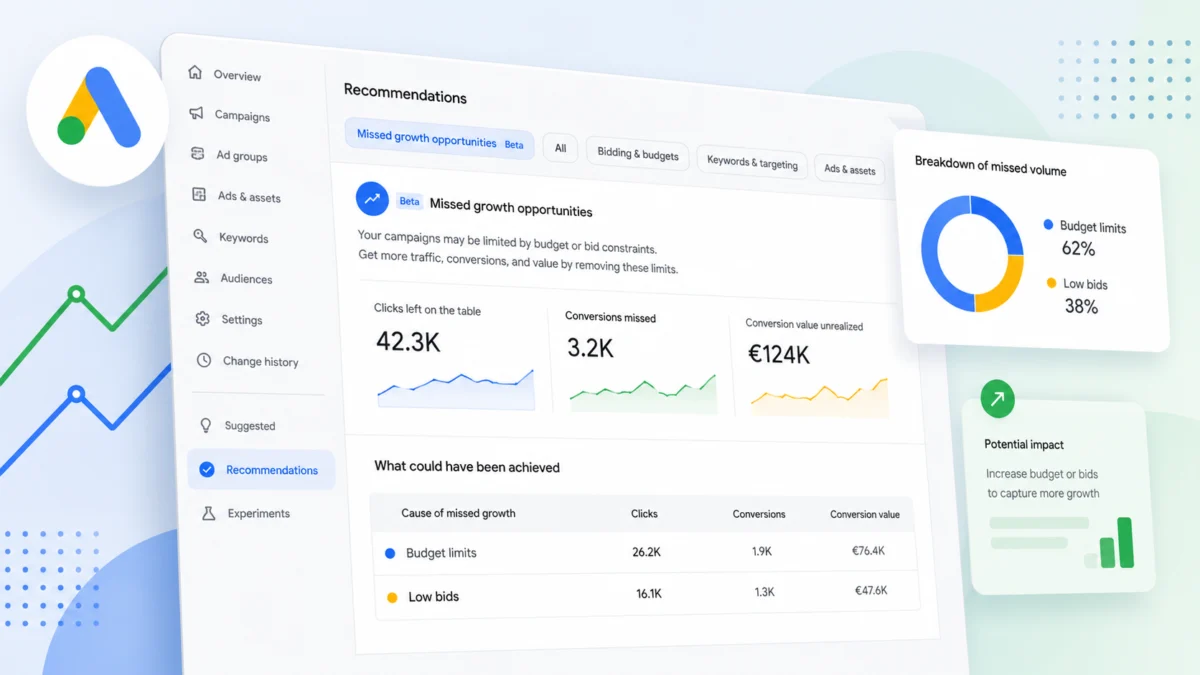
Google Ads is rolling out a significant update, integrating its "Missed Growth Opportunity" insights directly into the main Recommendations tab as a new beta feature. This strategic move aims to provide advertisers with a more transparent and actionable view of the potential traffic, conversions, and revenue they might be foregoing due to limitations in their budget allocation or current bid strategies. By surfacing these critical estimates alongside Google’s established optimization recommendations, the platform is taking a proactive step towards empowering advertisers with more granular data to inform their decision-making processes.
The Evolution of Google Ads Recommendations: A Historical Perspective
The concept of providing advertisers with performance recommendations is not new to Google Ads, formerly known as Google AdWords. Since its inception, Google has consistently sought to guide advertisers toward maximizing their campaign efficiency and, inherently, their ad spend on the platform. Early iterations of the system offered basic suggestions, such as keyword additions or negative keyword exclusions. However, as the digital advertising landscape grew in complexity, so did Google’s recommendation engine.
The introduction of the "Optimization Score" several years ago marked a significant milestone in this evolution. This score, a percentage estimate of how well an account is set up to perform, aggregates various recommendations and assigns a value to each, allowing advertisers to prioritize actions that could yield the greatest improvement. Recommendations range from adjusting bids and budgets to implementing new ad formats, improving ad strength, or leveraging automated strategies. The underlying philosophy has always been to simplify campaign management and unlock additional value for advertisers, often by suggesting adjustments that align with Google’s own business objectives of increasing ad revenue.
The "Missed Growth Opportunity" insights, previously confined to the experimental environment of Google Ads Labs, represent a more sophisticated layer of this recommendation framework. They move beyond general best practices to provide quantified projections of lost potential, directly linking specific constraints (budget, bids) to tangible business outcomes (traffic, conversions, revenue). This shift underscores Google’s commitment to leveraging its vast data processing capabilities and machine learning algorithms to offer highly personalized and impactful advice.
Chronology and Development: From Labs to Mainstream
The journey of the "Missed Growth Opportunity" insights began within Google Ads Labs, a dedicated space where Google pilots experimental features and gathers feedback from a select group of advertisers. This incubation period is crucial for refining new tools, testing their accuracy, and understanding their utility in real-world scenarios before a broader release. While the exact launch date within Labs is not widely publicized, it is understood to have been available to eligible participants for a period, allowing Google to iterate on the underlying models and user interface.
The transition from Google Ads Labs to the main Recommendations tab signifies a maturation of the feature. Moving it out of an experimental sandbox and into a prominent, easily accessible section of the platform indicates that Google has gained sufficient confidence in its stability and value proposition. This integration is currently being rolled out as a beta, meaning it will gradually become available to a wider pool of advertisers, allowing for continued real-world testing and feedback before a potential full-scale global deployment. This phased approach is typical for major Google Ads updates, ensuring a smooth transition and addressing any unforeseen issues.
The timing of this integration also aligns with a broader industry trend towards more proactive and predictive analytics in marketing. Advertisers are increasingly demanding tools that not only report past performance but also forecast future potential and guide strategic decisions. Google’s move positions its platform at the forefront of this trend, providing a competitive edge in an increasingly crowded ad tech market.
Detailed Breakdown of the New Feature and Its Mechanics

The newly integrated beta recommendation provides advertisers with a clear, estimated potential impact of increasing campaign budgets or raising bids. This feature is designed to highlight specific areas where current settings are acting as limiting factors, preventing campaigns from capturing additional market share or optimizing for higher performance.
Key aspects of the feature include:
- Estimated Missed Traffic: Projections of additional website visitors that could have been driven had budget or bid constraints been eased.
- Estimated Missed Conversions: An assessment of the extra conversions (e.g., sales, leads, sign-ups) that could have been achieved.
- Estimated Missed Revenue: A quantified figure representing the potential revenue increase from these additional conversions, assuming accurate conversion value tracking.
These insights are displayed directly within the Recommendations tab, providing a centralized location for all optimization suggestions. Crucially, the system differentiates between unrealized results caused by insufficient budgets versus those stemming from low bids. This distinction is vital for advertisers, as it points to different strategic interventions:
- Budget Constraints: Indicate that a campaign is consistently running out of budget before the day ends, causing ads to stop showing and missing out on valuable impressions and clicks. The recommendation would suggest increasing the daily or monthly budget.
- Bid Constraints: Suggest that while the budget might be sufficient, the current bids are too low to win enough auctions for valuable keywords or placements, leading to lower ad rank and missed impression share. The recommendation would advise raising bids, potentially for specific keywords or ad groups.
The underlying mechanism for these estimates relies heavily on Google’s advanced machine learning algorithms. These algorithms analyze a vast array of data points, including:
- Historical Performance Data: Past campaign performance, conversion rates, and revenue generated.
- Auction Insights: Data on impression share, average position, and competitive landscape.
- Search Volume Trends: Real-time and historical search demand for targeted keywords.
- User Behavior Signals: Demographics, interests, and past interactions of potential customers.
- Industry Benchmarks: Performance data from similar advertisers within the same sector.
By synthesizing these complex data sets, Google’s models can project what could have happened under different budget and bid scenarios. For instance, if a campaign consistently hits its daily budget by noon, the system can estimate the volume of searches and potential conversions missed in the latter half of the day. Similarly, if a keyword frequently loses out to competitors due to low bids, the model can predict the incremental traffic and conversions achievable with a higher bid.
Supporting Data and the Broader Industry Context
Google’s dominance in the digital advertising ecosystem lends significant weight to such features. According to various industry reports, Google continues to command a substantial share of the global digital ad market, with its search advertising revenue consistently strong, often exceeding $200 billion annually. This market leadership means that Google possesses an unparalleled wealth of data on user intent, search behavior, and advertising performance across virtually every industry. This extensive data pool is the foundation upon which the accuracy and relevance of features like "Missed Growth Opportunity" are built.
Advertisers, regardless of their size, frequently grapple with the challenges of optimal budget allocation and bid management. In competitive markets, even slight miscalculations can lead to significant missed opportunities or inefficient spend. Surveys of digital marketers consistently highlight budget optimization and maximizing ROI as top priorities and persistent pain points. The sheer volume of variables in a Google Ads campaign—keywords, ad copy, targeting, bidding strategies, ad extensions, landing page experience—can be overwhelming. Tools that simplify this complexity and provide clear, data-driven recommendations are therefore highly sought after.
The integration of these insights also aligns with the broader industry trend of increasing automation and the application of artificial intelligence (AI) and machine learning (ML) in ad technology. From smart bidding strategies that automatically adjust bids in real-time to dynamic creative optimization, AI is transforming how digital advertising campaigns are managed. The "Missed Growth Opportunity" feature can be seen as another step in this direction, providing intelligent insights that help advertisers bridge the gap between their current performance and their full potential. It enables a more proactive, predictive approach to campaign management, moving beyond reactive adjustments based on past data.
Inferred Statements and Expert Reactions
While Google has not released extensive official statements beyond the initial beta announcement, one can infer the company’s rationale. A Google spokesperson would likely emphasize the company’s commitment to providing advertisers with transparent, actionable insights that empower them to make more informed decisions and maximize their return on ad spend. The goal, from Google’s perspective, is to foster advertiser success by illuminating previously hidden opportunities for growth, thereby encouraging more effective use of the platform and, implicitly, increased investment.

From the perspective of advertisers and industry experts, the reception is likely to be a mix of cautious optimism and practical scrutiny. Many advertisers will undoubtedly welcome this increased visibility into potential missed opportunities. The ability to quantify the impact of budget and bid constraints in terms of traffic, conversions, and revenue provides a powerful argument for securing additional marketing funds or reallocating existing budgets more effectively. It can serve as a valuable tool for justifying spend to stakeholders and demonstrating the direct correlation between investment and potential growth.
PPC expert Thomas Eccel was among the first to spot and report this update, noting that the feature is essentially a rebranded and integrated version of the former "Missed Growth Opportunity" tool from Google Ads Labs. This observation is crucial as it confirms the maturity of the feature and its progression from an experimental stage. Eccel’s insight highlights the continuity of Google’s efforts to bring useful tools from its testing grounds to a broader audience, albeit sometimes under a new guise.
However, experienced PPC managers will approach these estimates with a degree of caution. While Google’s models are sophisticated, they are still, as the original article notes, "modeled estimates—not guarantees." Advertisers understand that real-world performance can be influenced by numerous external factors not fully captured by an algorithm, such as competitor actions, market seasonality, macroeconomic shifts, and broader consumer sentiment. Therefore, these insights are likely to be treated as directional guidance, requiring validation against an advertiser’s own internal performance data, business objectives, and overall marketing strategy.
Analysis of Implications and Broader Impact
The integration of "Missed Growth Opportunity" insights carries significant implications for various stakeholders within the digital advertising ecosystem.
For Advertisers:
- Enhanced Visibility and Strategic Planning: The most immediate benefit is the enhanced visibility into untapped potential. Advertisers can now more easily identify campaigns that are "leaving money on the table" and prioritize where additional investment could yield the greatest returns. This facilitates more strategic budget planning and resource allocation.
- Improved Budget Justification: Quantified projections of missed revenue provide powerful data points for marketers to present to finance departments or senior management when advocating for increased ad spend.
- Risk of Over-Reliance: A potential drawback is the risk of advertisers becoming overly reliant on automated recommendations without applying critical human judgment. While these insights are valuable, blindly following them without understanding the underlying business context or validating the projections could lead to suboptimal outcomes or inflated ad spend.
- Competitive Pressure: If many advertisers act on these recommendations simultaneously, it could lead to increased competition and higher Cost-Per-Click (CPC) in certain niches, potentially diminishing the individual return for some.
For Google:
- Increased Ad Spend: By clearly illustrating missed opportunities, Google effectively encourages advertisers to increase their budgets and bids, directly contributing to its ad revenue. This is a core business objective for the company.
- Enhanced Platform Value: Providing such sophisticated insights reinforces Google Ads’ position as an indispensable tool for digital marketers, increasing advertiser loyalty and attracting new users.
- Data-Driven Leadership: The feature demonstrates Google’s continued leadership in leveraging AI and ML for actionable advertising intelligence, setting a higher standard for competitor platforms.
For the Digital Advertising Ecosystem:
- Raising the Bar for Ad Management: The availability of these insights may compel advertisers to adopt more data-driven and analytical approaches to campaign management. Marketers who fail to interpret and act judiciously on such recommendations might find themselves at a disadvantage.
- Shift in Agency-Client Dynamics: Advertising agencies can leverage these insights to demonstrate value to clients, identifying growth opportunities and justifying strategic adjustments. However, it also requires agencies to develop deeper analytical skills to interpret Google’s models and integrate them with broader client strategies.
- Ethical Considerations: The power of such recommendations also raises ethical considerations regarding the balance between guiding advertisers and potentially encouraging excessive spending. Transparency about the modeling methodology will be crucial for maintaining trust.
Best Practices for Advertisers in Leveraging New Insights
To effectively utilize the "Missed Growth Opportunity" insights, advertisers should adopt a disciplined approach:
- Treat as Directional Insights: Recognize that these are estimates based on models. They provide a strong indication but are not infallible predictions.
- Cross-Reference with Internal Data: Always validate Google’s recommendations against your own conversion data, profit margins, customer lifetime value (CLTV), and overall business objectives. A conversion might be financially viable for Google, but not necessarily for your specific business model.
- A/B Test Changes: When considering significant budget or bid increases based on these recommendations, implement them as controlled experiments. Start with a smaller increase or test in a specific campaign segment to observe the actual impact before rolling out widely.
- Maintain Human Oversight: While automation is powerful, human strategic thinking remains irreplaceable. Understand why Google is making a recommendation and how it aligns with your broader marketing strategy and budget constraints.
- Consider the Broader Marketing Funnel: Remember that Google Ads is one component of a larger marketing ecosystem. Evaluate how increasing spend in Google Ads might impact other channels or overall customer acquisition costs.
- Monitor Performance Closely: After implementing changes, rigorously monitor key performance indicators (KPIs) to ensure the actual results align with or exceed the estimated growth. Be prepared to adjust quickly if performance deviates.
In conclusion, Google Ads’ integration of "Missed Growth Opportunity" insights into its main Recommendations tab represents a significant advancement in empowering advertisers with actionable data. By quantifying the potential impact of budget and bid constraints on traffic, conversions, and revenue, Google is providing a powerful tool for identifying untapped growth. While these modeled estimates offer invaluable directional guidance, their effective utilization hinges on advertisers combining Google’s sophisticated analytics with their own critical judgment, business acumen, and a rigorous approach to validation and testing. The success of this feature will ultimately be measured by its ability to consistently deliver real, verifiable growth for advertisers, further solidifying Google Ads’ role as a cornerstone of digital marketing strategy.