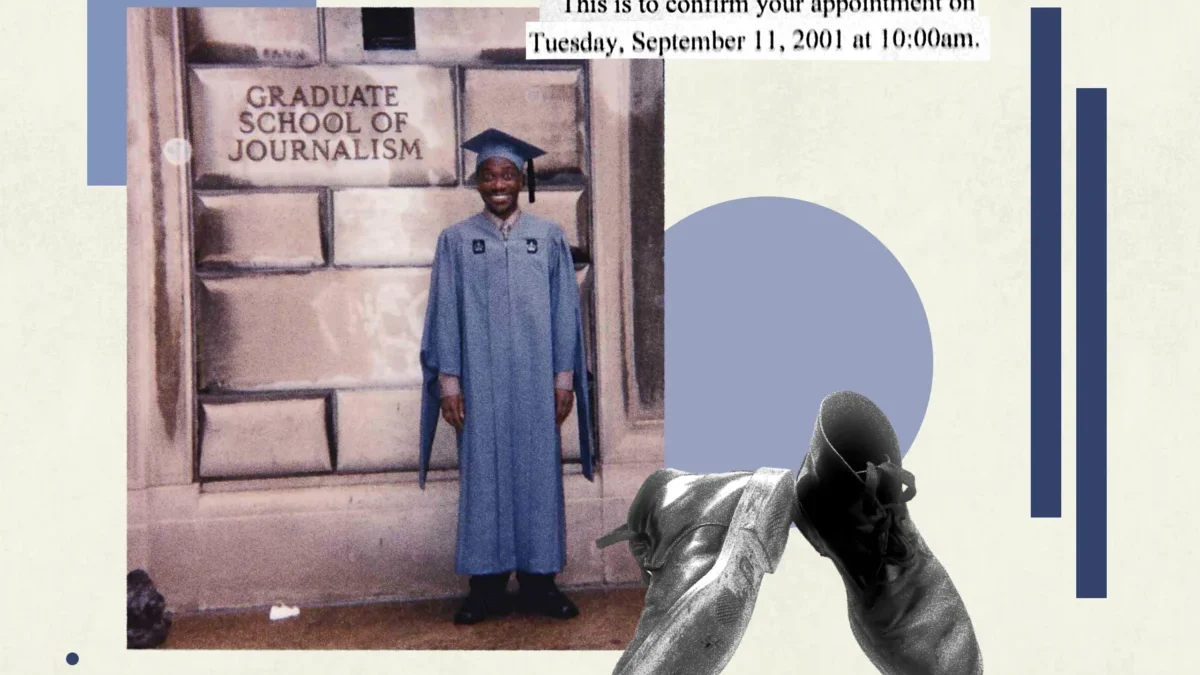
Twenty-five years after the morning of September 11, 2001, physical relics of that fateful Tuesday remain preserved in closets and storage boxes across the United States. For Nicholas Boston, a media studies professor and graduate of the Columbia Journalism School Class of 1999, those physical memories are held in a pair of black chukka boots stored in a plastic bag, their soles permanently dusted with the ash of the collapsed World Trade Center towers.
The terrorist attacks of September 11, orchestrated by the militant group al-Qaeda, forever altered the geopolitical trajectory of the United States. Four commercial airliners were hijacked, resulting in the coordinated destruction of the twin towers of the World Trade Center in New York City, structural damage to the Pentagon in Arlington, Virginia, and a thwarted strike that ended in a crash in a field in Somerset County, Pennsylvania. The attacks claimed the lives of 2,977 victims, excluding the 19 hijackers, and injured more than 6,000 others. Beyond the immediate loss of life, the tragedy triggered profound systemic shifts across the American media industry, transforming how news is gathered, reported, and consumed in the twenty-first century.
The Chronology of a Shattered Morning
On September 11, 2001, the rhythms of normal life in New York City abruptly dissolved. Boston, who had recently left a position at a financial journalism website located near Wall Street, was en route to a 10:00 a.m. job interview for an entry-level reporter position at an office building on Madison Avenue in Midtown Manhattan.
The confirmation letter for the interview, preserved alongside his boots, outlined rigorous expectations for prospective journalists: candidates were told to expect an assignment of six to ten stories per week, with a heavy emphasis on self-generated reporting. However, the events of the morning superseded all professional preparations.
At 8:46 a.m., American Airlines Flight 11 struck the North Tower of the World Trade Center. At 9:03 a.m., United Airlines Flight 175 struck the South Tower. As Boston traveled southward on the subway system, transit announcements increasingly truncated routes, halting service further and further away from the Financial District as a collective sense of foreboding gripped commuters.
Upon arriving at the Madison Avenue office, the receptionist informed him that a plane had crashed into the Pentagon—site of American Airlines Flight 77’s impact at 9:37 a.m. Shunted into a windowless conference room to await the deputy editor, Boston and the newsroom staff watched live broadcasts as the South Tower collapsed at 9:59 a.m., followed by the North Tower at 10:28 a.m.
The interview was immediately abandoned. Rather than returning home, Boston walked southward toward Ground Zero alongside a fellow Columbia Journalism School alumnus who was working as a local newspaper reporter.
Lower Manhattan Under Siege: A Landscape of Devastation
The journey toward the epicenter of the disaster revealed a cityscape coated in pale-gray, pulverized concrete and debris. Traversing Lower Manhattan, the two journalists encountered impromptu rescue efforts organized by civilians. Near City Hall, ordinary citizens dressed in business attire loaded makeshift wooden stretchers onto flatbed trucks to ferry supplies and casualties toward the disaster zone.
At approximately 5:20 p.m., the 37-story 7 World Trade Center collapsed, a structural failure precipitated by fires fueled by debris from the North Tower. The ensuing shockwaves and structural instability prompted law enforcement to establish rigid security perimeters. By 7:00 p.m., as the reporters reached Canal Street, permanent barricades were erected, restricting unauthorized entry to Lower Manhattan for months.
Attempting to find a semblance of normalcy, Boston steered toward a favorite magazine store near Broadway and Broome Street, only to find it shuttered. In retrospect, the closed storefront served as an early economic indicator of the accelerating financial pressures confronting the print media industry at the turn of the millennium.
The State of the Media Industry in 2001
The Class of 1999 from Columbia Journalism School entered an employment market characterized by intense volatility. The traditional career pipeline—wherein graduates began their work in smaller regional and local markets before ascending to major metropolitan publications in New York—was rapidly fracturing.
Instead, the tail end of the dot-com boom had drawn many newly minted journalists toward digital enterprises in Manhattan’s burgeoning "Silicon Alley." Boston had recently departed a financial news portal situated in the Trinity Building, a short walk from the World Trade Center, only to experience a layoff when the initial Web 1.0 bubble burst.
The events of September 11 compounded these economic fractures. Across the media landscape, publishing houses and newsrooms instituted immediate hiring freezes. The position Boston had interviewed for on Madison Avenue was never rescheduled.
Faced with a contracting journalism job market, Boston pivoted to the non-profit sector, accepting a role as communications director for an environmental justice organization that would become one of the first to analyze the toxic environmental and occupational health hazards generated by the collapse of the World Trade Center. Subsequent stints at the New York Observer and Condé Nast eventually led him back to academia, where he pursued doctoral studies at the University of Cambridge examining digital media aspirations.
Broader Economic and Professional Implications
The structural shocks of 9/11 reverberated far beyond the immediate devastation of Lower Manhattan, leaving a permanent imprint on the business models and operational practices of the American news media.
Economically, the attacks coincided with a broader advertising downturn. Major news organizations experienced a sudden collapse in corporate ad revenue just as expenses surged due to the round-the-clock deployment of reporters to domestic security beats, Washington, D.C., and international conflict zones in Afghanistan and Iraq. Print publications, already vulnerable to the early migrations of readers toward free digital content, absorbed a financial blow from which many regional outlets never fully recovered.
Journalistically, the tragedy accelerated the shift toward 24-hour cable news dominance and rapid-fire online updates. The imperative to cover a sprawling, multifaceted national security crisis redefined the daily workflow of reporters, establishing a precedent for continuous, real-time crisis reporting that would characterize the social media era. Furthermore, government transparency and press access experienced a paradigm shift; the creation of the Department of Homeland Security and the implementation of sweeping intelligence legislation introduced new bureaucratic hurdles to information-gathering that persist today.
Pedagogy and the Generational Shift in Media Studies
Now a tenured professor of media studies at the City University of New York’s Lehman College, Boston incorporates the historical analysis of post-9/11 press discourse into his curriculum. Over more than a decade of teaching, he has observed a distinct generational shift in how students perceive the events of that day.
In the decade and a half immediately following the attacks, university classrooms were populated by students who could vividly recall personal trauma, community displacement, or the loss of loved ones. Discourse during those years was often emotionally charged and deeply personal.
As the years have progressed, however, that visceral connection has waned. Contemporary cohorts of college students, born after the turn of the millennium, approach the subject through the lens of historical analysis rather than living memory. For these students, September 11 occupies a place in the historical continuum alongside other foundational national crises, prompting staid academic contemplation rather than immediate grief.
Ultimately, the quarter-century elapsed since 2001 has transformed September 11 from a breaking news event into a foundational epoch of modern American history. For the journalism profession, it remains a stark reminder of the fragile intersection between historic crises, economic survival, and the enduring obligation to document the truth amidst the ash.