Understanding digital marketing performance has long depended on precise data capture, and in modern analytics, UTM parameters remain a foundational tool for attributing website traffic. Originally introduced through Urchin Software Corporation’s web analytics platform in the early 2000s, Urchin Tracking Module (UTM) codes continue to function as the bedrock for modern campaign measurement. Today, digital marketers leverage these text strings to track user journeys across diverse ecosystems, ranging from organic social media posts and paid advertising campaigns to newsletters and QR codes.
Without UTM tagging, digital attribution often collapses into ambiguity. When a brand shares identical URLs across Instagram Stories, LinkedIn updates, and email newsletters, untagged traffic typically coalesces into generic referral buckets or registers as direct traffic within platforms like Google Analytics 4 (GA4). Implementing proper link tagging resolves this opacity, allowing marketing professionals to isolate specific channels, measure precise ROI, and optimize resource allocation based on verified user behavior.

Evolution and Historical Context of URL Tagging
The origins of UTM parameters trace back to April 2005, when Google acquired Urchin Software Corporation, a San Diego-based tech company specializing in web statistics analysis. Google subsequently relaunched the technology as Google Analytics, democratizing enterprise-grade tracking for website owners worldwide. While the underlying software architecture evolved significantly over the decades—culminating in the modern event-based tracking model of Google Analytics 4—the basic mechanism of appending query parameters to URLs remained constant.
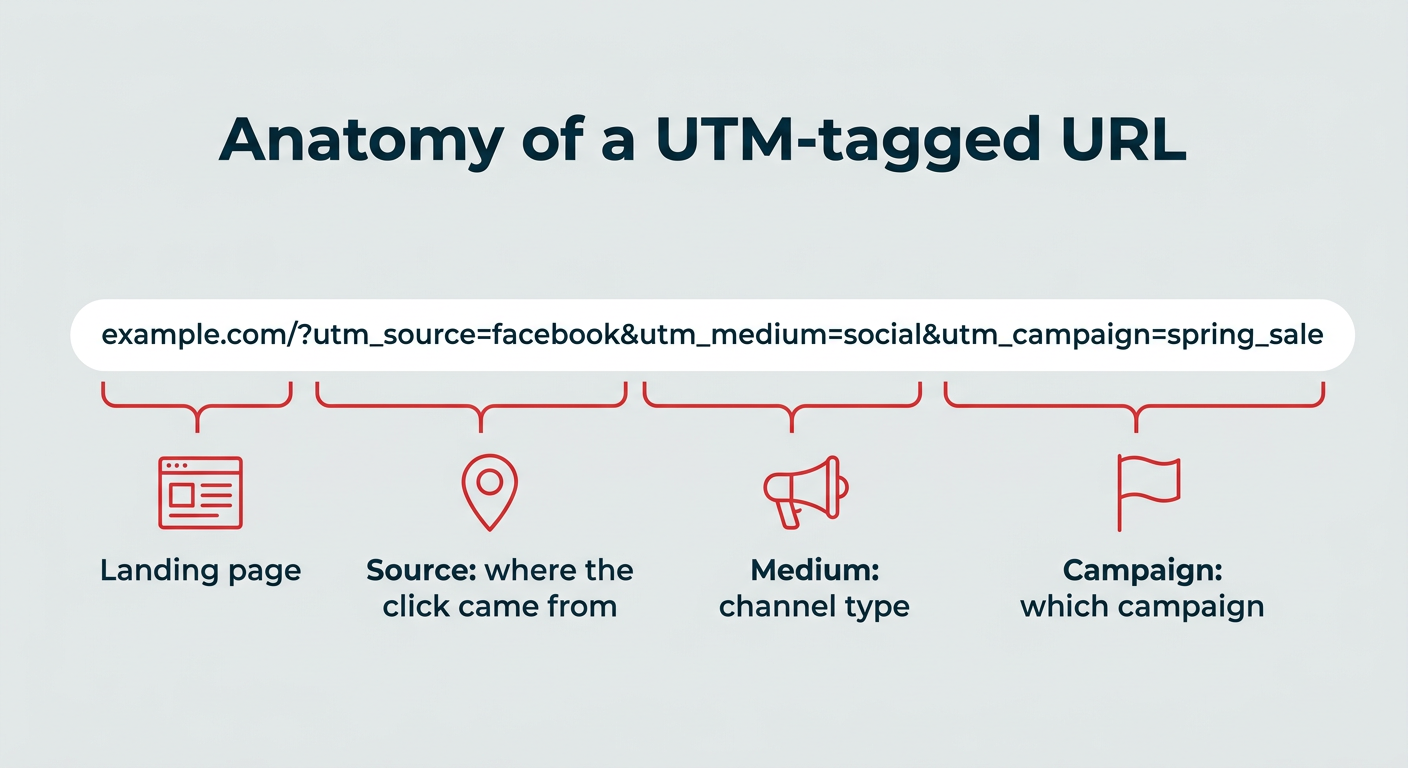
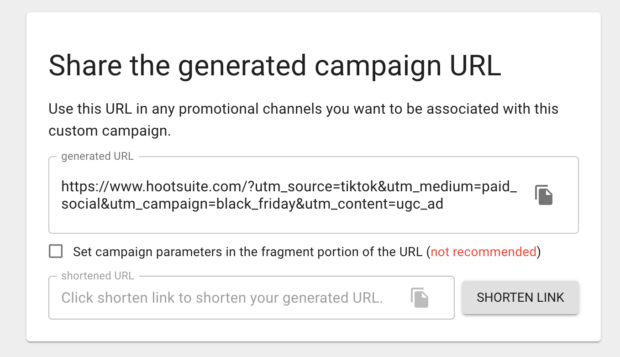
An Urchin Tracking Module code functions as a harmless string of text attached to the end of a destination URL. Adding these parameters does not alter the landing page experience for the end user; visitors still arrive at the intended destination. However, the appended tags communicate specific metadata back to analytics suites upon execution. For example, a properly formatted URL incorporating UTM parameters appears as follows:
www.example.com/?utm_source=facebook&utm_medium=social&utm_campaign=spring_sale

In this structural anatomy, the question mark acts as a separator between the base URL and the query parameters, while the ampersand links individual parameters together. This simple yet robust logic allows platforms like Hootsuite and GA4 to ingest granular data regarding visitor origins.
Core Architecture: The Five Standard UTM Parameters
To maintain structural integrity and data cleanliness, digital marketing frameworks rely on five standard UTM parameters. Three of these parameters are strictly required by most analytics configurations to establish baseline attribution, while two serve as optional modifiers for granular segmentation.
1. utm_source (Required)
The source parameter identifies the specific origin of the traffic. It answers the fundamental question of which platform, website, or partner entity directed the user to the destination link. Examples include values like instagram, newsletter, or partner_site. Maintaining strict lowercase naming conventions prevents analytical fragmentation, as tools like GA4 treat uppercase and lowercase strings as entirely distinct entities.
2. utm_medium (Required)
The medium parameter designates the overarching channel category through which the traffic arrived. While the source identifies the specific platform, the medium defines the general communication type. Standardized values include social for social media traffic, email for direct messaging, cpc for cost-per-click advertising, and referral for inbound links from external websites. Grouping traffic by medium enables high-level comparisons across broader marketing channels.
3. utm_campaign (Required)
The campaign parameter names the specific marketing initiative, product launch, or promotional push associated with the link. By assigning a uniform campaign identifier—such as summer_sale_2026—across diverse platforms, marketing teams can aggregate performance data for multi-channel efforts. This parameter facilitates holistic analysis, allowing analysts to evaluate the collective performance of an overarching strategy rather than viewing individual posts in isolation.
4. utm_term (Optional)
Initially engineered to track paid search keywords, the term parameter now serves a dual purpose. While still deployed for keyword tracking in search engine marketing, contemporary media buyers frequently utilize utm_term to denote specific audience segments, demographic targets, or product sub-categories within ad sets.
5. utm_content (Optional)
The content parameter isolates the exact creative element or user-interface component that prompted the click. This variable proves indispensable during A/B testing cycles. When deploying two distinct ad variations pointing to the same landing page, assigning unique values like video_ad_blue_btn versus static_image_red_btn enables precise evaluation of creative performance.
Comparative Analysis: UTM Parameters versus Google Tag Manager
A frequent point of confusion among emerging digital marketers involves distinguishing between UTM parameters and Google Tag Manager (GTM). While both systems operate within the broader discipline of digital analytics, they solve fundamentally different problems and occupy entirely separate operational domains.
UTM parameters function as a URL tagging system. They live explicitly within the links shared across external channels and communicate the origin and context of an incoming user click to analytics tools. Conversely, Google Tag Manager is a tag management system that lives entirely within the infrastructure of a website. GTM deploys, updates, and manages third-party tracking scripts, pixels, and conversion snippets without requiring developers to repeatedly edit raw site code.
To summarize the operational dichotomy: UTMs label traffic arriving at a digital property, whereas GTM records the on-site events—such as form submissions, button clicks, scroll depth, and e-commerce transactions—that occur after the visitor arrives. Industry standard practices dictate the concurrent deployment of both systems for comprehensive attribution modeling.
Methodologies for Generating and Managing UTM Links
Creating tracking links manually by appending text strings directly to URLs invites human error. Typographical mistakes, missing question marks, or accidental spaces can easily compromise data integrity. Consequently, marketing operations teams rely on structured generation tools and standardized internal workflows.
Automated Generation via Social Media Management Platforms
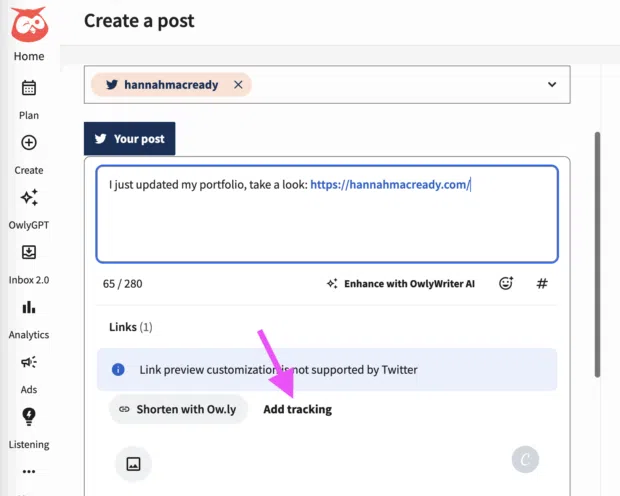
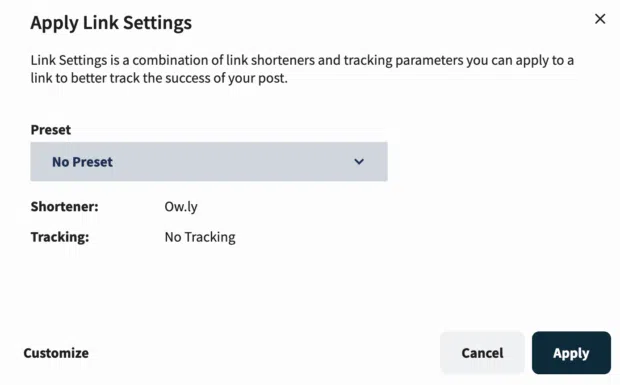
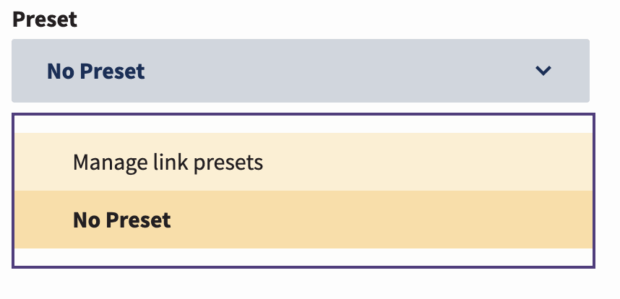
Enterprise tools such as Hootsuite Social OS streamline the UTM creation process by integrating link builders directly into content composition workflows. When scheduling posts, marketers can utilize built-in tracking features to apply predefined UTM presets. This automation ensures that entire social media teams adhere to strict naming conventions without manual data entry. Furthermore, native link shorteners—such as ow.ly or custom vanity domains—transform lengthy, parameter-heavy URLs into clean, user-friendly links suitable for public distribution.
Dedicated URL Builders
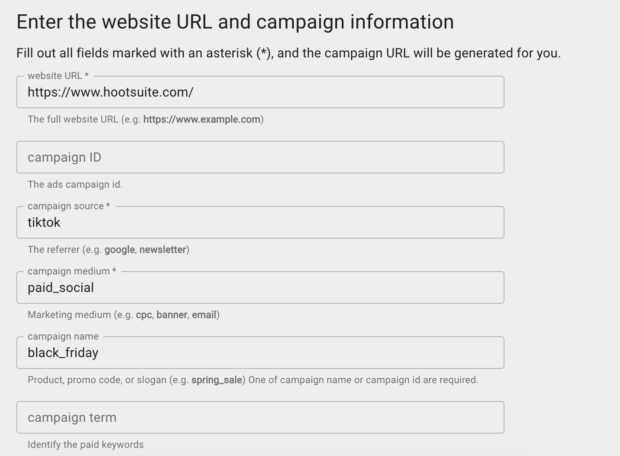
For external campaigns distributed via email, QR codes, or third-party partnerships, tools like the Google Campaign URL Builder provide a standardized interface. Users input the destination website along with designated source, medium, and campaign fields to automatically generate error-free tracking URLs.
Establishing a centralized campaign log via spreadsheet software—paired with automated visualization layers like Google Looker Studio—prevents organizational drift. A master UTM repository ensures that past, present, and future campaigns maintain uniform naming structures, shielding analytics reports from fragmentation.
Analytical Application within Google Analytics 4
Once tagged links circulate across digital channels, marketing teams must navigate analytics environments to interpret the incoming data streams. Google Analytics 4 serves as the primary repository for processing UTM performance metrics.
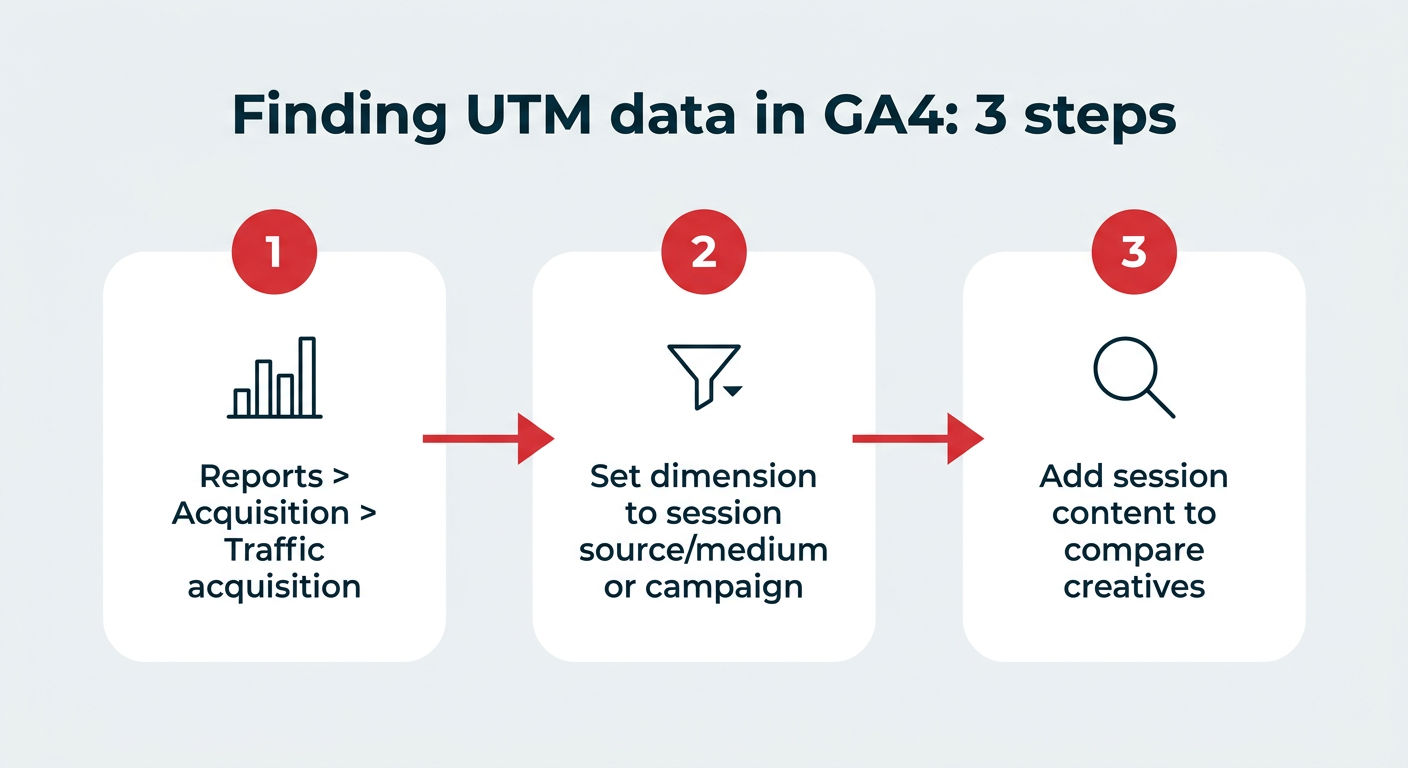
Within the GA4 interface, foundational traffic attribution data resides under the Reports > Acquisition > Traffic acquisition menu. Analysts can adjust the primary dimension dropdown to evaluate sessions by Session source, Session medium, or Session campaign name. This view provides immediate insight into which platforms and promotional pushes generate the highest volume of user engagement.
For advanced analysis, GA4’s Explore workspace enables the creation of custom free-form reports. By importing dimensions such as Session campaign and Session manual ad content, analysts can perform granular evaluations of specific creative variations and audience segments.
Data retention settings require careful administrative oversight within GA4 configurations. By default, user-level and event-level data retention is restricted to two months. Organizations must navigate to Admin > Data Settings > Data Retention and extend this window to 14 months to facilitate year-over-year campaign performance comparisons.
Strategic Best Practices and Industry Standards
Maintaining a pristine analytics environment requires strict adherence to operational governance. Industry leaders emphasize several critical practices to safeguard data quality:
- Enforce Uniform Lowercase Conventions: Because query parameters are strictly case-sensitive, variations like "Facebook" and "facebook" register as separate sources in reporting dashboards. Standardizing lowercase entries prevents data bifurcation.
- Maintain Self-Explanatory Naming Structures: Campaign names should be intuitively clear to stakeholders across various corporate departments. Descriptive conventions—such as
q3-product-launch-social—eliminate ambiguity during cross-functional reporting reviews. - Implement Rigorous Quality Assurance: Incorporating a mandatory review step before publishing links prevents minor typographical errors from corrupting entire datasets.
- Maintain Centralized Documentation: Utilizing shared master ledgers ensures that historical naming conventions remain accessible to all marketing personnel over time.
Limitations and Privacy Considerations in Modern Attribution
While UTM parameters remain an indispensable asset for digital strategists, practitioners must acknowledge their structural limitations. UTMs operate on a session-based attribution model. If a user visits a site via a tagged social media link, deletes their cookies, and later returns directly to complete a purchase, the initial UTM attribution data may not capture the conversion path accurately.
Furthermore, evolving global data privacy regulations, browser-level tracking preventions, and cookie deprecation initiatives continue to reshape the digital analytics landscape. While UTM codes are fundamentally privacy-compliant—as they do not store personally identifiable information (PII)—broader tracking restrictions underscore the necessity of treating UTM analytics as directional signals rather than absolute accounting metrics.
Despite these structural constraints, implementing a disciplined UTM strategy remains a vital differentiator for organizations seeking to measure return on investment accurately. By bridging the gap between external creative output and internal website analytics, structured URL tagging transforms raw clicks into actionable business intelligence.