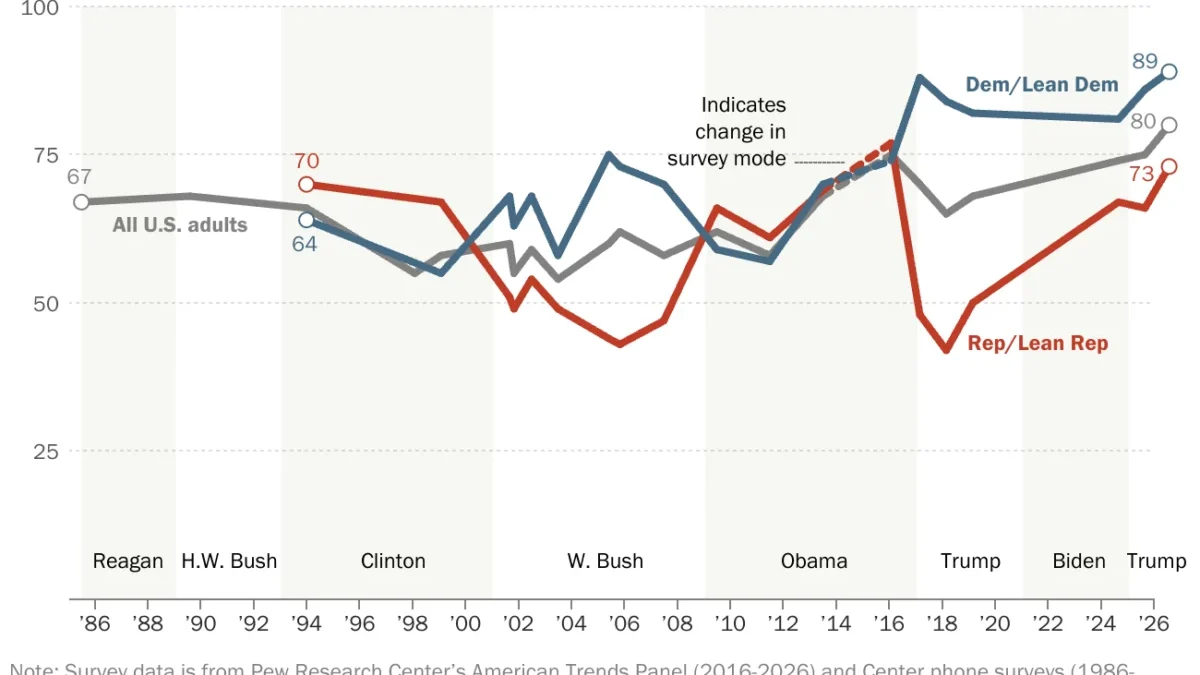
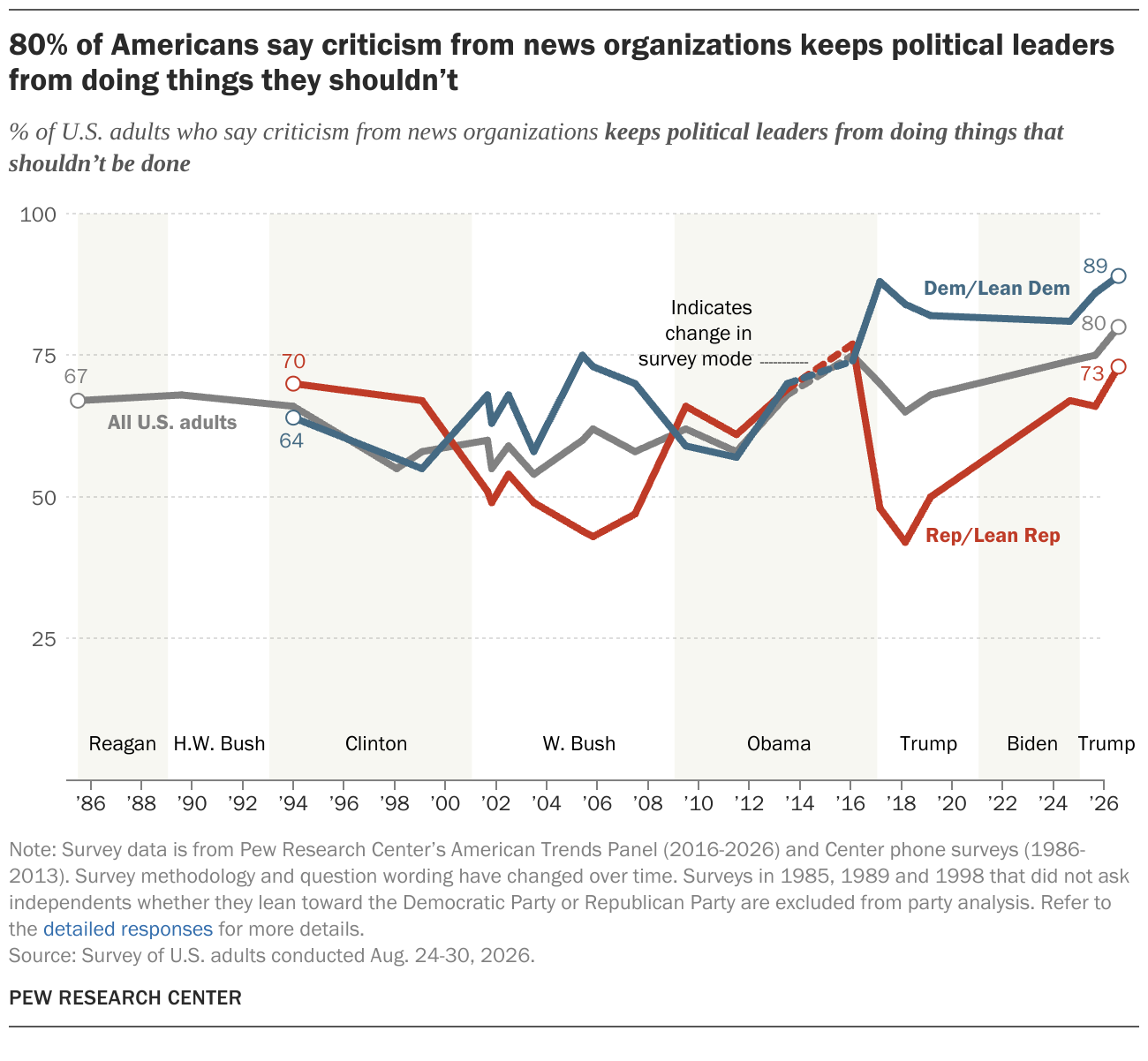
In an era defined by intense political polarization and a shifting landscape of digital discourse, the American public maintains a steadfast belief in the institutional necessity of a critical press. A comprehensive survey conducted by the Pew Research Center in late August 2026 reveals that a supermajority of the U.S. population—80%—believes that news organizations serve a vital function by holding political leaders accountable and preventing government overreach. This figure marks a notable increase from the 75% recorded in September 2025, suggesting a growing public consensus on the role of the "watchdog" press in the national discourse.
The data, derived from the American Trends Panel, highlights a rare moment of alignment across the partisan divide. While the American electorate is often deeply fractured on issues of policy, culture, and governance, 89% of Democrats and Democratic-leaning independents, alongside 73% of Republicans and Republican-leaning voters, now agree that media scrutiny keeps politicians in check. This sentiment persists across various demographics, showing little deviation based on age, education, or political ideology within the major parties.
The Historical Context of the Watchdog Role
The concept of the press as a Fourth Estate—an entity capable of providing a check on the powers of the legislative, executive, and judicial branches—has been a cornerstone of American democratic theory since the founding of the Republic. However, public perception of how well the media fulfills this role has fluctuated significantly over the past four decades.
Data collected by the Pew Research Center since 1985 illustrates a volatile trajectory. In the mid-1980s, roughly 67% of Americans viewed media criticism as a necessary deterrent against corruption or malpractice. By the early 2000s, this number began to oscillate, often mirroring the party affiliation of the sitting president. The historical trend shows that voters frequently express higher levels of confidence in the media’s watchdog capacity when the political party in power is the one they oppose. Conversely, when their own party holds the White House, supporters are more likely to view such criticism with skepticism, occasionally labeling it as obstructionist or biased.
Chronology of Public Sentiment
To understand the current climate, one must look at the shifts in public opinion over the last decade:

- 2016–2017: Amid the political transition of 2016, public sentiment regarding the media’s role saw a brief convergence at 75% in February 2016. By March 2017, the partisan divide widened, with only 48% of Republicans viewing media criticism as beneficial, compared to 88% of Democrats.
- 2018–2019: The divide peaked during this period. In March 2018, only 42% of Republicans credited the media with keeping leaders in check, a stark contrast to the 84% of Democrats who did so.
- 2024: As the country moved through the final year of the Biden administration, 67% of Republicans expressed confidence in the media’s oversight role, while 81% of Democrats held the same view.
- 2025–2026: A surprising reversal occurred. Despite the shift in presidential power to the Republican party, the share of Republicans who view media criticism as a positive check on government rose to 73% in August 2026, while Democratic support climbed to 89%.
This shift is particularly intriguing because it defies the traditional "opposing party" theory. Even under a Republican administration, a growing number of Republican voters are affirming the importance of media scrutiny, a trend that warrants further analysis by political scientists and media analysts.
Breaking Down the Partisan Divergence
The recent data challenges the long-held assumption that trust in the media is strictly tied to partisan loyalty. While the traditional partisan gap has narrowed, the nuances remain significant. The 16% of the public who believe that media criticism does more to hinder leaders from "doing their job" represent a segment of the population that may feel the news cycle is overly adversarial or distracting.
Political analysts note that the rise in the perceived value of the watchdog role may stem from a heightened anxiety regarding government transparency. In an age where misinformation can spread rapidly, the role of established news organizations in vetting facts has arguably become more central to the national psyche. By acting as a filter, traditional media outlets are increasingly seen as the primary defense against the normalization of political misconduct.
A Reversal in Declining Trust
The surge in support for the media’s watchdog role coincides with a broader, albeit subtle, increase in trust toward news organizations. After years of declining confidence—a trend that was particularly acute among Republican voters—the 2026 data indicates a slight rebound. This upward trend in trust is visible across both major political parties.
Whether this is a long-term shift or a temporary response to current events remains to be seen. Media experts argue that the increasing complexity of federal policy, coupled with high-stakes geopolitical tensions, has prompted citizens to seek out reliable sources of information to navigate the political landscape. When citizens feel they cannot rely on official statements alone, the perceived value of independent investigative reporting rises proportionally.
Implications for Governance and Media
The implications of this survey are far-reaching. For political leaders, the message is clear: a large majority of their constituents expect, and indeed demand, that they be held to account. Public officials who view media criticism as an inherent attack on their legitimacy may find themselves at odds with the electorate, which overwhelmingly views such friction as a healthy, necessary component of a functioning democracy.
For the media industry, these results provide a mandate to continue rigorous investigative work. However, the industry also faces the challenge of maintaining this trust. With 16% of the population still concerned that media criticism is a hindrance to effective governance, news organizations must navigate the fine line between investigative accountability and perceived partisanship. The sustainability of this high level of public support will likely depend on the industry’s ability to remain objective and transparent in its own practices.
Methodology and Scope
This analysis is based on the American Trends Panel, a nationally representative survey of 5,166 U.S. adults conducted between August 24 and August 30, 2026. The methodology involved detailed outreach to ensure the sample accurately reflected the diversity of the American population. By utilizing longitudinal data that stretches back to 1986, the Pew Research Center has provided a rare, long-term perspective on how the democratic relationship between the press and the public has evolved.
The researchers note that while the wording of survey questions has occasionally been adjusted to reflect changing technological and social contexts, the core sentiment being measured—the belief in the necessity of a critical, investigative press—has remained a consistent focal point. The survey data is intended to help observers understand not just the current political climate, but the fundamental values that undergird the American political system.
Conclusion
As the United States enters the latter half of the decade, the consensus among the public remains that democracy requires a witness. The 80% of Americans who support the watchdog role of the media are expressing a commitment to the principle that government power should never be absolute. While the specific motivations behind this support may vary between a Democrat in a blue state and a Republican in a red state, the result is the same: a persistent, widespread, and growing demand for accountability in the halls of power.
As trust in media institutions shows signs of recovery, the onus falls on both the media to act as an impartial monitor and on the public to continue engaging with the news critically. The interplay between the two—the press and the people—remains the primary mechanism through which the American public ensures that their leaders are held responsible for their actions. Whether this alignment holds in the face of future political volatility will be a key metric for the health of American democratic institutions in the coming years.