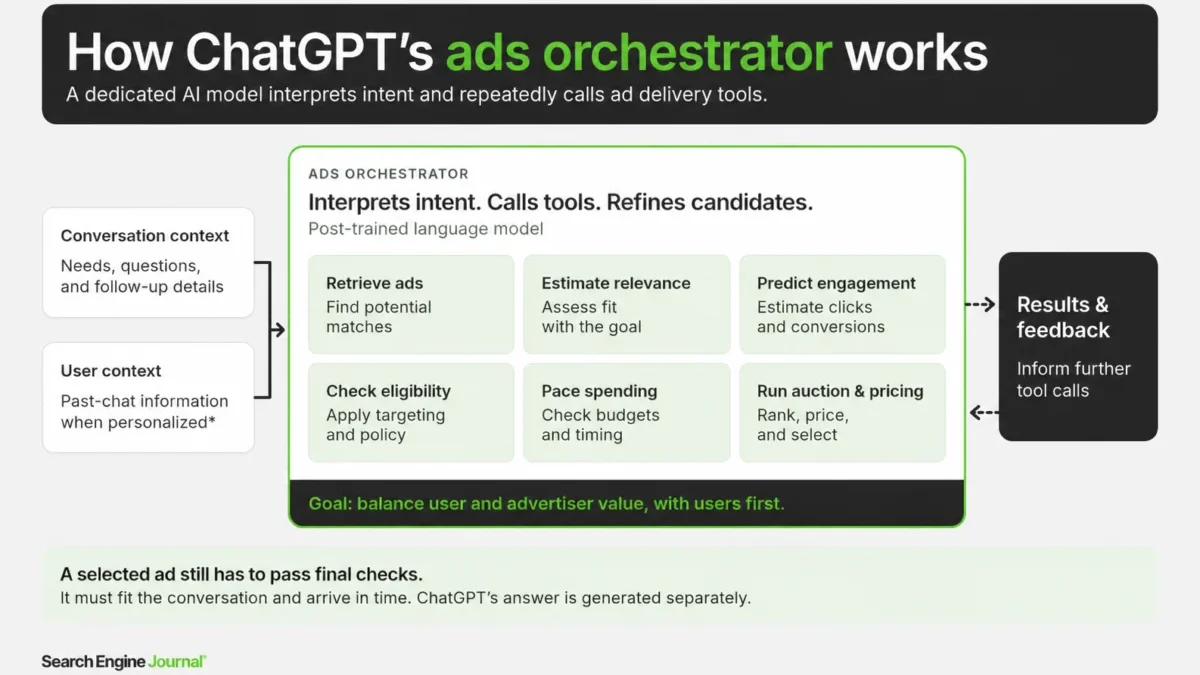
OpenAI has recently pulled back the curtain on the technical architecture powering its ChatGPT advertising platform, providing a granular look at how the company manages the delicate balance between user experience and commercial monetization. The disclosure outlines a sophisticated, multi-layered system designed to deliver contextually relevant advertisements while maintaining a strict firewall between the generative AI model responsible for answering queries and the secondary system responsible for ad selection. This revelation comes at a pivotal time for the company, as it reports that its advertising business has reached a $1 billion annualized revenue run rate in under 200 days since launch, with more than 100,000 advertisers participating in the ecosystem.
A Chronology of Rapid Monetization
The emergence of ChatGPT as an advertising powerhouse represents one of the fastest scaling operations in the history of digital advertising. Since the integration of advertising, OpenAI has moved with calculated speed to transition from a subscription-only model to a hybrid revenue stream. The initial launch phase prioritized stability and user trust, focusing on non-intrusive placements that aligned with the conversational flow.
The trajectory began with limited beta testing aimed at gauging user sentiment toward sponsored content within an AI chat interface. Following positive reception and high engagement metrics, the company scaled the program globally. By crossing the $1 billion annualized revenue threshold in fewer than seven months, OpenAI has signaled to the market that it is a legitimate competitor to established search and social media giants. This rapid adoption, however, has also brought increased scrutiny from advertisers and regulators alike, particularly regarding data privacy and the transparency of ad-targeting mechanisms.
Structural Integrity: Separating Content from Commerce
A central pillar of OpenAI’s technical defense against accusations of bias is the complete architectural separation between the "answer generation" model and the "ad selection" model. According to the technical breakdown provided by the company, these two functions operate on distinct codebases and utilize different model instances.
The logic is designed to prevent a "feedback loop" where the presence of an ad might influence the content of an AI response. When a user enters a query, the generative model begins drafting a reply. Simultaneously, a separate module—referred to by OpenAI as the "orchestrator"—analyzes the conversation’s context. This orchestrator functions independently, meaning that even if the ad selection process encounters latency or technical failure, the primary generative response remains unaffected and continues to populate in the chat interface. If an advertisement is not selected or rendered within the specific millisecond window required to appear alongside the text, it is simply discarded. This "fail-safe" ensures that the speed and quality of user information are never compromised by the monetization layer.
The Role of the Orchestrator and Stateful Context
The intelligence of the ad system lies in the "orchestrator," which acts as the intermediary between the user’s conversation and the auction house. Unlike traditional keyword-based advertising, which often relies on a single isolated search term, OpenAI’s system is "stateful." It retains the context of the conversation as it evolves, allowing it to move beyond the user’s most recent message.
For instance, if a user initiates a broad inquiry about productivity software and later pivots to a specific question about guest billing policies, the orchestrator recognizes the accumulated intent. It maps these requirements into "embeddings"—numerical representations of meaning—which allow the system to identify relevant ads that do not necessarily share the exact keywords used by the user. By evaluating both the surface-level query and the deeper, implicit needs of the user, the system aims to serve ads that feel like helpful extensions of the conversation rather than intrusive interruptions.
The Anatomy of an Auction: From Selection to Impression
The journey of an advertisement within the ChatGPT ecosystem is a rigorous process that involves multiple stages of vetting. Once the orchestrator identifies potential candidate ads, it subjects them to a series of eligibility filters. These include standard criteria such as geographic targeting, policy compliance, and the advertiser’s remaining campaign budget.
Once an ad passes the eligibility phase, it moves to the auction. It is crucial to note that the language model does not personally "pick" the winner; rather, it provides the signals that inform the auction mechanism. The auction tool handles the final ranking, pricing, and ultimate selection based on a combination of relevance scores and predicted performance metrics—such as the probability of a user click or a downstream conversion.
Even after an ad wins an auction, it is not guaranteed an impression. OpenAI employs a final "safety and appropriateness" check. The system assesses whether the ad remains relevant to the specific tone and content of the final conversation thread. If an ad is deemed potentially jarring or contextually misaligned, the system can block it even after it has secured the winning bid. This creates a challenging environment for advertisers, who may find their ads winning auctions but failing to achieve impressions due to these secondary contextual filters.
Transparency and the Advertiser’s Dilemma
While the technical clarity provided by OpenAI is a significant step forward, it leaves several critical questions unanswered for the marketing community. The current reporting infrastructure, as described, provides data on the outcomes of these stages—such as whether an ad failed an eligibility check or lost out in the auction. However, the extent to which this data is exposed to the advertiser remains unclear.
For the 100,000+ advertisers currently utilizing the platform, the primary challenge is attribution. While OpenAI has reported high revenue growth, it has yet to publish performance benchmarks or controlled studies regarding Return on Ad Spend (ROAS) or Customer Acquisition Cost (CAC). Without this data, advertisers are forced to operate on a trial-and-error basis. The lack of clarity regarding how much of the "success" of an ad is due to the platform’s targeting versus organic user interest remains a point of contention.
Furthermore, the "revenue run rate" reported by the company is a projection, not an audited collection. It reflects the momentum of the platform but does not necessarily translate to universal advertiser profitability. Analysts have noted that for the advertising business to remain sustainable, OpenAI must move beyond mere "adoption" figures and begin demonstrating long-term retention and clear conversion benefits for businesses across different industry verticals.
Future Implications and Industry Outlook
The integration of advertising into large language models represents a fundamental shift in how digital information is monetized. By treating the conversation as a dynamic, stateful entity, OpenAI is setting a new standard for intent-based advertising. The ability to understand a user’s evolving needs over several exchanges is a capability that traditional search engines have struggled to achieve with the same level of nuance.
However, the industry will be watching closely to see if this model can maintain its integrity as demand for ad space grows. The potential for "ad creep"—where commercial interests might subtly influence the phrasing of AI responses—remains the single greatest reputational risk for the company. As OpenAI continues to refine its orchestrator and expand its advertising tools, the pressure will be on to provide more robust reporting and clearer insights into the ROI of these placements.
For now, the technical breakdown serves as a necessary assurance that the wall between content and commerce is structurally sound. As the platform matures, the ultimate test will be whether OpenAI can prove that its ads provide genuine value to the user, rather than simply acting as a tax on the conversation. Advertisers should prepare for a landscape where relevance is no longer just about keywords, but about the fluid, evolving context of human-AI interaction. Future disclosures regarding conversion metrics and more granular campaign performance data will be essential for the next phase of growth in this rapidly evolving digital ecosystem.