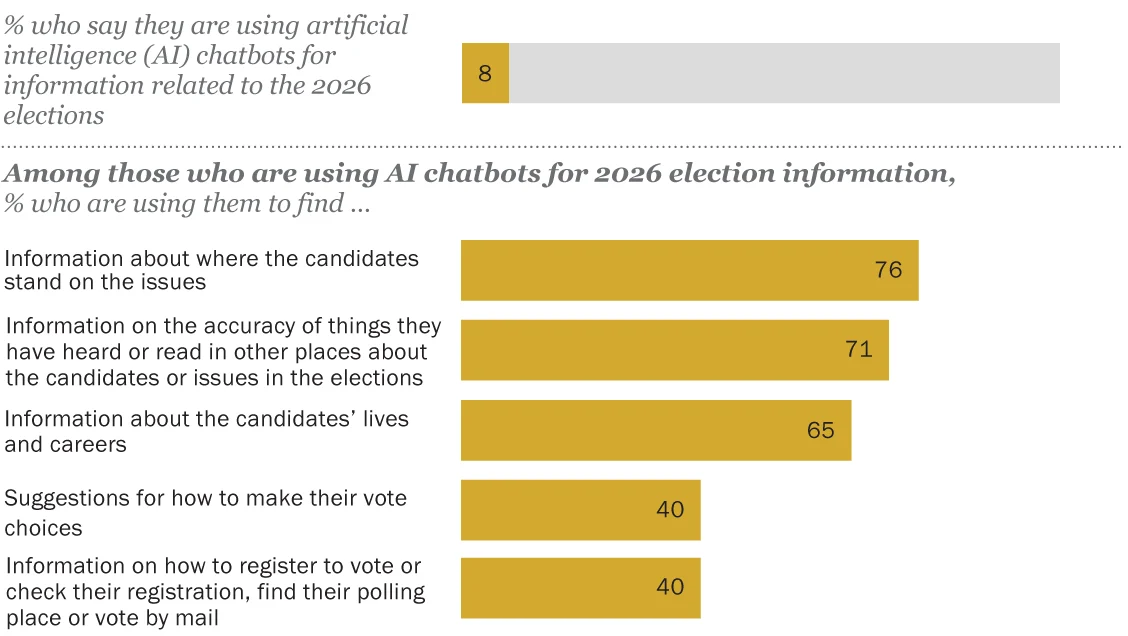
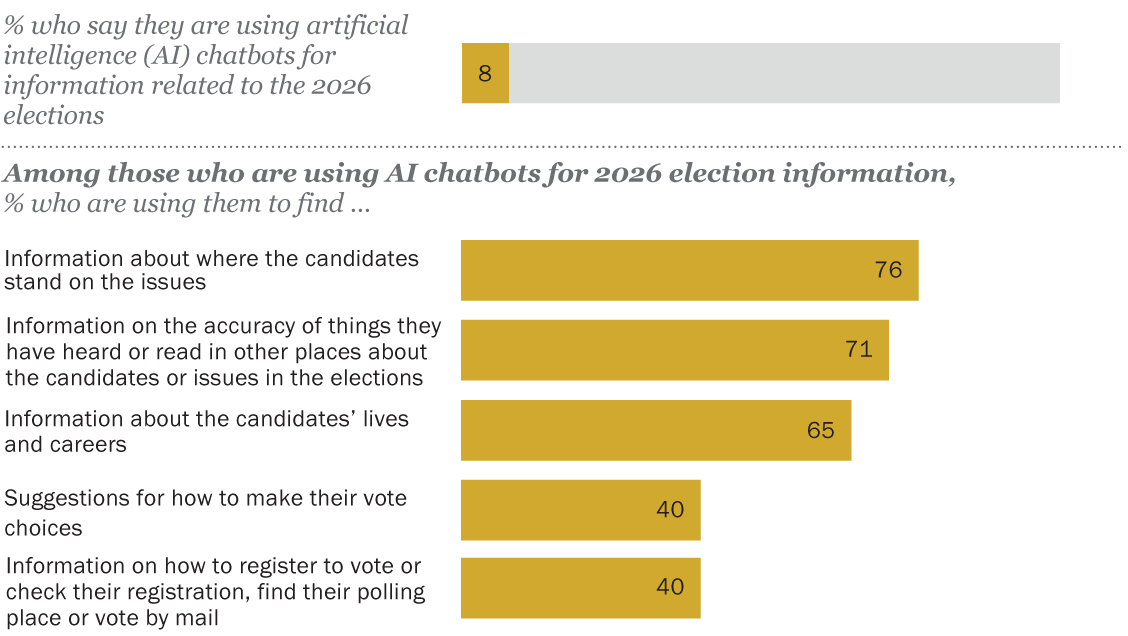
As the 2026 midterm election cycle reaches its fever pitch, the American electorate is navigating an information landscape fundamentally transformed by the rapid integration of artificial intelligence. While generative AI tools like ChatGPT, Google Gemini, and Microsoft Copilot have seen widespread adoption—with approximately half of all U.S. adults now utilizing them for daily tasks—their role in the political sphere remains surprisingly limited. A new study from the Pew Research Center, conducted between October 12 and 18, 2026, reveals that only 8% of U.S. adults are actively turning to these sophisticated chatbots to inform their electoral decisions.
This data suggests a notable disconnect between the ubiquity of AI technology in the consumer marketplace and its current utility as a primary source of political intelligence. As voters prepare to head to the polls, the majority of the population continues to rely on traditional media, social networks, and direct candidate outreach, leaving AI as a peripheral, albeit growing, player in the democratic process.
A Shifting Digital Landscape: The 2026 Context
The 2026 midterm elections represent a critical moment for the American political system. With control of both chambers of Congress hanging in the balance, the stakes are perceived to be high. The introduction of AI into this environment has prompted significant debate among tech analysts, election integrity experts, and political strategists.
In the early months of 2026, concerns were rampant regarding the potential for AI-generated misinformation to influence voter behavior. Regulatory bodies and major tech companies implemented safeguards, such as watermarking AI-generated content and restricting chatbots from providing specific voting instructions or engaging in political campaigning. These guardrails, combined with a general public skepticism toward "black-box" algorithms, may contribute to the modest 8% adoption rate for election-related inquiries.
The Anatomy of AI-Driven Political Research
For the small segment of the population—roughly one-in-twelve adults—that does utilize chatbots for election research, the motivations are specific and highly targeted. Rather than using these tools to find broad ideological talking points, users are leveraging them as verification engines.
According to the Pew Research Center findings, 76% of these AI-using voters rely on chatbots to clarify where candidates stand on key policy issues. This suggests that voters are seeking to cut through the noise of campaign advertisements by asking for summarized, objective-sounding policy positions.
A significant 71% of these users turn to AI to perform "fact-checks" on information they have encountered elsewhere. This reflects a growing public awareness of misinformation and a desire for tools that can synthesize conflicting claims. Furthermore, 65% of these users query chatbots about the professional and personal histories of candidates, using AI as an accessible, rapid-reference library for political backgrounds.
While these information-seeking behaviors are prominent, the use of AI for direct voter logistics—such as checking registration status, locating polling places, or understanding mail-in ballot procedures—remains lower, at 40%. This is likely due to the proactive efforts of state election offices to provide highly reliable, government-sanctioned digital portals, which voters often trust more than general-purpose AI models.
Demographic Disparities in AI Adoption
The demographic breakdown of AI usage for political purposes mirrors existing trends in broader technology adoption. There is a distinct "digital divide" characterized primarily by age. Adults under the age of 50 are significantly more likely to integrate chatbots into their workflow, with 11% of this cohort reporting that they have consulted an AI tool for election-related information. In contrast, only 4% of adults aged 50 and older have done the same.
This divide is consistent with long-standing observations by the Pew Research Center regarding the digital literacy gap between younger, "digital native" generations and older demographics. However, as the 2026 cycle progresses, it remains to be seen whether these patterns will shift as chatbots become more deeply embedded in everyday applications like web browsers and mobile operating systems.
Implications for Election Integrity and Future Cycles
The low adoption rate of 8% carries profound implications for the future of political campaigning and election administration. On one hand, the limited usage suggests that fears of AI-driven mass manipulation through chatbots may have been overstated, at least for the 2026 midterms. Voters appear to be maintaining a healthy level of caution, perhaps wary of the hallucinations or bias inherent in current large language models.
On the other hand, the high reliance among users on AI for "fact-checking" and policy summaries points to a significant opportunity—and a significant risk. If voters treat a chatbot’s output as an impartial arbiter of truth, the quality of training data and the transparency of the underlying algorithms become matters of national concern. If an AI model were to provide biased or incorrect information during the final days of an election, the impact on a close race could be substantial, even if only a small percentage of the electorate is using it.
A Chronology of AI in the 2026 Cycle
- January 2026: Tech giants announce voluntary commitments to limit the influence of generative AI on political discourse, including restrictions on generating deepfake political advertisements.
- March 2026: Primary season begins; initial reports indicate that while AI is being used for campaign fundraising emails, it has not yet become a staple of the voter-facing information ecosystem.
- June 2026: Pew Research Center publishes findings on the general state of AI in the U.S., noting that half of all adults are now using chatbots for various tasks, setting the stage for the fall election research.
- October 2026: As the midterm elections near, the final study on AI usage reveals that only 8% of voters are utilizing these tools for election-related queries, emphasizing that human-led information gathering remains the norm.
Reactions and Future Outlook
While there has been no formal "official" reaction to these specific statistics from major political parties, behind-the-scenes strategy sessions have been heavily focused on AI. Democratic and Republican committees have both invested heavily in AI-driven data analytics for voter targeting, but they remain cautious about deploying AI-based chatbots for direct voter interaction, fearing the potential for uncontrollable "rogue" responses that could lead to public relations disasters.
Political scientists and analysts suggest that the next two years will be critical. As AI models become more multimodal—incorporating real-time voice, video, and integrated web searching—the barrier to entry for the average voter will decrease. The 2028 presidential election cycle will likely look very different from the 2026 midterms, as the "novelty" phase of AI gives way to full-scale institutional integration.
The current 8% figure should not be viewed as a permanent ceiling. Rather, it serves as a snapshot of a public in a transitional phase—one that is aware of the power of artificial intelligence but is not yet prepared to grant it a central role in the most fundamental act of a democracy: the decision of who should lead. For now, the American voter remains a human-centric information gatherer, prioritizing traditional sources, peer discussion, and direct observation over the synthetic, algorithmic responses provided by the latest generation of chatbots.
The data provided by the American Trends Panel ensures that we have a clear, statistically sound baseline for future research. As the technology evolves, the challenge for researchers and policy makers will be to determine whether this 8% figure represents a permanent minority of tech-enthusiasts, or simply the first wave of a much larger, inevitable shift in the way the American public engages with its government and its candidates. Until then, the role of AI in the 2026 midterms remains a fascinating, yet secondary, component of a much larger and more complex electoral story.