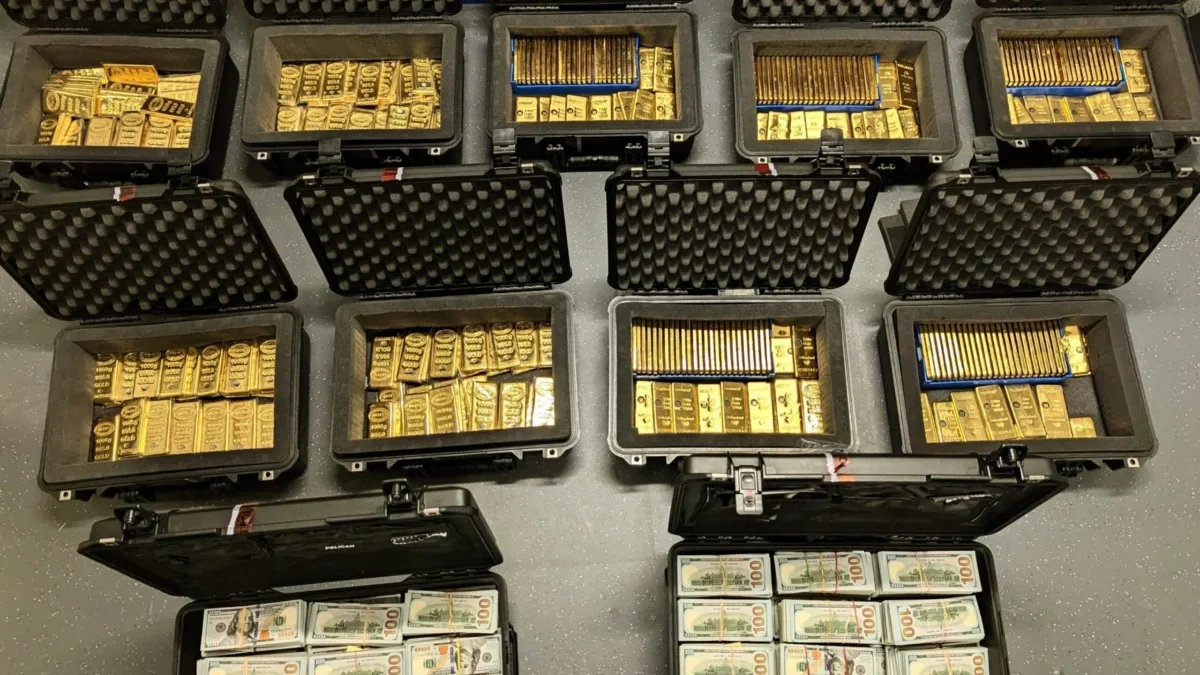
In a stunning breach of national security and fiscal integrity, David J. Rush, a former high-ranking federal executive, pleaded guilty on Tuesday in the U.S. District Court for the Eastern District of Virginia to a massive wire fraud scheme. The operation, which drained nearly $194 million from federal coffers, involved the fabrication of non-existent, highly sensitive intelligence programs to finance a lifestyle of extraordinary luxury, ranging from gold bullion stockpiling to the acquisition of high-end real estate in South Florida. The plea marks a significant conclusion to an internal investigation that exposed systemic vulnerabilities within the intelligence community’s contracting and oversight mechanisms.
The Anatomy of a Multi-Million Dollar Deception
Beginning in October 2025, David J. Rush, who held a Top Secret/Sensitive Compartmented Information (TS/SCI) clearance, leveraged his executive authority to bypass traditional fiscal controls. According to court filings, Rush operated under the auspices of a clandestine government agency—referred to in legal documents as "Government Agency 1." By positioning himself as both the architect and the approving official for these fabricated "Special Access Programs," Rush effectively removed any meaningful oversight of his activities.
The scheme functioned through two distinct, sophisticated pillars of fraud. The first involved the creation of a fictitious program that purportedly required the procurement of high-value real estate for operational staging in South Florida. Rush successfully coerced government contractors into participating by invoking the urgency of "classified work," even going so far as to mandate that participants sign non-disclosure agreements. When internal contracting officials raised legitimate questions regarding the exorbitant costs associated with these purchases, Rush utilized his security clearance as a weapon, informing staff that they lacked the "need to know" to question his directives.
Between November 2025 and March 2026, approximately $145 million was funneled through 0701 Holdings LLC, a shell company established under Rush’s direct control. The funds were allegedly used for "consulting" services, a cover that allowed Rush to siphon money into the acquisition of luxury assets. Among these were two massive properties in Palm Beach valued at $21.9 million and $27 million, respectively, a $13.65 million parcel, and a $40 million estate in Hobe Sound. Communications recovered during the FBI investigation revealed that Rush viewed these assets as investment vehicles, noting in one instance that he was carefully considering the resale potential of a guesthouse.
The Gold Standard of Greed
The second prong of the deception was arguably even more brazen. Rush convinced a subcontractor’s executive that a sensitive, six-person intelligence assignment necessitated the use of non-traditional assets, specifically gold, diamonds, or cryptocurrency, to maintain operational anonymity. Relying on this false directive, the subcontractor facilitated the purchase of 298 gold bars at a cost of $46.3 million to the taxpayer.
The physical logistics of the fraud were equally alarming. The gold was delivered to Rush’s office in Loudoun County, Virginia, stored within Pelican cases that were intended to signify highly sensitive intelligence equipment. When FBI agents executed a search warrant on May 19, 2026, they discovered the entire cache of 298 gold bars in Rush’s residence, along with $2.1 million in cash, significant quantities of foreign currency, and a collection of over 30 luxury watches, including high-value Rolex timepieces.
A Foundation of Fabricated Credentials
The investigation into Rush’s activities revealed that the fraud was facilitated not just by his position, but by a carefully constructed persona. Court documents detail that Rush had lied extensively about his educational and professional history. While he claimed to hold a doctorate from a New York institution and an undergraduate degree from a South Carolina university, neither institution could verify his attendance or graduation. Furthermore, his claims of being a combat veteran and a military pilot were entirely fictitious.
Although Rush left the Navy reserves in 2015, he continued to claim military leave from his civilian employment starting in 2021, successfully defrauding the government for 392 hours of paid time off based on these lies. This pattern of deception suggests that Rush’s entire career trajectory within the federal government may have been predicated on fraudulent documentation, raising severe questions regarding the effectiveness of background check procedures for high-level appointees.
Official Responses and Institutional Accountability
The exposure of the scheme began internally. CIA Director John Ratcliffe confirmed that the agency initiated an internal review after detecting anomalies that pointed toward criminal activity, subsequently referring the matter to the FBI.
"David Rush abused his position and betrayed the public trust and should be held fully accountable for his actions," Ratcliffe stated in a formal address following the plea. The sentiment was echoed by Attorney General Todd Blanche, who emphasized the administration’s intolerance for such behavior. "Federal employees are entrusted with serving the American people, not themselves," Blanche remarked. "The Trump Administration is committed to rooting out waste, fraud, and abuse in the federal government, including by prosecuting those who foolishly defraud American taxpayers."
The scale of the restitution is historic. Under the terms of the plea agreement, Rush is required to pay at least $195.4 million in restitution, covering the $193.6 million loss caused by the fraud and an additional $1.8 million in private charter flights that were billed to the government. He has agreed to forfeit all assets seized by the FBI, including the gold, the real estate portfolio, the 2026 BMW Alpina XB7 vehicles, and the $38.65 million remaining in the LLC’s accounts.
Broader Implications and National Security Concerns
Perhaps the most chilling aspect of the case is Rush’s admission that, in late 2025, he disclosed sensitive information regarding a U.S. clandestine human source to a foreign government official. This revelation elevates the case from simple financial fraud to a potential espionage catastrophe. The Director of National Intelligence has since requested a full investigation by the Inspector General for the Intelligence Community to assess the extent of the damage to national security caused by Rush’s actions.
The implications for the federal contracting process are profound. The ability of a single individual to designate programs as "classified" to avoid audit trails demonstrates a critical flaw in the oversight of the federal government’s intelligence spending. Lawmakers are already signaling an interest in reviewing the "read-in" process and the discretionary authority granted to senior executive officials.
As the case moves toward sentencing, scheduled for January 28, 2027, Rush faces a potential maximum of 20 years in federal prison. While the recovery of the assets provides some measure of relief to the Treasury, the intangible costs—the erosion of public trust and the potential compromise of sensitive intelligence sources—will likely be felt for years to come. The investigation remains ongoing, with federal authorities looking into whether other individuals were either negligent in their oversight or complicit in Rush’s long-running deception.
For the intelligence community, the Rush case serves as a stark reminder that even the most secure environments are susceptible to the "insider threat." As the government recalibrates its internal controls, the focus will remain on how a single official managed to operate a shadow economy for months without detection, effectively turning the machinery of national security into a personal bank account.