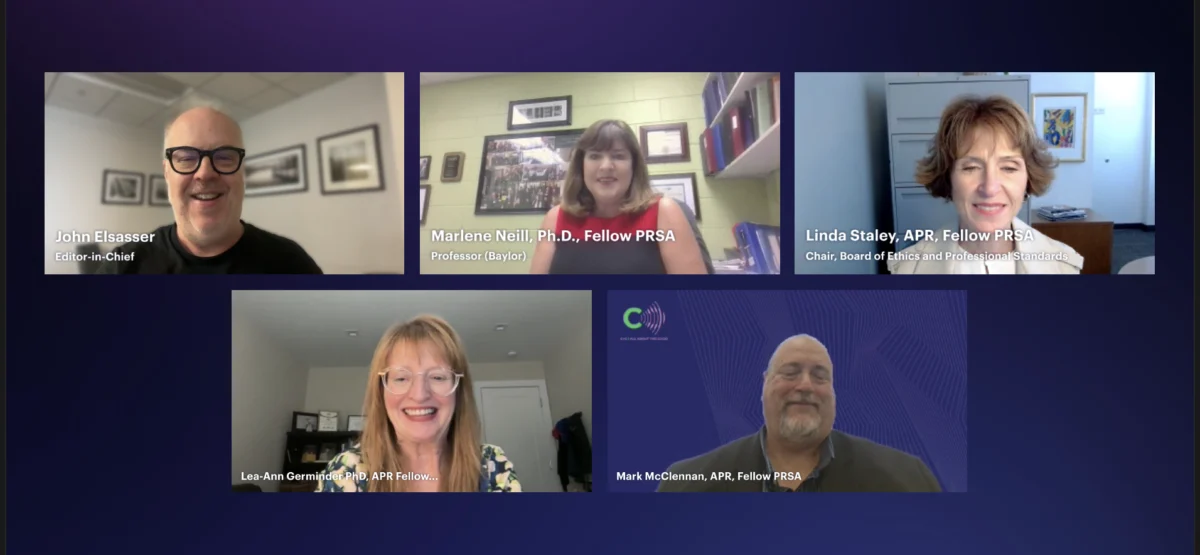
The emergence of agentic artificial intelligence represents a seismic shift in the professional landscape of public relations, moving beyond simple generative chatbots to autonomous systems capable of complex decision-making and task execution. As these tools become increasingly integrated into corporate communication workflows, the Public Relations Society of America (PRSA) has initiated a critical dialogue to ensure that human judgment remains at the helm of strategic messaging. During the September 24 edition of "Strategies & Tactics Live," a panel of industry experts convened to address the ethical imperatives of integrating autonomous AI agents into the modern PR toolkit.
Defining Agentic AI in Communications
Unlike traditional generative AI, which functions primarily as a passive respondent to human prompts, agentic AI operates with a degree of autonomy. These systems are designed to pursue goals, engage in reasoning, perform planning, and utilize various digital tools to complete tasks without constant human intervention. Mark McClennan, APR, Fellow PRSA, who led the development of the PRSA’s recent ethical advisory on the subject, emphasized that these agents are shifting the paradigm of public relations operations.
"Agents pursue goals and complete tasks on behalf of the end-user, often using capabilities such as reasoning, planning, memory, tool-use, and adaptation," McClennan explained during the broadcast. The potential applications for these systems are vast, ranging from real-time media monitoring and content distribution to the orchestration of complex stakeholder engagement workflows. According to the PRSA advisory, these agents can supervise other AI systems, effectively functioning as automated project managers within a communications department.
The Chronology of Ethical Oversight
The PRSA’s focus on this topic is part of a broader, ongoing effort to modernize professional standards in the face of rapid technological disruption. The organization has designated September as "Ethics Month," a time dedicated to reflecting on the core values that govern the profession. The timeline of this initiative is as follows:
- Early 2023: As the widespread adoption of Large Language Models (LLMs) surged, PRSA leadership began identifying gaps in current ethical guidelines.
- July 2026: The Board of Ethics and Professional Standards released a formal advisory specifically addressing the use of AI agents, providing a framework for how PR practitioners should navigate these technologies.
- September 24, 2026: The "Strategies & Tactics Live" event served as a platform to disseminate these findings, featuring four leading experts in ethics and communications strategy.
This proactive approach is designed to prevent the "perfect storm" described by Dr. Marlene Neill, a professor at Baylor University and member of the Board of Ethics and Professional Standards. Dr. Neill notes that the industry is currently under intense pressure to improve efficiency, leading many organizations to adopt AI tools without sufficient training or a clear ethical policy. "These are ingredients that could result in a serious crisis for an organization," she warned.
The Data Behind the Shift
The pressure to integrate AI is supported by market data indicating significant productivity gains in the communications sector. According to recent industry surveys, nearly 60% of PR firms have begun testing or fully implementing AI-driven automation for routine tasks such as drafting press releases, summarizing earnings reports, and conducting sentiment analysis. However, the speed of adoption has often outpaced the development of governance frameworks.
The risk, as identified by the panel, lies in the "black box" nature of autonomous agents. Because these systems often process data in ways that are not immediately transparent, there is a high potential for algorithmic bias, the amplification of misinformation, and the erosion of brand trust. The PRSA advisory specifically cautions against using AI to impersonate individuals, simulate artificial consensus, or conceal corporate sponsorship—practices that could lead to severe reputational damage and legal liability.
Human Judgment as the Ultimate Safeguard
A recurring theme during the panel discussion was the necessity of maintaining "human-in-the-loop" oversight. Linda Staley, APR, Fellow PRSA, and chair of the 11-member Board of Ethics and Professional Standards, stressed that the PRSA Code of Ethics—a document that has evolved since the organization’s founding—remains the bedrock of modern practice.
"We are translating and interpreting the Code through the lens of contemporary issues and tools," Staley said. The central challenge, she argued, is not merely technical, but existential. As AI assumes responsibility for the mechanical aspects of public relations, practitioners must define their unique value proposition. "If we’re able to use AI to do many of the tasks that we used to do, then what is our value to our employers? It is our ethical judgment, our humanity, our ability to reason, and our ability to create communications that inspire trust."
This sentiment was echoed by Dr. Lea-Ann Germinder, who emphasized that ethical literacy must be treated with the same importance as technical proficiency. "You can’t learn about the tools and not have ethical decision-making about using them," she stated. Her research highlights that as the scope of PR expands, the professional responsibility of the communicator extends beyond the client to the public at large.
Implications for the Industry
The implications of these advancements are profound. As AI agents become more sophisticated, the role of the PR professional will likely shift from "content creator" to "AI orchestrator and ethical auditor." This transition requires a new set of competencies:
- Skepticism and Fact-Checking: Practitioners must revert to fundamental journalistic principles, questioning the veracity of AI-generated insights and performing rigorous fact-checking.
- Transparency and Disclosure: The panel was unanimous in their stance that disclosure is a non-negotiable requirement. If the use of an AI agent materially affects a communication, the audience deserves to know.
- Algorithmic Auditing: Organizations must establish protocols to monitor AI outputs for bias, fairness, and potential harm to vulnerable stakeholders.
- Moral Stewardship: Professionals must acknowledge that AI is not an "ethical actor." It lacks moral judgment and does not face professional consequences. The onus for these factors remains entirely with the human practitioner.
Conclusion: The Future of Professional Responsibility
The September 24 livestream underscored that while the tools of the trade are evolving at a breakneck pace, the fundamental mission of public relations remains unchanged. The ability to foster trust, manage reputation, and navigate complex social dynamics requires a human element that technology cannot replicate.
As the industry moves forward, the PRSA’s emphasis on "ethical literacy" serves as a critical reminder that technological efficiency is not a substitute for professional integrity. The "perfect storm" described by Dr. Neill is avoidable, provided that organizations prioritize comprehensive training, clear ethical guidelines, and a commitment to transparency. By embracing these principles, PR professionals can leverage the power of agentic AI to enhance their reach and effectiveness, while ensuring that the core values of honesty, fairness, and public interest remain at the heart of their practice. The future of the profession depends not on how well we command the machines, but on how well we safeguard the humanity within our communication.