As conversational artificial intelligence fundamentally transforms how consumers gather information, traditional digital marketing strategies are experiencing a paradigm shift. Today, millions of users turn to generative AI platforms like ChatGPT, Perplexity, and Google Gemini to research products, compare services, and answer complex queries. Instead of navigating a traditional search engine results page populated by a list of blue links, modern consumers increasingly rely on synthesized, conversational responses. Consequently, a brand’s hard-earned digital visibility can vanish into an AI-generated answer without a single click ever registering on a website analytics dashboard.
This digital evolution has given rise to a vital new discipline: Answer Engine Optimization (AEO). To successfully navigate this landscape, digital marketers and enterprise organizations are adopting specialized tools known as AEO checkers. These software solutions monitor brand representation across AI platforms, identify content gaps, and track how often a company is cited as an authoritative source by artificial intelligence models.
Understanding the Mechanics of Answer Engine Optimization
Answer engine optimization is the strategic process of maximizing the frequency and accuracy with which a brand is mentioned or cited within AI-generated responses. While traditional Search Engine Optimization (SEO) focuses on securing high rankings within keyword-based lists of links, AEO operates on a different plane. Answer engines read vast quantities of multi-source data, synthesize the information, and deliver a single, cohesive response designed to resolve a user’s intent immediately.
![AEO checker tools that measure answer engine visibility [2026]](https://53.fs1.hubspotusercontent-na1.net/hubfs/53/aeo-checker-1-20260903-3858273.webp)
Despite their operational differences, SEO and AEO are complementary rather than competing forces. High-performing SEO practices—such as rigorous technical optimization, robust backlink profiles, and clear content structures—supply the foundational crawlability, indexing, and authority signals that large language models rely on when determining which sources to trust and cite. When an answer engine cites a piece of content, it typically selects web pages that feature structured data, direct and unambiguous answers to real-world questions, and claims backed by verifiable primary sources.
The Evolving Role and Function of an AEO Checker
An AEO checker functions as a diagnostic instrument for the modern digital ecosystem. By continuously measuring a brand’s visibility across conversational engines, these tools synthesize complex performance data into actionable optimization recommendations.
A comprehensive AEO checker typically evaluates several core performance indicators:
- Citation frequency, which measures how often an AI model links directly to a brand’s domain as a reference.
- Brand mention tracking, which notes instances where a company is referenced in the text without an accompanying hyperlink.
- Competitor benchmarking, which highlights which rival companies are capturing citations for targeted queries.
- Sentiment analysis, evaluating whether the conversational context of a mention is positive, neutral, or negative.
- Factual accuracy, detecting instances where an artificial intelligence engine misrepresents a brand’s product features, pricing, or core offerings.
Once these metrics are gathered, advanced checkers rank necessary optimizations, flagging technical updates, schema corrections, and entity improvements designed to maximize citation potential.
![AEO checker tools that measure answer engine visibility [2026]](https://no-cache.hubspot.com/cta/default/53/9dd5e54b-fbef-4dd0-bc44-1689feb1ea18.png)
Manual Visibility Audits Across Leading AI Platforms
While automated software solutions provide necessary scalability, digital marketing teams frequently begin their AEO journey by conducting manual audits across major AI interfaces. This hands-on approach builds foundational familiarity with how artificial intelligence engines process and display information.
Evaluating Google AI Overviews
Google introduced AI Overviews (AIOs) to its search results page in May 2024, altering the visibility dynamics of traditional search. These summaries appear only when Google’s proprietary systems determine that an AI-generated overview adds distinct value to classic search queries.
To conduct a manual audit of Google AI Overviews, digital strategists execute a standardized process:
![AEO checker tools that measure answer engine visibility [2026]](https://53.fs1.hubspotusercontent-na1.net/hubfs/53/aeo-checker-2-20260903-852936.webp)
- Query Definition: Compile a comprehensive list of high-priority search terms, including brand names, branded product categories, and informational queries relevant to target buyers. These must be executed in signed-out or incognito browsing sessions to eliminate personalized search bias.
- Result Interpretation: Record whether an AI Overview is triggered, whether the target domain appears among the inline source links, and the exact claims made by the system. If competitors are cited instead of the brand, this establishes an immediate content gap.
- Performance Tracking and Reporting: Because Google Search Console historically rolls AI Overview activity into standard web search performance reports rather than separating generative impressions, teams must document results manually using screenshots, query logs, dates, and geographic locations. Although Google began rolling out a dedicated generative AI performance report, its widespread availability remains phased.
Analyzing ChatGPT and Perplexity Citations
Perplexity and ChatGPT handle external information retrieval differently, requiring distinct auditing protocols. Perplexity attaches inline citations to virtually every answer, linking directly to referenced sources while maintaining a dedicated panel of sources on the right-hand side of the interface. ChatGPT utilizes web search capabilities when queries require real-time data or when users explicitly activate web browsing features, presenting inline citation indicators and a corresponding source list beneath the response.
To properly evaluate these platforms, marketers must frame prompts carefully. Direct, current questions—such as inquiries regarding the best software categories for specific use cases—force the engines to reach outward for live, verifiable sources. Because generative models produce non-deterministic outputs, running identical prompts across multiple fresh sessions is essential for establishing reliable citation patterns.
Key Buyer Criteria for Selecting AEO Software
As manual spot-checks become unsustainable at enterprise scale, organizations are increasingly turning to dedicated AEO software. Selecting the right platform requires evaluating several core criteria:
![AEO checker tools that measure answer engine visibility [2026]](https://53.fs1.hubspotusercontent-na1.net/hubfs/53/aeo-checker-3-20260903-8904553.webp)
- Multi-Engine Coverage: The software must monitor visibility across primary conversational platforms, including ChatGPT, Perplexity, and Google Gemini.
- Historical Data Retention: Platforms need to track visibility scores over weeks and months to measure upward or downward trends accurately.
- Actionable Diagnostics: Checkers should move beyond simple reporting to offer prioritized content, structural, and schema recommendations.
- Integration Capabilities: Enterprise-grade tools connect visibility data directly with customer relationship management (CRM) systems to measure downstream pipeline impact.
Categorizing the Leading AEO Checker Tools
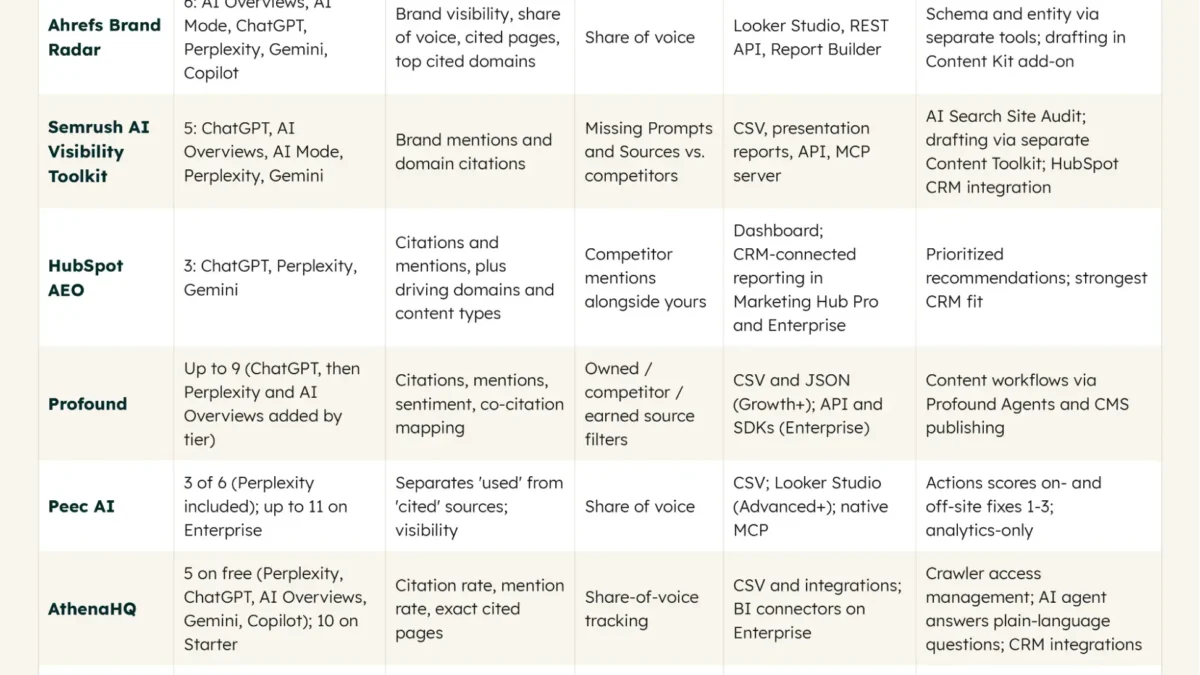
The software market has rapidly expanded to accommodate the demand for AI visibility tracking. Platforms can be categorized based on their primary operational strengths:
Tools Featuring AI Overviews Tracking
- Ahrefs Brand Radar: Leverages real search query data rather than synthetic prompts, utilizing a massive index centered on Google AI Overviews.
- Semrush AI Visibility Toolkit: Integrates with organic research metrics to identify which ranking keywords already trigger AI Overviews, allowing teams to optimize near-inclusion web pages.
Tools Featuring ChatGPT Citation Detection
- HubSpot AEO: Tracks both direct citations and text-based brand mentions across ChatGPT, Perplexity, and Gemini, detailing the specific competitor domains and content types driving visibility.
- Profound: Focuses heavily on citation context, offering advanced sentiment scoring, uncited-prompt detection, and granular breakdowns categorized by source type (owned, earned, and competitor).
Tools Focused on Perplexity Monitoring
![AEO checker tools that measure answer engine visibility [2026]](https://53.fs1.hubspotusercontent-na1.net/hubfs/53/aeo-checker-4-20260903-6212698.webp)
- Peec AI: Functions as a specialized analytics platform designed to deliver streamlined, clean performance data specifically for Perplexity citations.
- AthenaHQ: Provides accessible Perplexity tracking across various subscription levels, including a conversational assistant interface.
Tools Specializing in Schema and Entity Readiness
- Scrunch AI: Evaluates whether AI crawlers can successfully access, render, and interpret website architecture.
- Conductor: Combines 24/7 technical monitoring features with sophisticated content scoring capabilities.
Essential Metrics for Measuring AEO Success
Evaluating the efficacy of an answer engine optimization strategy requires tracking a distinct set of Key Performance Indicators (KPIs). Industry professionals recommend focusing on several critical metrics:
- Visibility Score: The aggregate percentage of target queries where a brand is either mentioned or cited.
- Share of Voice (AI): The proportion of AI citations captured by a brand compared to its primary market competitors.
- Uncited Mention Rate: The frequency with which a brand is referenced in text without receiving a proper hyperlink citation, indicating a need for stronger entity authority work.
- Zero-Click Influence Proxies: Monitoring branded search volume lift and direct traffic patterns to gauge brand awareness generated by invisible AI interactions.
Because answer engines frequently resolve inquiries without dispatching a physical website visitor, digital marketers must view visibility scores and direct referral revenue as two distinct yet highly interconnected measures of modern marketing success.
Implications and the Future of Digital Discovery
![AEO checker tools that measure answer engine visibility [2026]](https://53.fs1.hubspotusercontent-na1.net/hubfs/53/aeo-checker-5-20260903-8938354.webp)
The institutional shift toward answer engines represents one of the most profound transformations in the history of digital marketing. As search engines evolve from routing traffic to directly answering user questions, organizations that fail to adapt their content strategies risk digital obscurity. By deploying sophisticated AEO checkers, maintaining rigorous schema standards, and structuring content for machine comprehension, businesses can secure their foothold in the emerging era of conversational artificial intelligence search.