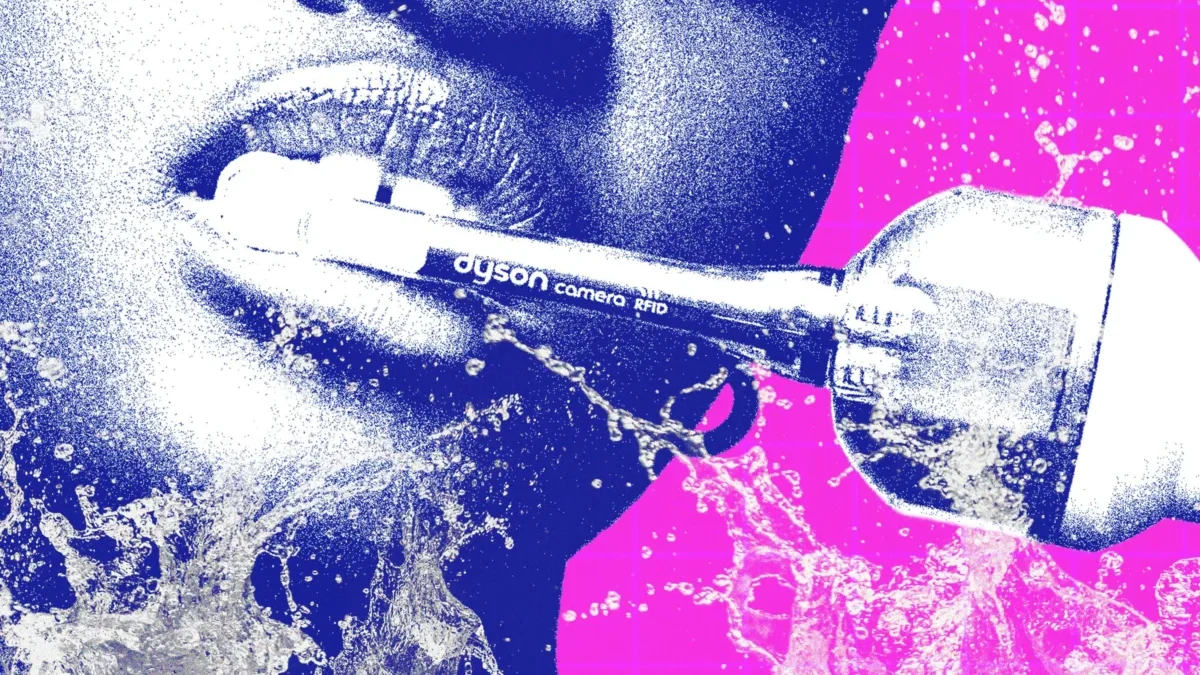
Engineering ambition has long been the defining hallmark of Dyson. Over the past few decades, the British technology company transformed mundane household appliances—stick vacuums, hand dryers, and bladeless fans—into luxury lifestyle status symbols through sheer force of industrial design. Yet, transitioning from airflow aerodynamics to personal hygiene proved to be an altogether different challenge. Earlier this month, amid high-profile global fanfare, founder James Dyson unveiled the company’s most audacious personal care device yet: the Dyson CameraJet. Retailing at a staggering $499, the toothbrush was marketed as a revolutionary leap forward in oral hygiene, equipped with an integrated macro-lens camera, a proprietary "Gap Optical Targeting system," and an onboard fluid reservoir designed to precisely pinpoint and flush interdental spaces.
However, within days of hitting store shelves, the flagship device suffered an unprecedented and rapid retail collapse. Reports of critical hardware failures, battery compartment flooding, and complete device breakdowns surfaced almost immediately upon consumer unboxing. By mid-September, just weeks after a glamorous international launch event in Paris, the CameraJet had vanished from retail inventories across the United States, the United Kingdom, France, and Singapore.
While Dyson corporate representatives have vehemently denied that a formal product recall is underway, attributing the sudden absence of stock to overwhelming global demand and supply chain scaling issues, independent hardware experts and disgruntled consumers paint a starkly different picture. The swift rise and stall of the CameraJet raises fundamental questions about the limits of over-engineering, the extreme manufacturing tolerances required for consumer waterproofing, and whether Dyson’s culture of unyielding technological complexity may have finally outpaced practical engineering realities.
A Brief History of Oral Care Innovation and Dyson’s Entry
To understand the scale of Dyson’s ambition, one must examine the incremental history of the toothbrush. The concept of the bristle toothbrush dates back to the Ming Dynasty in China during the 15th century—a remarkably resilient design that remained essentially unchanged for centuries. The paradigm shifted in 1937 when Tomlinson Moseley secured a patent for the Motodent, widely recognized as the earliest iteration of the electric toothbrush. Over the subsequent decades, companies refined sonic and oscillating technologies, but the fundamental mechanics of brushing remained straightforward: mechanical friction aided by toothpaste and manual flossing.
Dyson, however, has never been a company content with straightforward solutions. Buoyed by the massive commercial success of its digital motors and air-treatment products—such as its premium hair dryers and cord-free vacuum cleaners—the firm expanded into increasingly eccentric product categories. While some experiments, like its air-purifying Zone headphones, faced lukewarm market reception and eventual discontinuation, the company poured six years of research, 38 dedicated patents, and millions of dollars into developing the CameraJet.
The device represented a monumental convergence of optics, artificial intelligence, and fluid dynamics. Rather than relying solely on traditional bristles, the CameraJet utilized a miniature macro camera paired with a targeting algorithm trained on approximately 470,000 dental images. Within 100 milliseconds of activation, the system was engineered to identify gaps between teeth and direct 12.5 milliliters of stored mouth rinse precisely where plaque and debris accumulate. It was a technical marvel on paper—combining brushing, imaging, and water flossing into a single, high-end consumer electronics package.
Chronology of a Rapid Disappearance
The timeline of the CameraJet’s launch and subsequent disappearance highlights a staggering operational crisis. The product made its high-profile debut in Paris, spearheaded by James Dyson, signaling a major push into the high-end oral care market.
- September 8: The Dyson CameraJet officially launches in retail stores across the United States.
- September 9: Barely 24 hours after the initial consumer rollout, early adopters take to online forums and tech publications to report critical hardware failures. Users report devices dying within 30 seconds of activation, accompanied by water leakage directly into the battery compartments.
- September 10: Consumer Reports receives a review unit, which subsequently ceases all operations less than 24 hours after unboxing.
- September 11: French technology outlet Numerama reports that Dyson’s official French website and retail locations have abruptly halted all sales of the $479 (equivalent) toothbrush.
- September 15: Retail stores in the UK, Singapore, and the US systematically pull the remaining stock from shelves, aligning with a silent global inventory freeze.
- Late September: Online consumer forums, including Reddit threads, fill with complaints. Users coin satirical monikers such as the "ScameraJet," noting that they are unable to process returns due to discarded packaging or international travel constraints.
Official Corporate Stance Versus Expert Analysis
Faced with mounting consumer backlash and empty store shelves, Dyson’s communications team has pushed back against the narrative of a botched rollout. Liv Thomas, Dyson’s head of Beauty Communications, maintained in statements to industry media that the product has not been recalled. Instead, Thomas framed the situation as a logistical triumph plagued by unprecedented success.

"The CameraJet is experiencing strong demand globally, and we are experiencing shortages of supply as we are in the process of scaling up production," Thomas stated, adding that units are expected to return to shelves in the coming weeks.
When pressed regarding the widespread reports of liquid ingress, battery failures, and sudden device deaths, Thomas conceded that a specific manufacturing glitch had been identified. "We have identified a single component issue affecting a small number of early batches," she said. "We have isolated those batches and are supporting affected customers."
Despite these assurances, Dyson declined to answer specific inquiries regarding where the device is still actively sold, the precise date shipments were halted, the exact nature of the faulty component, or the precise number of global units affected.
Independent hardware experts, however, point toward fundamental engineering flaws rather than a minor component glitch. Kyle Wiens, CEO of hardware repair advocacy firm iFixit, suspects that the root cause lies in complex waterproofing tolerances.
"This sounds like a waterproofing issue. Making products at scale with the tolerances required to waterproof are hard," Wiens explains. "My guess without getting a chance to look at a failed unit is that we either have a tolerance issue where some parts aren’t mating perfectly, or a failure in the adhesive curing process, either during manufacturing or in shipping." Wiens notes that adhesive curing failures are notoriously insidious because a defective seal can pass factory quality control testing, only to fail later when exposed to environmental heat and humidity during international transit.
Adam Toner, founder and technical director of UK-based electronic design consultancy Ripcord Designs—whose portfolio includes work with Formula One Management and Panasonic—echoes these concerns. Having analyzed teardown videos and battery-replacement mechanisms circulating online, Toner suggests that the battery compartment serves as a direct vulnerability point for internal moisture migration.
"On a product like this, there just should never be any water ingress into the internals," Toner states. "Once you pull the battery off—which is where people say they’re seeing water—it looks like there is probably access from that battery compartment into all of the internals of the device." Toner notes that common symptoms such as charging failures, sudden overheating, and electrical short circuits are textbook indicators of internal water damage, likely stemming from a compromised gasket, O-ring, or seal.
Implications and Broader Industry Lessons
The CameraJet controversy highlights a timeless engineering adage: complexity often introduces vulnerability. Spending six years developing a device that intentionally carries, pumps, and sprays liquid while containing sensitive optical electronics and lithium-ion batteries requires flawless execution. When water breaches the enclosure of a $500 device within 24 hours of use, consumer trust evaporates just as quickly.
Beyond the immediate financial and reputational fallout for Dyson, industry analysts suggest this misstep should prompt a broader operational reckoning. Dyson has historically maintained tightly controlled, closed-ecosystem manufacturing practices that offer limited repairability and sparse availability of replacement parts or diagnostic documentation for consumers and independent technicians.
According to iFixit’s Wiens, the CameraJet chaos offers Dyson a vital wake-up call to pivot toward sustainable design and repairability. "They should take this opportunity to invest in repairability," Wiens asserts. "Making products easier to fix also makes them easier to rework when manufacturing defects occur. Dyson is way behind the industry on making repair parts and information available for their products. This should be a wake-up call for them to step up."
As consumers await the promised return of the CameraJet in the coming weeks, the episode serves as a cautionary tale for the consumer electronics industry at large. No amount of AI targeting algorithms, high-resolution macro cameras, or multi-million-dollar marketing campaigns can compensate for the fundamental physics of keeping water away from electronics. For Dyson, the path forward will require not only fixing a faulty component batch, but also restoring consumer confidence in a brand built on the promise of uncompromising engineering excellence.