The digital landscape is defined by a paradoxical lifecycle: the moment a website is launched, it begins a slow, inevitable descent into obsolescence. In the modern web development paradigm, the launch date is the zenith—the singular point where the codebase, design, and messaging are in perfect alignment. From that day forward, the site enters a state of entropy. Markets shift, competitors update their value propositions, and the underlying technology stack undergoes constant evolution. While the site does not necessarily break in a technical sense, it loses its relevance, effectively becoming a digital artifact of a previous organizational state.
This phenomenon, often referred to as "website decay," has long been accepted as an unavoidable cost of doing business. However, the emergence of autonomous, AI-driven web management systems is challenging this assumption. By utilizing intelligent agents that continuously optimize and maintain digital properties, the industry is moving toward a model where a website is a living, evolving entity rather than a static publication. Pierre Burgy, co-founder of the autonomous website platform Fimo, has been at the forefront of this shift, identifying the friction between total machine autonomy and the essential human requirement for creative oversight.
The Lifecycle of Digital Decay
Industry analysis indicates that the average lifespan of a professional website’s design and content relevance is approximately 18 to 24 months. During this period, the "drift" occurs incrementally. A design system update might be implemented in a component library, but fail to propagate to secondary pages. Images may be uploaded without proper compression, contributing to cumulative performance degradation. Accessibility standards, such as WCAG (Web Content Accessibility Guidelines), are frequently updated; a site that is compliant on launch day may fall out of alignment within a few months.
For years, the solution was reactive: periodic, large-scale redesigns or "refresh" projects that require significant capital expenditure and internal labor. This cycle creates a bottleneck, as teams are constantly torn between building new features and patching the technical debt of their existing presence. The promise of autonomous agents is to eliminate this cycle by automating the "eighty percent"—the rule-bound, repetitive, and time-consuming tasks that do not require creative judgment.
The Mechanics of Autonomous Optimization
In a fully realized autonomous environment, the role of the web team transitions from manual maintenance to high-level orchestration. Intelligent agents, acting as continuous background processes, monitor the site’s health in real-time. For example, if an agent detects a design-system discrepancy on a pricing page, it automatically reconciles the CSS tokens. If an image is identified as non-optimized, the agent compresses it without human intervention.
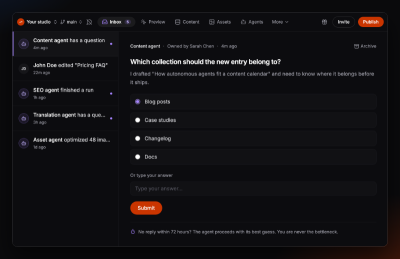
Crucially, these systems include a feedback loop. When an agent identifies a potential accessibility regression, it can either remediate the issue or escalate it to a human developer with a clear diagnostic report. This capability transforms the developer’s morning routine: instead of manually auditing a site for broken links or misaligned components, they begin the day by reviewing a curated list of high-level decisions.
The Human-Agent Boundary
Despite the technical feasibility of full automation, practitioners have expressed significant reservations regarding the "black box" nature of autonomous systems. Empirical evidence from the development of platforms like Fimo suggests that the primary hurdle is not technological capability, but the psychological and professional comfort of the stakeholders involved.
The fundamental design problem identified by Burgy is that a website is a multi-disciplinary asset. A single page may be the domain of a brand designer, a content strategist, and a software engineer. Each of these stakeholders views "autonomy" through a different lens. For a developer, allowing an agent to manage technical performance or accessibility updates is a welcome relief. For a brand designer, allowing an agent to adjust a color palette or modify layout logic is perceived as a threat to visual identity.
This realization has led to a transition in how these systems are architected. Rather than a binary "on/off" switch for autonomy, modern platforms are shifting toward a granular, permission-based model. By composing specific agents for specific tasks, organizations can define where the "line of human intervention" resides.
Chronology of Web Management Evolution
- The Static Era (1990s–2005): Websites were manually coded or edited, requiring constant human interaction for even the simplest updates.
- The CMS Revolution (2005–2015): The rise of Content Management Systems (CMS) democratized updates but introduced the problem of content sprawl and unmanaged technical debt.
- The Design System Era (2015–2022): The introduction of atomic design and component-based development improved consistency but increased the complexity of maintaining global design tokens across thousands of pages.
- The Autonomous Era (2023–Present): The integration of LLMs (Large Language Models) and agentic workflows allows for real-time monitoring and self-healing of digital properties.
Strategic Implications for Organizations
The shift toward autonomous maintenance has profound implications for corporate strategy. By offloading technical upkeep, organizations can reallocate human capital toward activities that provide a competitive advantage, such as market research, user experience innovation, and creative storytelling.
However, this transition requires a shift in internal governance. If an agent is granted the power to modify a site, the organization must establish clear guardrails. This includes version control history, rollback capabilities, and "human-in-the-loop" checkpoints for high-stakes pages. The objective is not to remove human input, but to elevate it. Instead of spending 40 hours a month fixing broken links, a team can spend those 40 hours conducting A/B tests or refining user journeys.
Establishing Trust Through Transparency
A key challenge in the adoption of autonomous web tools is building organizational trust. Transparency is the antidote to the "black box" fear. Leading platforms are now providing exhaustive logs that allow users to view the "reasoning" behind an agent’s decision. By comparing "before" and "after" states of an automated change, teams can verify that the agent is adhering to the established design system and brand guidelines.
This observability transforms the relationship between the developer and the tool. As an agent proves its reliability over time, the "line" of human oversight can be moved further away, granting the agent more autonomy. This is an iterative, trust-based process that evolves alongside the organization.
The Real Risk: Stagnation
In the final analysis, the resistance to autonomous websites often stems from a fear of loss of control. Yet, industry experts argue that the real risk lies in inaction. A website that remains "frozen" in time is not a safe website; it is an increasingly irrelevant one. As search engine algorithms continue to prioritize content freshness and site performance, stagnant websites suffer in visibility and user engagement.
The goal of autonomy is to ensure that a website is always at its best, not just on its launch day, but every day thereafter. By decoupling the site’s health from the team’s manual intervention, businesses can ensure their digital presence remains a reflection of their current capabilities rather than a legacy of their past.
Ultimately, the future of the web lies in the balance between human taste and machine efficiency. Organizations that successfully draw the line between the "chores" that agents should handle and the "judgment" that humans must provide will be the ones that thrive in an increasingly automated digital environment. The point of autonomy was never to remove the human from the process; it was to remove the decay that has plagued the internet since its inception.