The landscape of digital discovery is undergoing its most radical transformation since the advent of commercial search engines, driven by the explosive growth of artificial intelligence answer engines. According to recent comprehensive data released by Wix Studio, monthly unique visitors to major AI answer platforms surged from 634 million in the first quarter of 2025 to 904 million in the first quarter of 2026, marking a staggering growth of over 40% in just one year. This rapid shift in consumer behavior has forced digital marketers, content creators, and enterprise strategists to fundamentally rethink how visibility is earned, measured, and sustained across the digital ecosystem.
As generative pre-trained transformers and large language models (LLMs) capture a larger share of user intent, a new discipline has emerged: Answer Engine Optimization, commonly referred to as AEO or AI SEO. While early industry speculation suggested that AI search would render traditional search engine optimization obsolete, empirical data from leading SEO research firms demonstrates a symbiotic relationship. Answer engines still rely heavily on the fundamental infrastructure of traditional web crawlers, indexers, and ranking algorithms to source, verify, and cite information. Consequently, modern web strategy requires a dual-focus approach ensuring brand visibility in both classic search engine results pages and generative AI summaries.
The Technical and Infrastructure Foundation of AI Search
To comprehend how modern AI search functions, industry analysts point to the underlying mechanics deployed by major technology gatekeepers. Google has explicitly stated that its AI Overviews and AI Mode operate using a customized version of the Gemini model integrated directly into its existing foundational search systems. Similarly, conversational discovery platforms such as ChatGPT Search fetch real-time web results through enterprise-grade data providers that incorporate traditional index architectures like Bing in specific contexts.
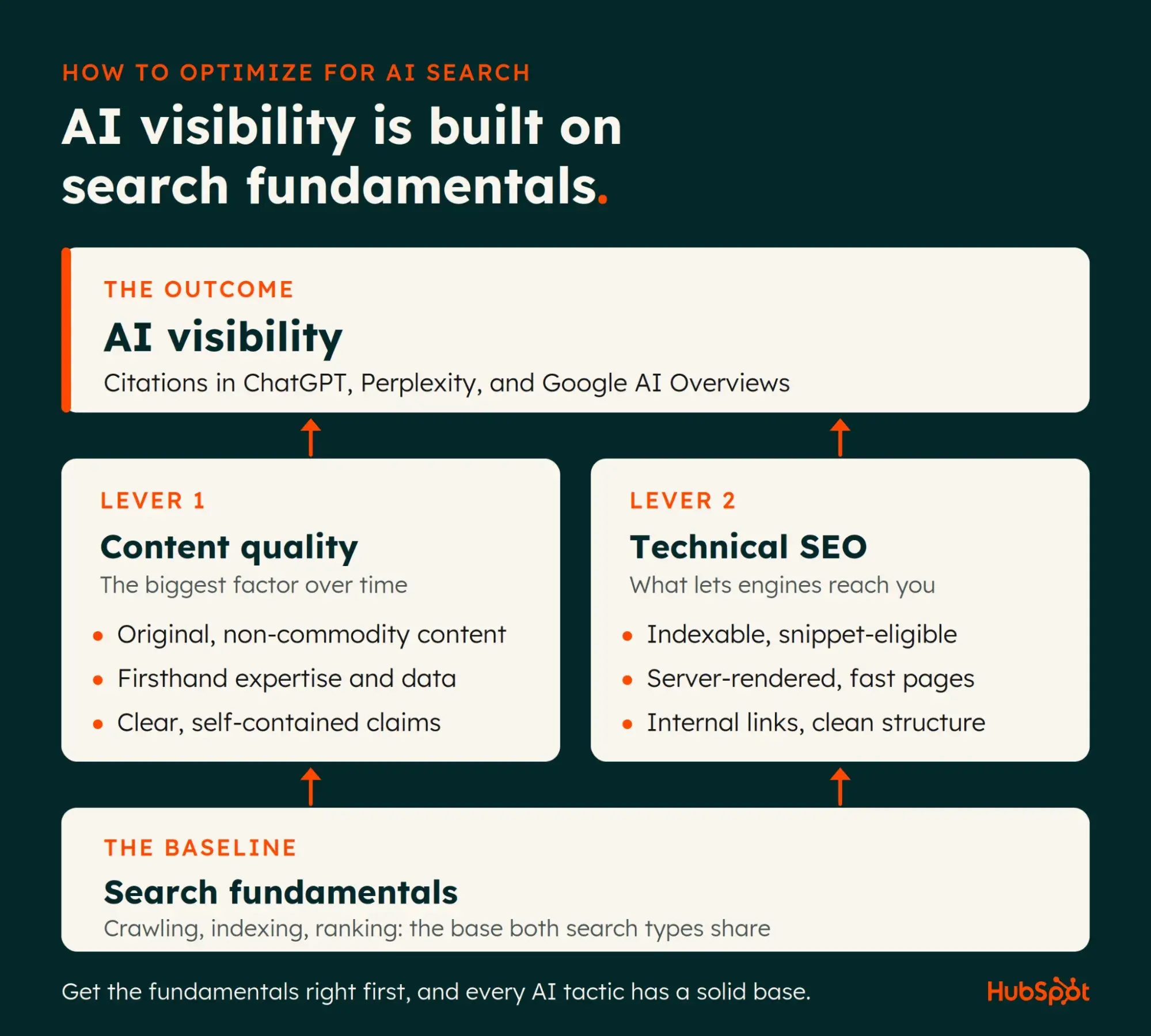
This shared technological foundation dictates that an enterprise must first clear baseline technical SEO requirements before attempting to capture AI citations. A webpage that cannot be efficiently crawled, rendered, and indexed by traditional bots inherently possesses fewer pathways into an AI-generated response. Furthermore, technical performance metrics play a profound role in citation frequency. Empirical analysis from SE Ranking reveals a direct correlation between site speed and citation success. Specifically, web pages achieving a First Contentful Paint of under 0.4 seconds average nearly 6.7 ChatGPT citations, whereas pages with load speeds exceeding 1.13 seconds average roughly 2.1 citations.
A critical vulnerability in modern technical execution involves the handling of client-side JavaScript. While advanced crawlers like Googlebot successfully render JavaScript when unblocked, many alternative AI scrapers process only raw HyperText Markup Language. Consequently, content dependent entirely on client-side rendering may appear entirely blank to crawlers utilized by platforms like Perplexity or specialized LLM agents. Industry standards now dictate that primary informational content must be served via server-side rendered HTML to maximize accessibility across diverse crawler architectures.
The Imperative of People-First, Non-Commodity Content
Beyond technical mechanics, content quality remains the single most influential variable governing long-term AI search visibility. Google’s official guidelines emphasize that unique, compelling, and useful content heavily dictates generative AI presence. AI models are inherently designed to recognize commodity content—information that merely repackages widely available consensus data—and have minimal incentive to cite pages that the model could theoretically synthesize internally from its pre-existing training parameters.
To overcome this limitation, content strategists are increasingly pivoting toward non-commodity assets defined by original proprietary data, firsthand subject-matter expertise, and distinct human perspectives. Data from empirical studies underlines this trend: content incorporating direct expert quotes draws an average of 4.1 ChatGPT citations compared to 2.4 for unquoted content, while pages containing 19 or more distinct data points average 5.4 citations against 2.8 for data-light alternatives.

Furthermore, the structural formatting of this expertise dictates extraction accuracy. Recent computational linguistics research indicates that bulleted lists and structured tables deliver up to 43% higher extraction accuracy for LLMs compared to identical information presented in traditional narrative prose. When insights are stated plainly and front-loaded within the opening paragraphs of a document, answer engines can more reliably lift them as self-contained, verifiable claims.
Divergent Behaviors Across Leading Answer Engines
A critical insight for contemporary digital strategists is that different answer engines exhibit distinct preferences regarding content types, citation frequency, and indexing velocity. Market analyses from research groups such as Fan Out indicate that platform behaviors vary significantly between conversational aggregators. Perplexity operates as a prolific citation engine, supplying roughly 59% of off-site citations analyzed in specific B2B studies and drawing on an average of 10.8 sources per answer. In contrast, ChatGPT maintains a more selective posture, averaging approximately 3.3 citations per query.
Furthermore, these platforms display distinct source preferences. Perplexity heavily weights community discussion platforms and user-generated content networks—such as LinkedIn, G2, and Reddit—which collectively account for over 17% of its citations. Conversely, ChatGPT demonstrates a stronger affinity for traditional long-form editorial and publisher articles. Experimental tracking by SE Ranking and Search Engine Land further illustrates temporal discrepancies; Perplexity has been observed indexing and elevating newly published domains within one to three days, whereas ChatGPT exhibits a more measured integration curve that strengthens over weeks of consistent publication and brand entity reinforcement. Notably, cross-platform overlap remains exceptionally low, with studies indicating that fewer than 8% of cited URLs appear across multiple competing answer engines.
Structured Data, Snippets, and Governance
To facilitate accurate parsing by machine learning models, structured data schema serves as a machine-readable map of webpage architecture. Industry authorities consistently caution that schema markup must strictly mirror the visible text consumed by human visitors. Employing disparate data structures for crawlers versus users constitutes cloaking, which violates core search quality guidelines and risks algorithmic penalization.
Concurrently, snippet controls act as critical gatekeepers for AI visibility. Directives established via robots meta tags, the X-Robots-Tag HTTP header, or inline attributes like data-nosnippet directly govern how much text an engine may extract. Because AI features rely on snippet-eligible indexing to formulate responses, overly restrictive character caps or inadvertent no-snippet declarations can inadvertently lock a high-value page out of generative summaries entirely.
Measuring Return on Investment and Strategic Implications
As corporate budgets increasingly shift toward Answer Engine Optimization, executive leadership demands measurable accountability. Advanced measurement workflows now integrate traditional analytics with specialized brand tracking tools to monitor mention frequency, sentiment analysis, and downstream conversion attribution. By tracking how generative citations influence pipeline acquisition rather than relying solely on traditional organic traffic metrics, organizations can accurately evaluate the commercial impact of their AEO investments.
Ultimately, the maturation of AI search underscores that digital discoverability is a dynamic, continuous discipline. Enterprises that establish robust technical foundations, prioritize authoritative firsthand research, and adapt their structural formatting to match the parsing habits of diverse large language models will secure a sustainable competitive advantage in the evolving digital economy.