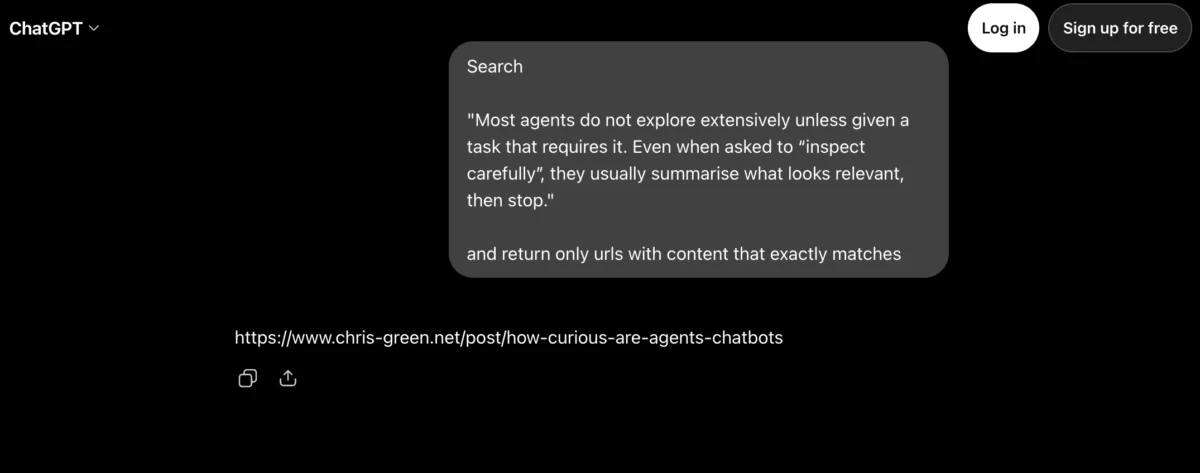
For decades, the standard procedure for search engine optimization (SEO) professionals to verify whether a specific web page had been indexed was to utilize the "site:" search operator. By prefixing a URL with "site:" in Google or Bing, practitioners could confirm if a search engine’s crawler had successfully ingested and categorized their content. In scenarios where access to Google Search Console (GSC) or Bing Webmaster Tools (BWT) was unavailable—such as when auditing a third-party site or performing competitive analysis—this operator served as the definitive litmus test for visibility. Similarly, copying a unique, substantial snippet of text from a page and searching for it within quotation marks allowed SEOs to confirm indexation and identify potential instances of content syndication or unauthorized scraping.
However, the rapid ascent of Large Language Model (LLM) powered search interfaces, such as ChatGPT Search and Perplexity, has introduced a new layer of complexity to the digital discovery landscape. As these AI tools shift from traditional link-based results to answer-based synthesis, the transparency of the "indexing" process has become increasingly opaque. While GSC and BWT remain the gold standards for diagnostic data, the current search environment requires supplementary methodologies to understand how generative AI systems perceive and retrieve specific web pages.
The Evolution of Retrieval Verification
The fundamental mechanism of search has transitioned from simple keyword matching to semantic retrieval. While traditional search engines still rely on indexation as the primary barrier to entry, AI-powered tools function by retrieving relevant "chunks" of information from their underlying data sources. If a user inputs a specific query, the AI must first retrieve the correct document from its index before it can synthesize an answer.
This creates a distinct challenge for content owners: if a page is not retrieved during the AI’s inference process, it is effectively invisible to the user, regardless of whether it resides in the backend database. To address this, industry experts have proposed a "retrieval-based verification" method. By prompting an AI chatbot to perform a search for a specific, verbatim string of text found on a target page, administrators can gain insight into whether that page is currently being utilized as a source of information.
The prompt, "Search for [insert snippet] and return any results which contain that exact text only," serves as a functional equivalent to the legacy "site:" search. When an AI returns the URL in question, it provides empirical evidence that the page has been successfully crawled, indexed, and deemed relevant enough to be included in the AI’s retrieval augmented generation (RAG) pipeline.
Fact-Based Analysis of AI Indexing Implications
The absence of a page in an AI’s search results does not necessarily indicate a failure of traditional indexing. Instead, it highlights a secondary hurdle: retrieval. A page may be fully indexed by Google, yet fail to appear in an AI response due to several technical or editorial factors.
First, the page may lack sufficient topical authority. AI models are trained to prioritize high-trust sources; if a page is considered low-authority, it may be filtered out during the ranking stage of the retrieval process. Second, the content may not be "distinct" enough. If the text snippet is generic or duplicates information found on higher-ranking, more authoritative domains, the AI system may prioritize those competing sources, effectively rendering the original page invisible in the response.
Furthermore, there is a temporal component to consider. The interval between a page being "crawled" and being "ready for retrieval" in an AI index can be significantly longer than in traditional search indices. Unlike the near-real-time updates of modern web crawlers, LLM knowledge bases are often subject to periodic updates or "refresh" cycles. Consequently, SEO professionals must exercise patience and perform longitudinal testing—revisiting the verification process over several days—to account for these latency periods.

Methodological Workflow for Verification
To standardize this verification process, professionals have begun developing custom tooling to bypass the manual, time-consuming nature of copy-pasting snippets into chat interfaces. One such initiative, the "Exactly Matchy" extension, provides a streamlined workflow for this task. By automating the extraction of text and the subsequent submission of a search prompt, such tools allow for the batch testing of multiple pages.
However, the integration of third-party extensions into browser environments carries inherent security risks. Security researchers caution that installing unverified extensions requires careful code review, as these tools often have the capability to read site data and interact with authentication tokens. For the enterprise-level SEO, the use of custom, internally vetted scripts remains the safest methodology for performing large-scale indexation checks.
The Broader Context of Search Performance
It is critical to distinguish between "retrievability" and "ranking." Confirming that an AI can return a page through a specific snippet search is not a guarantee that the page will drive organic traffic or appear in response to broader, intent-based queries.
If a page is retrievable but fails to generate traffic, the issue likely lies within the quality and relevance of the content itself. In an AI-first search world, content must be highly optimized for "information density." AI systems are programmed to synthesize the most relevant, helpful, and concise information. If a page fails to offer unique insights or fails to answer the user’s query with greater efficacy than its competitors, the AI will naturally omit it from its final output, even if it has access to the page in its index.
Strategic Considerations for Digital Stakeholders
The industry response to this shift has been one of adaptation rather than abandonment. While the reliance on GSC data remains paramount, the ability to test against AI-search interfaces provides a necessary, albeit informal, barometer for visibility in the emerging "Answer Engine" economy.
Industry analysts emphasize three key actions for those whose pages fail these retrieval tests:
- Technical Audit: Ensure that the page is not blocked by robots.txt or meta-robots tags, which would prevent the initial crawl.
- Structural Optimization: Improve the semantic structure of the content. Use clear headers and concise language that explicitly answers potential user questions, making the page more "retrievable" by AI models.
- Authority Building: Focus on signals that improve domain authority, as these remain the most significant factors in how AI systems weigh competing information sources.
Ultimately, this "workaround" serves as a bridge for the current transitionary period. As search engines continue to integrate generative AI more deeply into their primary interfaces, the distinction between a "search index" and an "AI knowledge base" will continue to blur. For now, the combination of traditional diagnostic tools and active AI-retrieval testing represents the most comprehensive approach to maintaining visibility in a landscape where the rules of engagement are being rewritten in real-time.
As the digital ecosystem moves forward, transparency remains the primary request from the SEO community. Whether through improved APIs from AI search providers or standardized protocols for RAG-based indexing, the need for verifiable data will continue to drive innovation in how we measure, monitor, and optimize for the future of search.