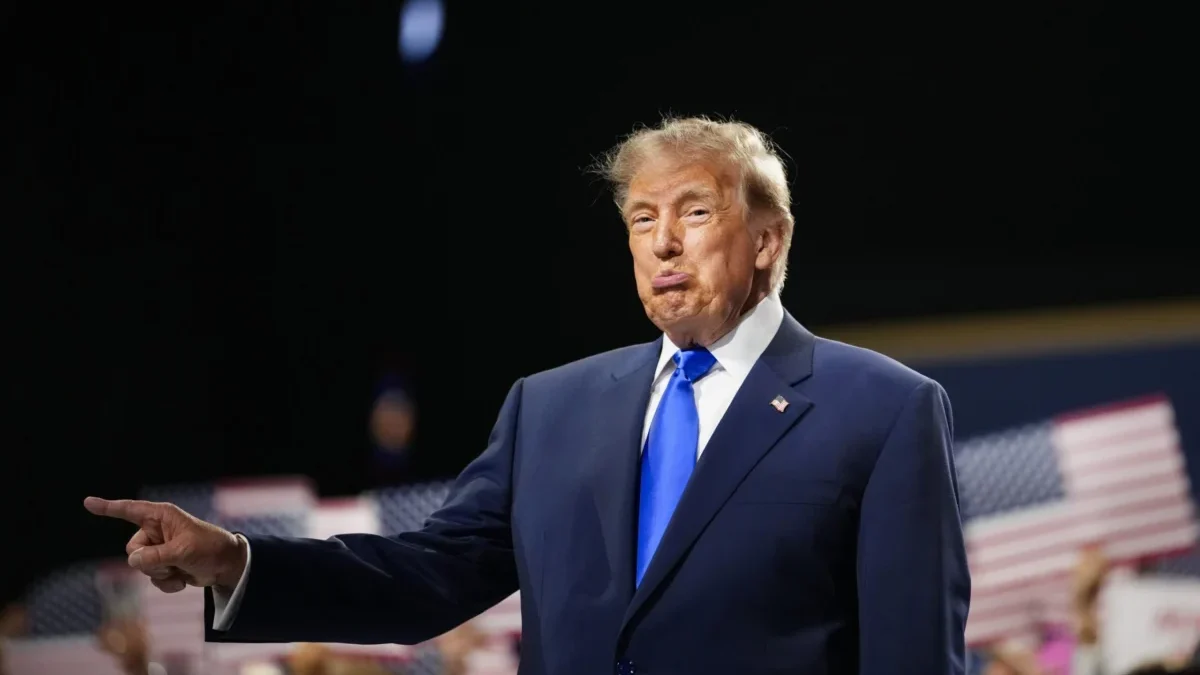
During a recent high-stakes campaign stop in North Carolina, former President Donald Trump reiterated a bold and fiscally ambitious campaign pledge: a $5,000 "dividend" payment to American citizens if he succeeds in the upcoming midterm elections. Addressing a cheering crowd in a critical battleground state, Trump framed the proposal as a straightforward economic stimulus. "If we win, we’re going to get you $5,000. So that’s it. Very simple," he stated. However, despite the gravity of such a promise in a climate defined by persistent inflation and economic anxiety, the proposal has been met with a resounding silence from the very Republican candidates currently fighting to maintain or capture congressional majorities.
The disconnect between the former president’s rhetoric and the day-to-day operations of down-ballot Republican campaigns highlights a growing strategic rift. As the party attempts to navigate the final stretch of the election cycle, many candidates appear to be treating the "Trump dividend" not as a core platform pillar, but as a political liability or an impractical abstraction.
A Pattern of Strategic Distance
The silence from GOP candidates is not accidental; it is a calculated effort to maintain control over their own campaign narratives. Approximately one week after the proposal was unveiled at an unconventional midterm convention in Dallas, there is virtually no evidence that Republican candidates in competitive districts have integrated the $5,000 pledge into their digital advertising, direct mail, or television spots.
For the most part, the pledge is absent from the airwaves. When candidates are pressed by journalists regarding the feasibility or specifics of the payment, the standard response is a pivot toward traditional fiscal talking points—tax cuts, deregulation, and border security. The reluctance suggests that campaign strategists view the proposal as a distraction that invites scrutiny regarding the national debt and the inflationary pressures currently straining the American economy.
Economic Context and the Reality of Implementation
The current economic landscape—characterized by fluctuating interest rates, elevated consumer prices, and volatile fuel costs—makes the prospect of a $5,000 handout particularly provocative. Economists have noted that such a direct cash injection, which would effectively cost the federal government more than $1 trillion, could theoretically exacerbate the very inflationary pressures that voters are currently citing as their primary concern.
The logistical and legislative hurdles to such a plan are significant. While Trump has suggested that the dividend could be funded through revenue generated by import tariffs and savings realized from the proposed Department of Government Efficiency, these mechanisms remain theoretical. Furthermore, the president’s assertion that the payment could be executed without congressional approval has been met with skepticism from legislative leadership. House Speaker Mike Johnson has indicated that such a major expenditure would unequivocally require congressional authorization, placing the decision squarely in the hands of the very legislators currently distancing themselves from the idea.
Chronology of the Proposal
The evolution of the $5,000 dividend pledge can be traced back to previous campaign cycles and earlier economic rhetoric from the Trump administration.
- Pre-2024 Cycle: During previous terms and early campaign appearances, Trump floated the idea of $2,000 payments to citizens, often linked to economic growth or savings from government restructuring. These proposals ultimately did not manifest into policy.
- The Dallas Convention: The current $5,000 figure was formally introduced during the party’s midterm convention in Dallas. The announcement was intended to energize the base and provide a clear, tangible contrast to Democratic economic policies.
- The North Carolina Rally: In the week following the convention, Trump doubled down on the promise in North Carolina, attempting to solidify it as a signature campaign pledge.
- The Present: As of mid-cycle, the pledge has largely stalled in the public discourse, overshadowed by discussions surrounding the One Big Beautiful Bill Act and localized campaign issues.
Institutional Support and Dissenting Voices
While the rank-and-file candidates have largely ignored the promise, the Republican National Committee (RNC) has attempted to frame the proposal as a central component of a broader, coherent economic vision. RNC spokesperson Natalie Baldassarre stated, "Of course we encourage all Republican candidates to run on his agenda, and that includes efforts to put more money in the pockets of the American people."
However, this encouragement has failed to gain significant traction. The rare exception to this trend is Republican Rep. Derrick Van Orden, who is running for reelection in a highly competitive Wisconsin district. Van Orden has voiced support for the proposal, positioning it as a direct benefit to his constituents. Yet, for most other candidates, the risk of alienating fiscal conservatives or providing an opening for Democratic attacks outweighs the potential populist appeal of the dividend.
Democratic Counter-Arguments and Strategic Analysis
The Democratic campaign arm has seized upon the proposal as a primary point of attack, framing it as a continuation of a pattern of broken promises. Viet Shelton, a spokesperson for the House Democratic campaign, characterized the idea as a "recycled broken promise that voters know Republicans will never deliver." By labeling the proposal as performative, Democrats are aiming to undermine the credibility of Republican economic messaging.
From a strategic standpoint, Republican strategists remain deeply divided. Doug Heye, a veteran Republican operative and former RNC communications director, offered a blunt assessment of why the proposal has failed to find a home in most campaigns. "It’s a dumb idea," Heye noted. "There’s no way to pay for it and it would spike inflation." His analysis underscores the broader tension within the party: the clash between the populist impulses of the party’s base and the traditional, fiscally conservative approach favored by many establishment strategists and vulnerable incumbents.
The Broader Impact on Campaign Strategy
The failure of the $5,000 dividend to gain widespread adoption suggests that Republican candidates are prioritizing localized, high-impact issues over nationalized, large-scale economic experiments. Most competitive campaigns have instead anchored their platforms to the One Big Beautiful Bill Act, which includes provisions like the elimination of taxes on tips and overtime pay. These policies are viewed as more grounded, easier to explain to voters, and less susceptible to the criticism of being inflationary.
Additionally, many candidates are choosing to focus on hyper-local concerns—such as infrastructure projects, regional healthcare access, and specific environmental issues—which resonate more effectively in individual districts. By avoiding the nationalized controversy of the $5,000 payout, candidates are attempting to insulate themselves from the volatility of presidential-level promises.
Future Implications for Legislative Governance
Should the Republican party retain control of the House and Senate, the existence of this pledge will likely create an immediate friction point between the legislative branch and the executive. If the promise is treated as a binding commitment by the base, the party will face a "day of reckoning" regarding the national debt.
If the proposal is discarded, it risks alienating the populist wing of the party that viewed the $5,000 dividend as a tangible solution to their economic hardships. If the party attempts to move forward with it, they will face a difficult path in the legislative process, requiring them to find trillions in offsets—a task that would likely necessitate painful cuts to other government programs or significant tax increases elsewhere, both of which are politically fraught.
In conclusion, the $5,000 dividend stands as a microcosm of the current state of American politics: a high-profile, emotionally resonant promise that clashes with the realities of fiscal policy and the strategic necessities of local campaigning. As the midterm elections approach, the absence of this proposal from the mainstream Republican campaign toolkit serves as a testament to the fact that while slogans may capture a crowd, the hard work of governance requires a level of economic detail that is often left behind in the fervor of a campaign rally.