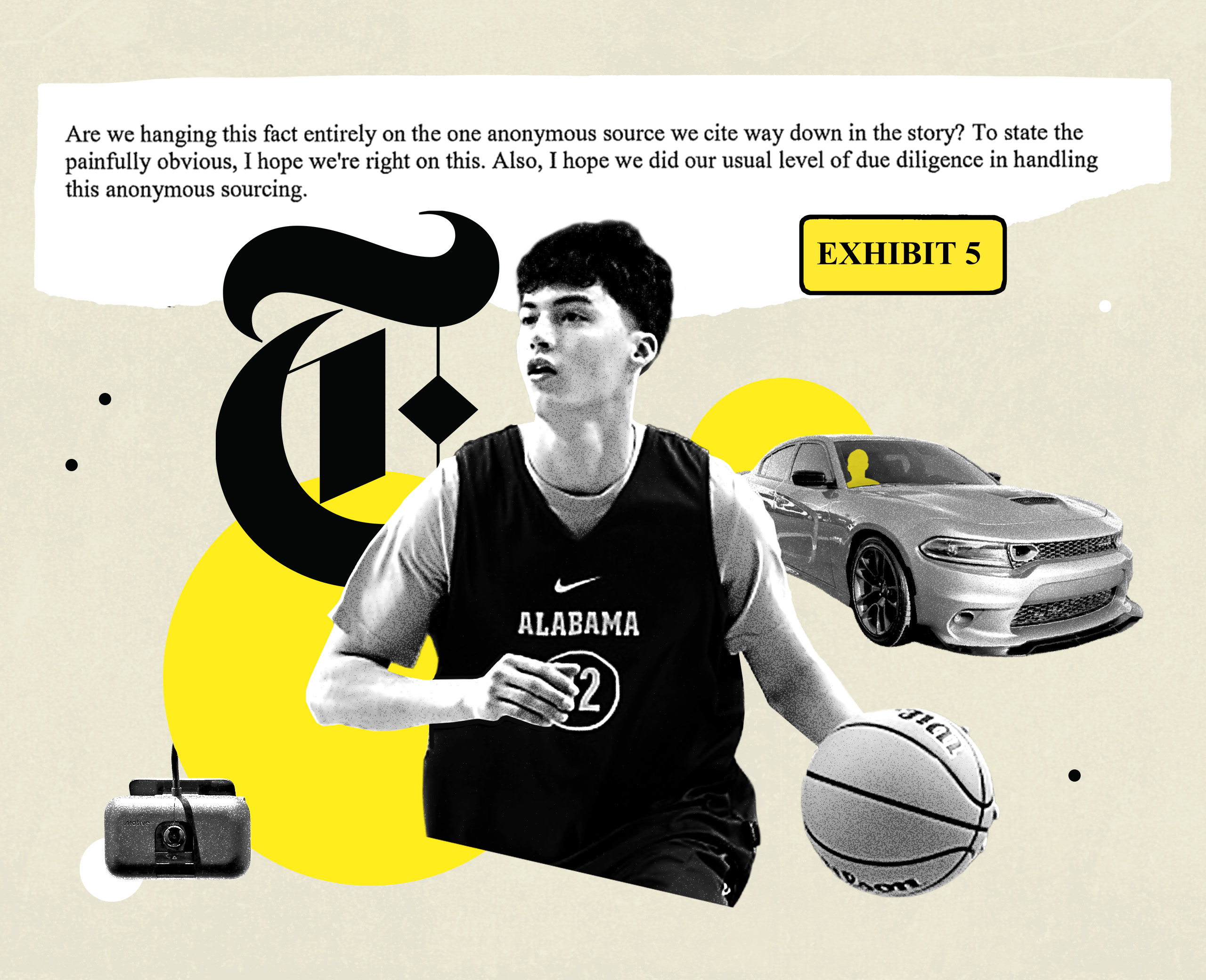
The evening of March 16, 2023, began with an internal administrative warning that would ultimately foreshadow a historic courtroom defeat for the newspaper of record. Phil Corbett, then the associate managing editor and standards editor at the New York Times, fired off an email to the leadership of the paper’s sports section following the publication of a high-profile scoop. The report linked a University of Alabama basketball player to a fatal shooting on the Tuscaloosa strip. Corbett’s message was a stark piece of institutional caution: “To state the painfully obvious, I hope we’re right on this. Also, I hope we did our usual level of due diligence in handling this anonymous sourcing.”
Corbett’s anxieties were well-founded. What followed was a journalistic misfire of historic proportions, culminating last month in a United States District Court verdict in the Northern District of Alabama. A federal jury ordered the New York Times Company to pay $9.25 million in damages to Kai Spears, a former University of Alabama freshman basketball player whose life and collegiate career were upended when the paper mistakenly placed him in a car at the scene of a tragic murder. While District Judge Annemarie Carney Axon later trimmed the award to $4.75 million, ruling the punitive damages excessive, the legal blow marked the first domestic defamation trial loss for the Times in over half a century.
An examination of hundreds of pages of court filings, deposition transcripts, and internal communications reveals a cascading series of journalistic missteps. From shaky anonymous sourcing and flawed face-to-face interviews to a sluggish, 79-day correction window and an internal email trail stripped of attorney-client privilege, the case offers a sobering case study in the perils of high-stakes deadline reporting.
The Tragedy in Tuscaloosa and the Origins of a Rumor
The foundational events of the underlying tragedy occurred in the early morning hours of January 15, 2023. Hours after a University of Alabama basketball game, players and acquaintances spent the evening visiting local establishments, including the Houndstooth Bar, Moe’s Original BBQ, and a local Waffle House. Sometime after midnight, an escalating dispute on the Strip culminated in gunfire.
A 23-year-old mother of a young child, serving as an innocent passenger in a passing vehicle, was struck and killed by a stray bullet. The shooter was subsequently convicted of murder. Meanwhile, Darius Miles, a member of the Alabama basketball squad, was implicated in allegedly providing the weapon used in the offense. Miles pleaded not guilty and faced capital murder charges, alongside subsequent felony additions.
In the wake of the shooting, local journalists immediately began probing the periphery of the event. Reporters quickly learned that an unidentified individual associated with the basketball program had been present in one of the vehicles during the exchange of gunfire. Local investigative reports, notably by Ryan Phillips of the Tuscaloosa Patch, quickly cleared up the identity of this individual. Police records and local sources confirmed that the person in the car was an Alabama basketball manager—someone who had been formally cleared by local law enforcement—and explicitly not a player.
The Reporting Process and the Anonymous "Source A"
Two months later, as the NCAA men’s basketball tournament loomed, veteran Times sports reporter Billy Witz traveled to Tuscaloosa to examine the institutional fallout of the shooting on the university’s top-ranked team. During his visit, Witz consulted documents and met with an individual identified in court briefs only as “Source A.”
According to deposition testimony given by Witz in July 2024, Source A showed him documents and a surveillance video depicting the scene of the shooting. Yet, under cross-examination by Stephen New, attorney for Kai Spears, Witz conceded that the surveillance footage was not definitive. When New asked if Spears was depicted in the video, Witz admitted, “I don’t believe so.”
Prior to publication, Witz traveled to Birmingham to meet with the basketball team and secured a brief, recorded locker-room interview with Spears, then an 18-year-old freshman. The audio transcript revealed a halting exchange:
Witz: “Kai? Hey, I’m Billy Witz with the New York Times.”
Spears: “Nice to meet you.”
Witz: “Hey, I know this is a touchy subject, but I understand you were in the car on the night of the shooting, and I could only imagine—I saw the video of it—I mean, I could only imagine, like, how terrifying that must have been. I mean—can you just describe, like, kind of what—”
Spears: “I’m sorry. I’m not going to be able to speak on that matter.”
Witz: “Okay. Okay. Okay. Like, anything? Or—okay, all right. Okay. Sorry. Thanks. Okay.”
Crucially, Witz never directly asked Spears if he was a passenger in the vehicle. In a grueling ten-hour deposition, New grilled the reporter on this critical omission. Witz defended his approach by stating he believed the premise was true and prioritized asking about the player’s emotional reaction to the video. When New pressed whether an explicit question might have elicited a denial that would have stopped the story, Witz admitted, “I don’t think we would have run the story.”
Publication, Immediate Denials, and Institutional Defiance
The article was published online on March 15, 2023, under the definitive headline: “A Fourth Player Was at a Deadly Shooting, in a Car Hit by Bullets.” The piece relied on a collaborative editing process between Witz and editor Oskar Garcia. The copy asserted without immediate attribution that the fourth player was “Kai Spears, a freshman walk-on whose presence at the scene had not been previously reported.” Nine paragraphs later, the text attributed the claim to a single anonymous person familiar with the case.
The reaction was swift and unequivocal. Hours after publication, attorney Stephen New fired off an email to the Times denouncing the claim as “demonstrably false and libelous.” The University of Alabama athletic department released an official statement labeling the report inaccurate. Spears posted a public statement on social media accusing the paper of a complete disregard for the truth, while his father, Christian Spears, then the athletic director at Marshall University, announced they were exploring legal remedies.
Despite the mounting pushback, the Times newsroom dug in. Internal messaging revealed that while colleagues reached out to check on Witz’s confidence, Witz privately acknowledged some equivocation from his source and noted that another source warned he might be wrong. Nevertheless, the paper’s public posture remained defiant. A spokesperson repeatedly told media outlets that the Times stood firmly by its reporting.
The Correction and the Road to Trial
It was not until May 30, 2023, after Spears filed a formal defamation lawsuit in federal court, that the paper’s resolve began to crack. As legal discovery forced the disclosure of true records, it became clear that Cooper Lee, a student team manager, was the actual occupant of the vehicle.
On June 2, 2023, nearly two months after the initial publication, the Times published a corrective piece written by investigative reporter Steve Eder, titled “Alabama Basketball Manager Says He, Not Player, Was at Deadly Shooting.” The original story was amended with a softer headline, and editors appended a formal correction.
Throughout the subsequent litigation, representatives for the Times maintained that the error was an "honest mistake" committed by a diligent journalist acting in good faith. Company representatives argued that despite receiving denials from the university and Spears’s camp, alternative sources were unwilling to provide verifiable alibis during the immediate aftermath, leaving the paper unable to independently confirm the error prior to the lawsuit.
During the trial itself, Witz took the stand and offered a direct apology to Spears, stating he wanted to own up to the misidentification. However, the jury remained unpersuaded that the paper’s pre-publication due diligence met professional standards. After a brief deliberation, the panel awarded $9.25 million to Spears, marking a painful reckoning for an organization unaccustomed to domestic trial losses.
Broader Implications for Modern Journalism
The fallout from Spears v. The New York Times Company serves as a cautionary tale for modern newsrooms navigating the pressures of digital-age publishing, anonymous sourcing, and rapid news cycles.
Media ethics experts note that institutional skepticism—the healthy instinct to question denials issued by powerful universities or PR offices—must be balanced against rigorous source validation. When a published report relies primarily on a single anonymous source and faces immediate, universal refutation by key stakeholders, the burden of proof shifts back to the newsroom.
As news organizations grapple with shrinking resources and heightened legal scrutiny, the Alabama verdict underscores a foundational maxim of journalism: the speed of a scoop must never outpace the rigor of verification, and the courage to break a story must be matched by the integrity to correct it swiftly when evidence proves it wrong.