The modern digital landscape is undergoing a massive structural shift. Traditional search engine optimization (SEO), long the cornerstone of digital marketing, is increasingly sharing the stage with Answer Engine Optimization (AEO). As consumers migrate from typing keywords into traditional search bars to asking conversational questions of generative artificial intelligence models like OpenAI’s ChatGPT, Google Gemini, and Perplexity, businesses are forced to adapt. This evolution has given birth to a brand-new corporate expense line item: the AEO budget.
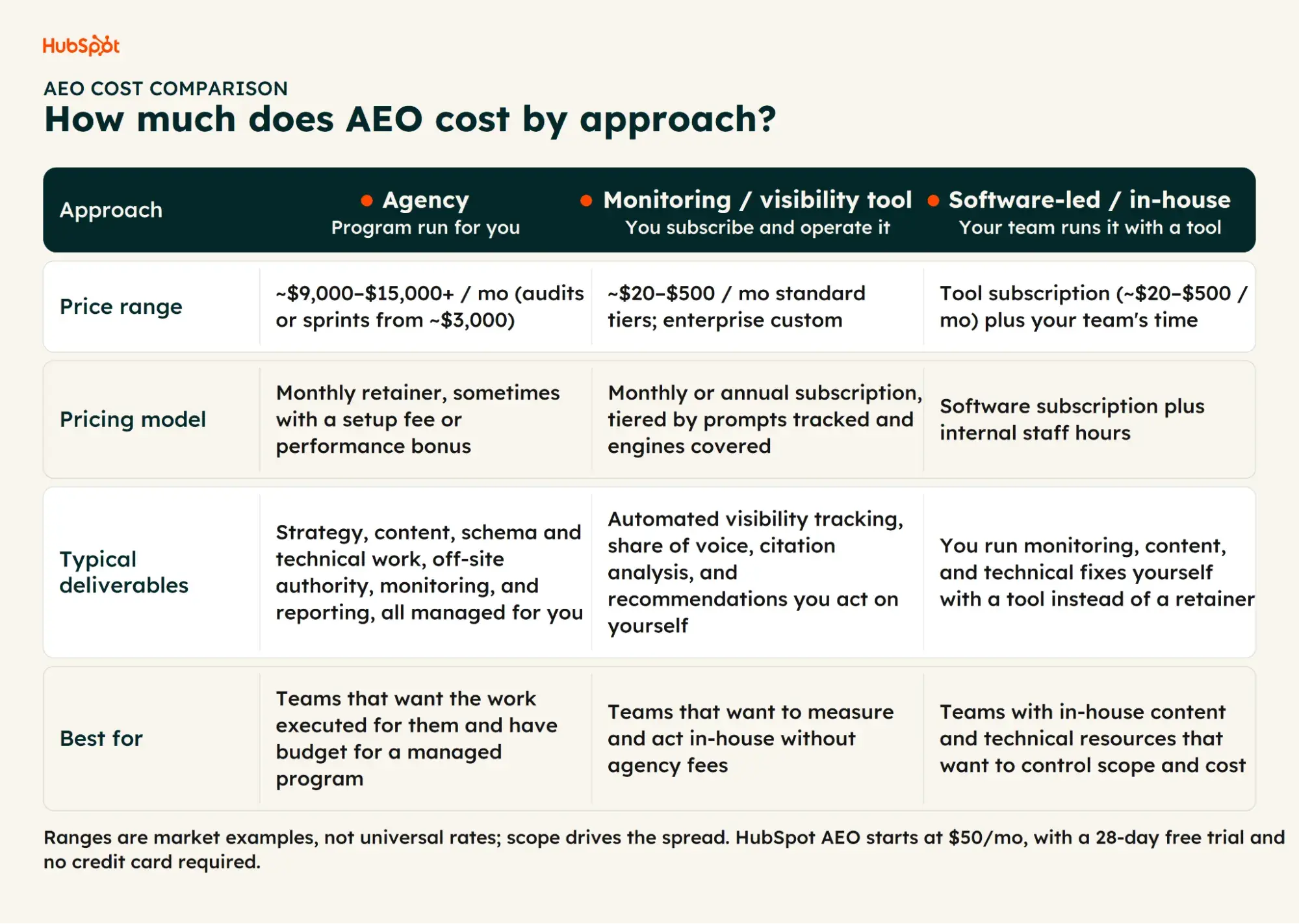
Understanding how much AEO costs requires looking across a broad spectrum of services and technologies. At its baseline, AEO can cost roughly $30 to $50 a month for a self-managed monitoring tool. At the high end, comprehensive, full-service agency programs designed to overhaul an entire brand’s digital footprint can easily exceed $15,000 a month, with a wide array of customized options resting in between. Deciding where an organization lands on this financial spectrum depends almost entirely on the scope of work required, internal team capabilities, and strategic growth goals.
The Origins and Background of the AEO Economy
The rapid commercialization of large language models (LLMs) fundamentally altered how users discover information, products, and services online. While search engines historically rewarded brands for ranking web pages based on keyword density, backlinks, and technical health, answer engines synthesize information to provide direct, synthesized responses. Consequently, appearing as a cited source within an AI-generated answer has become critical for brand survival.
Data collected across the digital marketing sector highlights the urgency of this transition. Industry research indicates that AI-driven referral traffic roughly tripled over a twelve-month period leading into late 2025. Although LLM referrals still account for a relatively modest slice of overall web traffic—typically sitting below 2% of total referral datasets—their influence on high-intent buyer journeys is disproportionately large. Early adopters of AEO are finding that users coming via AI platforms often exhibit higher conversion rates because the artificial intelligence has already pre-qualified the brand as an authoritative answer.
Recognizing this trend, marketing technology vendors and specialized agencies rushed to build out products and services tailored to AI visibility. By 2026, the marketplace matured into distinct tiers, making it vital for chief marketing officers and business owners to carefully evaluate pricing models before committing capital.

AEO Pricing Across Approaches: Agencies, Monitoring Tools, and In-House Software
Most marketing departments evaluating the cost of AEO choose among three primary operational approaches: hiring an external agency, purchasing dedicated monitoring and visibility software, or executing an in-house strategy utilizing modern software toolkits.
-
Agency Programs and Retainers
For enterprises lacking internal technical SEOs, prompt engineers, or content creators, full-service agencies offer comprehensive AEO management. One-time audits or initial strategy sprints generally start around $3,000. Meanwhile, ongoing monthly retainers typically range from $9,000 to over $15,000. For custom enterprise solutions featuring extensive off-site authority building and continuous multi-engine prompt testing, costs can climb even higher. Agencies generally bill via a monthly retainer, sometimes paired with a setup fee or a hybrid performance model. -
Monitoring and Visibility Software
Businesses that prefer to execute strategy internally frequently rely on standalone tracking platforms. Standard self-serve monitoring software ranges from approximately $29 to $489 per month, with pricing tiers usually metered by the volume of prompts tracked and the specific AI engines covered. For example, entry-level tools may start around $30 to $50 a month for basic multi-engine tracking (such as HubSpot AEO at $50/mo), while more robust enterprise tools or higher-tier plans like Profound or Peec AI can scale from $95 to nearly $500 monthly for comprehensive share-of-voice analytics. -
Software-Led and In-House Execution
Taking an in-house approach requires paying for a software subscription while absorbing the internal labor costs of content writers and technical developers. Platforms like HubSpot have integrated AEO tracking directly into broader marketing suites—such as Marketing Hub Professional and Enterprise—while also offering standalone access. This path allows organizations with existing marketing talent to control scope and expenditure without paying steep agency markups.
Key Drivers Behind AEO Pricing Variations
The extreme variance in AEO pricing is rarely driven by arbitrary vendor markups; rather, it reflects the underlying complexity of optimizing for non-deterministic AI models. Five primary factors dictate where an organization’s expenditures will land:

- Scope of Work: Paying solely for visibility tracking is inexpensive. Adding technical schema markup, content restructuring, and off-site entity building significantly increases labor requirements and cost.
- Content Library Size: Brands with thousands of legacy pages require significantly more auditing, updating, and semantic structuring than startups with lean digital footprints.
- Number of Engines and Prompts Tracked: Monitoring visibility across a single engine like ChatGPT is far less resource-intensive than tracking hundreds of customized buyer prompts across ChatGPT, Gemini, Perplexity, Claude, and specialized vertical AI models.
- Competitor Density: Highly competitive industries—such as SaaS, financial services, or healthcare—require aggressive, continuous optimization to displace established market leaders inside AI citations.
- Provider Expertise: Specialized agencies with proven track records in LLM behavior and semantic search algorithms command premium pricing compared to generalist digital marketing firms.
AEO Versus SEO: Understanding the Relationship and Budget Allocation
A common pitfall for organizations diving into AEO is the assumption that it can entirely replace traditional search engine optimization. Industry experts emphasize that AEO and SEO are complementary disciplines rather than interchangeable substitutes.
Both strategies rely on the same foundational pillars: clear, authoritative, and structurally sound content hosted on a technically reliable website. However, their mechanics and metrics diverge sharply. SEO aims to rank web pages within traditional search engine results pages (SERPs) to earn clicks, measured via rankings, click-through rates (CTR), and impressions. AEO, conversely, strives to have a brand cited directly within conversational AI summaries, measured through brand mentions, citation frequency, and share of voice. Furthermore, while SEO caters to human readers skimming hyperlinked lists, AEO must satisfy the underlying machine learning algorithms that parse, weigh, and synthesize information before presenting it to the user.
Crucially, strong traditional SEO performance often feeds AEO success. Pages that rank prominently on Google are frequently pulled as authoritative source citations by LLMs. Consequently, abruptly defunding SEO to finance an aggressive AEO campaign can inadvertently damage the organic search rankings that support AI citations. Marketing executives are advised to treat AEO as an expansion of their existing search budgets rather than a reason to dismantle proven SEO frameworks.
Red Flags to Watch Out For in AEO Pricing
Because the AEO sector remains relatively young and standardized metrics are still evolving, deceptive pricing practices and inflated promises occasionally plague the market. Decision-makers should exercise caution when encountering specific warning signs:
- Guarantees of Exact AI Rankings: Because generative AI models are non-deterministic—meaning they can generate different responses to the exact same prompt run sequentially—no vendor can legitimately guarantee a specific, permanent position inside an AI answer.
- Vague "Full Optimization" Packages: Contracts that lack specific deliverables (such as the number of prompts tracked, schema implementations, or content pieces produced) often result in mismanaged expectations and wasted capital.
- Hidden Enterprise Lock-Ins: Be wary of software or agency providers that enforce rigid, multi-year contracts without offering an initial pilot phase or a performance-based exit clause.
- Rebranded Basic SEO: Some agencies attempt to repackage standard keyword research and basic meta-tag updates as cutting-edge "AI optimization" while charging inflated retainers.
Structuring a Cost-Effective 60-to-90-Day AEO Pilot
To mitigate financial risk and build a credible business case for executive stakeholders, organizations should consider launching a structured 60-to-90-day AEO pilot before committing to long-term retainers or expensive software tiers.
A successful pilot should remain lean and focused. Rather than attempting a massive content overhaul—which moves too slowly to measure within a three-month window—teams should anchor their pilot on affordable monitoring tools and diagnostic audits. For lean teams, the optimal priority order includes establishing a baseline visibility metric, tracking brand mentions across primary engines like ChatGPT, Gemini, and Perplexity, and identifying quick technical fixes on high-traffic landing pages.
Many software providers facilitate this exploratory phase by offering risk-free evaluations. For instance, platforms like HubSpot AEO provide introductory trials—such as a 28-day trial tracking 25 prompts across major engines without requiring a credit card—allowing small teams to map out their initial AI footprint at virtually no out-of-pocket cost. Following a trial, adopting a standard self-serve monitoring tier at roughly $50 a month limits a three-month exploratory pilot to a nominal financial investment while delivering continuous, actionable citation data.
Implications and Future Outlook
As artificial intelligence continues to reshape how humanity accesses information, Answer Engine Optimization is transitioning from an experimental tactic to a core component of digital corporate strategy. The financial commitment required to succeed in this space varies wildly based on an organization’s internal resources, ranging from modest monthly software subscriptions for self-sufficient teams to five-figure monthly retainers for enterprises outsourcing to specialized agencies.
Ultimately, organizations that approach AEO as a deliberate, measurable extension of their broader search and content marketing strategies—grounded in rigorous data tracking and realistic pilot phases—will be best positioned to capture high-intent digital traffic in the age of generative AI.