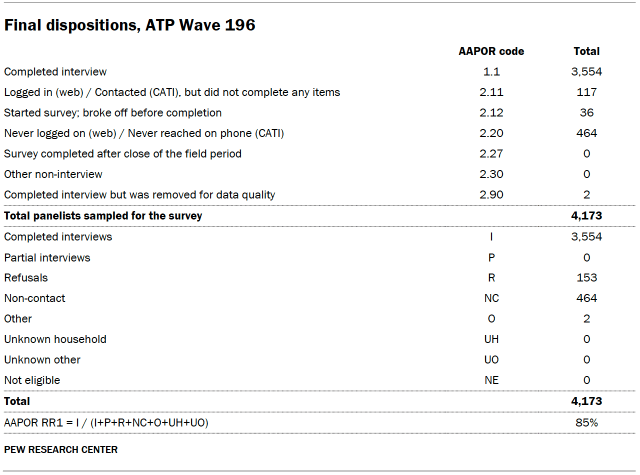
Pew Research Center’s American Trends Panel (ATP) continues to serve as a cornerstone for understanding the complex dynamics of public opinion in the United States. Its rigorous and transparent methodology underpins the credibility of its findings, providing a vital resource for policymakers, academics, and the public. The latest iteration, Wave 196, conducted from July 6 to July 12, 2026, exemplifies the Center’s unwavering commitment to scientific polling standards amidst an evolving landscape for survey research. This particular wave successfully engaged 3,554 panelists out of a sampled 4,173, yielding an impressive survey-level response rate of 85%. Such a high response rate for a national survey underscores the efficacy of the ATP’s established protocols and the commitment of its participants.
The meticulous design of Wave 196 aimed to capture a precise snapshot of American sentiment, with a reported margin of sampling error for the full sample standing at plus or minus 1.9 percentage points. This level of precision is critical for the nuanced analysis of societal trends and political leanings that Pew Research Center is renowned for. The survey notably incorporated oversamples of non-Hispanic Asian adults, 18- to 29-year-old validated voters, and Hispanic validated voters. This strategic oversampling is not merely a statistical technique but a deliberate effort to ensure that the voices and experiences of these smaller, yet demographically significant, subgroups are adequately represented and analyzed with greater accuracy, ultimately enriching the overall data quality and the depth of insights derived.
Evolution and Foundation of the American Trends Panel
The American Trends Panel itself is a testament to the ongoing adaptation required in modern survey research. Established in 2014, the ATP was conceived as a nationally representative panel of randomly selected U.S. adults, designed to provide consistent, high-quality data over time. Its evolution reflects a proactive response to the increasing challenges faced by traditional polling methods, such as declining landline usage and the rise of mobile-only households. Initially, prior to 2018, the ATP relied on a blend of landline and cellphone random-digit-dial (RDD) surveys for recruitment, administered in both English and Spanish. This approach, while standard for its time, presented inherent limitations in terms of reach and potential biases.
A significant methodological shift occurred in 2018 when the ATP transitioned to address-based sampling (ABS) for panel recruitment. This strategic move leverages the U.S. Postal Service’s Computerized Delivery Sequence File, a robust database estimated to cover an impressive 90% to 98% of the U.S. population. The ABS method offers several advantages, including a more comprehensive frame coverage than telephone-based methods, the ability to reach households without traditional landlines, and a reduction in reliance on self-reported contact information. For each sampled household, a systematic "next birthday" method is employed to select an adult participant, a common practice designed to minimize within-household selection bias. This continuous refinement of recruitment strategies ensures the panel remains representative and capable of capturing the diverse fabric of American society.
Furthermore, the ATP has consistently undertaken additional recruitment efforts, known as "oversamples," to enhance the statistical precision for specific demographic groups that are often underrepresented in general population samples or are of particular research interest. For instance, Hispanic adults were oversampled in 2019, Black adults in 2022, and Asian adults in 2023. These targeted efforts demonstrate a commitment to providing detailed insights into the experiences and opinions of America’s increasingly diverse population segments, ensuring that research findings are not only broadly representative but also deeply nuanced. The oversampled groups are subsequently weighted back to reflect their correct proportions in the total population, preventing any undue influence on overall population estimates while allowing for robust subgroup analysis.
Wave 196: Design and Execution
The sample design for Wave 196 specifically targeted noninstitutionalized persons aged 18 and older living in the United States. It employed a stratified random sampling approach from the existing ATP, where the pre-identified oversample groups—non-Hispanic Asian adults, 18- to 29-year-old validated voters, and Hispanic validated voters—were selected with certainty. The inclusion of "validated voters" is particularly significant, as it allows for more accurate analysis of political engagement and voting patterns, especially pertinent given the upcoming political cycles in the United States. The remaining panelists were sampled at rates carefully calibrated to ensure that each stratum’s representation in the final respondent pool mirrored its proportion in the broader U.S. adult population as closely as possible. This intricate sampling design, combined with sophisticated weighting adjustments, is paramount to producing unbiased and reliable data.
The development of the survey questionnaire itself is a collaborative and meticulous process. For Wave 196, the questionnaire was developed by experts at Pew Research Center in close consultation with SSRS, the survey research firm contracted to conduct the data collection. This partnership ensures that questions are not only conceptually sound and aligned with research objectives but also empirically robust and free from unintended biases. Before deployment, the web program for online respondents underwent rigorous testing across various platforms, including both PC and mobile devices, by both the SSRS project team and Pew Research Center researchers. Furthermore, test data was populated and analyzed using statistical software like SPSS to verify the integrity of survey logic, question flow, and randomization procedures. This exhaustive testing phase is crucial for identifying and rectifying any potential issues that could compromise data quality, ensuring a seamless and valid respondent experience.
Incentivizing Participation and Ensuring Data Quality
Recognizing the importance of respondent engagement, especially for panel surveys, all participants in Wave 196 were offered a post-paid incentive. These incentives, ranging from $5 to $15, were offered in the form of a check or a gift code for popular online retailers such as Amazon.com, Target.com, or Walmart.com. The use of differential incentive amounts is a strategic methodological choice, designed to address known disparities in survey response propensities across various demographic groups. By offering higher incentives to groups historically harder to reach, the ATP actively works to mitigate nonresponse bias, thereby fostering broader participation and enhancing the representativeness of the final dataset. This approach acknowledges the time and effort panelists invest in contributing to public knowledge.
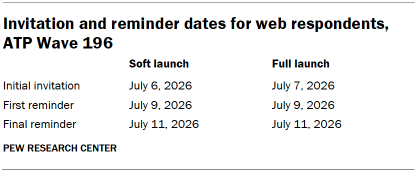
The data collection protocol for Wave 196 was a carefully orchestrated, multi-modal operation, spanning July 6 to 12, 2026. Data was collected through both self-administered web surveys and live telephone interviews, maximizing reach and accommodating different respondent preferences. For online panelists, the process began with postcard notifications mailed to a subset on July 6. The survey invitations were then rolled out in two phases: a soft launch on July 6 for 60 panelists, followed by a full launch on July 7 for all remaining English- and Spanish-speaking sampled online panelists. Panelists received initial email invitations and up to two email reminders if they had not yet responded. Additionally, for those who had consented, SMS invitations with a direct link to the survey and subsequent SMS reminders were dispatched, reflecting an adaptive approach to communication in the digital age.
For panelists who preferred or required live telephone interviewing, the process also involved strategic outreach. Prenotification postcards were mailed on July 2. A soft launch for telephone interviews commenced on July 6, with dialing continuing until a total of three interviews were completed, allowing for early quality checks. Subsequently, all remaining English- and Spanish-speaking sampled phone panelists were contacted throughout the remaining field period, with trained SSRS interviewers making up to six calls to ensure every opportunity for participation was extended. This dual-mode approach is a hallmark of robust survey methodology, balancing efficiency with accessibility and personal engagement.
Data quality checks are an indispensable component of the ATP’s methodology. Even with rigorous recruitment and data collection, the potential for "satisficing"—where respondents provide minimal effort answers rather than thoughtful ones—exists. To counter this, Center researchers performed thorough data quality checks to identify patterns indicative of satisficing, such as unusually high rates of blank answers or consistent selection of the first or last answer option. These meticulous reviews led to the removal of two ATP respondents from the Wave 196 dataset prior to weighting and analysis, underscoring the commitment to maintaining the highest possible data integrity.
The Intricacies of Weighting and Statistical Reliability
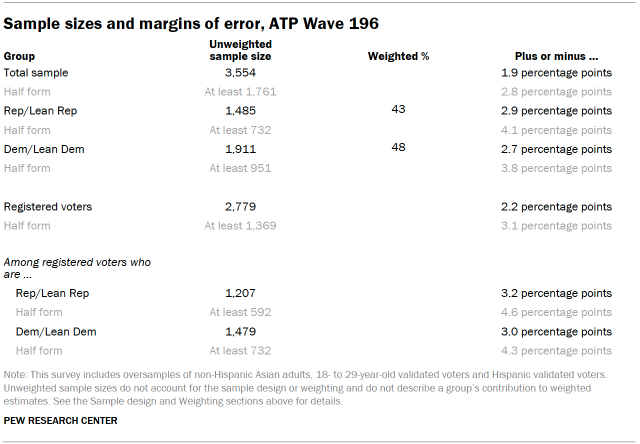
Weighting is perhaps one of the most complex yet critical stages in producing reliable survey data. The ATP employs a multi-stage weighting process that meticulously accounts for various probabilities of selection and nonresponse occurring at different points in the panel survey journey. Initially, each panelist is assigned a base weight, which directly reflects their probability of recruitment into the panel. These initial weights are then calibrated against established population benchmarks to correct for nonresponse in the initial recruitment surveys and any subsequent panel attrition. If only a subsample of panelists is invited to participate in a particular wave, this weight is further adjusted to account for any differential probabilities of selection within that subsample.
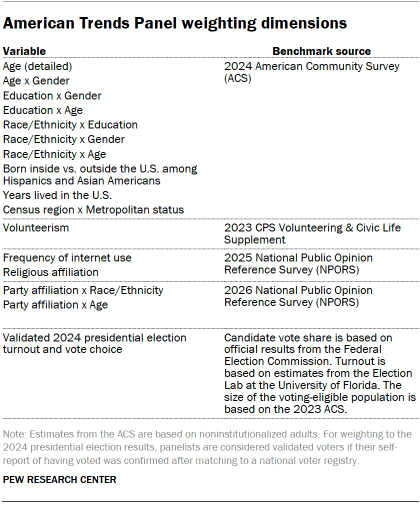
Once panelists complete the survey, the weights are calibrated a second time. This involves aligning the respondent sample with a comprehensive set of population benchmarks, as outlined in the accompanying tables, which typically include demographic variables such as age, gender, race/ethnicity, education, region, and voter registration status. This iterative calibration process ensures that the final weighted sample accurately reflects the demographic composition of the target U.S. adult population. To further enhance statistical stability and reduce variance, the weights are then "trimmed" at the 1st and 99th percentiles, mitigating the impact of extreme weights that could disproportionately influence results. It is crucial to note that all reported sampling errors and tests of statistical significance rigorously incorporate the effect of this complex weighting scheme, providing a more accurate reflection of the survey’s reliability.
Understanding the survey’s reliability also involves a clear grasp of its response rates and margin of error. While Wave 196 achieved an impressive 85% survey-level response rate, indicating strong engagement from sampled panelists, the cumulative response rate was 3%. This distinction is vital: the survey-level rate measures participation among active panelists invited to a specific wave, whereas the cumulative rate accounts for nonresponse at every stage, from initial recruitment to panel attrition and finally, wave participation. While a 3% cumulative response rate might appear low to an untrained eye, it is considered robust for a probability-based, address-recruited panel in the contemporary survey environment, reflecting the inherent challenges of engaging a truly representative cross-section of the population over time.
The margin of sampling error for the full sample of 3,554 respondents was calculated at plus or minus 1.9 percentage points at the 95% level of confidence. This means that if the survey were conducted 100 times, the true population value would fall within the reported range 95 times. However, it is a critical tenet of survey research to acknowledge that sampling error is not the sole source of potential inaccuracy. Other factors, such as question wording, the order of questions, interviewer effects, non-coverage of certain populations, and non-response bias, can also introduce error or bias into the findings. Pew Research Center’s methodology, with its rigorous questionnaire development, multi-modal data collection, and comprehensive weighting, is designed to minimize these non-sampling errors to the greatest extent possible.
Broader Impact and Implications
The meticulous methodological approach employed by the American Trends Panel carries significant implications for the broader landscape of public opinion research and informed public discourse. In an era often characterized by fragmented information and concerns about data integrity, the ATP stands as a beacon of reliability and transparency. The commitment to robust methods, from address-based sampling and strategic oversampling to rigorous data quality checks and sophisticated weighting, ensures that the insights derived from the ATP are not merely anecdotal but are statistically sound and representative of the diverse American public.
For policymakers, these data provide an evidence-based foundation for understanding public priorities, attitudes towards critical issues, and the impact of policy decisions. For the media, it offers a credible source to report on societal trends, political shifts, and demographic changes. For the academic community, it provides a rich dataset for further research and analysis, contributing to a deeper understanding of human behavior and social structures. The detailed methodological documentation, such as that provided for Wave 196, serves as a vital resource, allowing users of the data to fully comprehend its strengths and limitations, thereby fostering responsible interpretation and usage of the findings.
The continuous evolution of the ATP, as evidenced by its shift to ABS recruitment and ongoing oversampling strategies, reflects a proactive adaptation to the dynamic nature of survey science. It underscores a recognition that maintaining representativeness and accuracy requires constant innovation and adherence to best practices. As the U.S. population continues to diversify and communication technologies advance, the challenges for survey research will undoubtedly persist. However, the American Trends Panel, through its transparent, rigorous, and adaptive methodology, remains poised to provide invaluable insights into the American experience, contributing significantly to a more informed and nuanced understanding of public opinion.