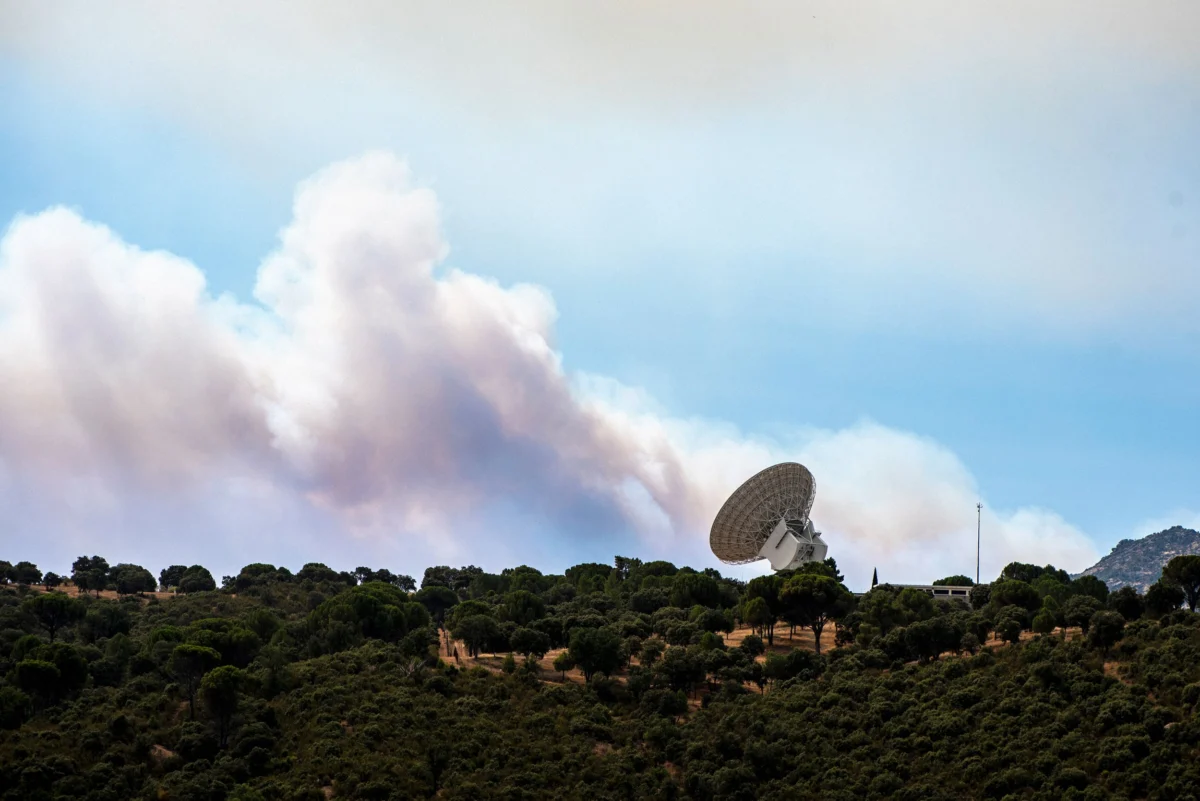
The intensifying grip of climate change has transcended terrestrial boundaries, now presenting a tangible threat to humanity’s ability to communicate with its emissaries across the solar system. In a stark illustration of this global crisis, raging wildfires in Spain recently encroached upon one of the three vital observatories managed by the U.S. National Aeronautics and Space Administration (NASA). This critical facility plays an indispensable role in maintaining contact with a pantheon of groundbreaking space missions, including the venerable Voyager 1 probe, the revolutionary James Webb Space Telescope, and the recently concluded Artemis mission that successfully orbited the Moon.
The unfolding crisis in Spain, declared a wildfire emergency by the government, saw multiple blazes burning out of control in the vicinity of Madrid. This led to urgent evacuation orders for approximately 60,000 residents, with the municipality of Robledo de Chavela, home to the crucial Deep Space Communications Complex, being directly impacted. Dramatic images circulated widely by news agencies depicted the iconic radio telescopes, instruments of profound scientific significance, wreathed in thick plumes of smoke and threatened by encroaching flames.
In the immediate aftermath, a NASA spokesperson confirmed to WIRED that all personnel at the Spanish facility had been successfully evacuated, prioritizing human safety above all else. While the immediate danger of the fire passing through the complex had subsided, the full extent of its impact on the highly sensitive and sophisticated equipment remained uncertain. "Any potential damage will be assessed when it is safe to do so," the spokesperson stated, indicating that a site assessment could commence as early as Saturday, contingent upon prevailing conditions.
To ensure the uninterrupted continuity of vital mission operations, NASA swiftly implemented contingency plans. The agency announced it had "seamlessly transitioned support for mission operations to the Goldstone Deep Space Communications Complex in California, ensuring continuity of service and uninterrupted support for spacecraft communications." This proactive measure underscored the paramount importance of maintaining constant communication links with the nation’s ambitious space exploration endeavors.
The Spanish facility, alongside its counterparts in Canberra, Australia, and Goldstone, California, forms what NASA aptly describes as the "largest and most sensitive scientific telecommunications system in the world." This interconnected network, known as the Deep Space Network (DSN), is the lifeline that enables NASA to transmit commands and receive invaluable data from spacecraft traversing the vast expanse of space. It is through this network that humanity receives images from the furthest reaches of our solar system, including data from Voyager 1, the most distant human-made object ever launched. The DSN is also instrumental in the operation of the James Webb Space Telescope, facilitating the transmission of its breathtaking cosmic discoveries, and in commanding a multitude of other robotic explorers. Beyond mission control, these facilities also contribute significantly to the field of radio astronomy, expanding our understanding of the universe. The sheer scope and sensitivity of this network highlight its irreplaceable role in advancing scientific knowledge and our comprehension of the cosmos.
Spain’s plight is not an isolated incident but rather a symptom of a wider, escalating global wildfire crisis. France is also grappling with out-of-control blazes, particularly in the Bordeaux region, a renowned wine-producing area. Residents and beachgoers in affected areas have witnessed skies turn an ominous orange and shores littered with waves of ash as firefighters valiantly battle to contain the infernos.
The French Interior Minister, Laurent Nunez, described the gravity of the situation, stating on national television channel Tf1, "We learned in the middle of the afternoon that, following the wind shift, it had become a large, self-sustaining fire that is extremely difficult to bring under control." He further elaborated on the fire’s eastward progression towards the Bordeaux metropolitan area, emphasizing the need for a reorganized response to combat it effectively from the ground and prevent further advancement.
Collectively, across Spain and France, an estimated 200,000 people have been compelled to evacuate their homes as these devastating wildfires rage. This staggering figure underscores the immediate human toll of these environmental disasters.
A Grim Timeline of Escalating Wildfires and Climate Impacts
The current wave of intense wildfires in Europe is inextricably linked to the record-breaking temperatures experienced across the continent this summer. A series of persistent heat domes have settled over Europe and the UK, exacerbating already dry conditions. These extreme heat events, fueled by the overarching forces of climate change, have turned vegetation into tinder, creating a highly flammable environment. The slightest spark can now ignite catastrophic infernos that are increasingly difficult to control.
The chronology of events leading to the current crisis paints a worrying picture:
- Early Summer: Record-breaking temperatures begin to manifest across Europe, with several countries experiencing unprecedented heatwaves. These prolonged periods of extreme heat contribute to significant drying of vegetation.
- Mid-Summer: The conditions ripen for widespread wildfire ignition. Small fires, often caused by natural factors like lightning or human carelessness, quickly escalate into uncontrollable infernos due to the parched landscape and high temperatures.
- Late Summer (Current Period): Major wildfire outbreaks erupt across southern Europe, particularly in Spain and France. These fires reach unprecedented scales, forcing mass evacuations and directly threatening critical infrastructure. The fire near NASA’s Deep Space Communications Complex in Spain is a direct consequence of these rapidly evolving conditions.
The phenomenon of extreme heat and subsequent wildfire outbreaks is not confined to Europe. Similar devastating events have unfolded in other regions of the world, including Ontario, Canada, and the US Pacific Northwest, further demonstrating the global reach of this climate-induced crisis.
The Deep Space Network: A Crucial Artery for Space Exploration
The Deep Space Network (DSN) is far more than just a collection of antennas; it is the nervous system of humanity’s ventures into the cosmos. Established in the late 1950s, the DSN has been instrumental in virtually every major space mission. Its three strategically located complexes—Goldstone, California; Canberra, Australia; and Robledo de Chavela, Spain—ensure that at least one site is always within line of sight of a spacecraft as the Earth rotates. This global distribution is essential for maintaining continuous communication, especially with probes traveling to the outer reaches of the solar system, where signals can take hours to travel one way.
The Robledo de Chavela facility, officially known as the Madrid Deep Space Communications Complex, was established in 1965. It has played a critical role in missions ranging from the Apollo lunar landings to the Mars rovers and the Voyager program. The recent threat posed by the wildfires highlights the vulnerability of even the most robust and strategically important infrastructure to the escalating impacts of climate change.
Broader Implications: Climate Change’s Reach Extends to the Stars
The incident in Spain serves as a potent reminder that the consequences of climate change are far-reaching and can impact even the most advanced technological endeavors. The ability to communicate with spacecraft is not merely about scientific curiosity; it is fundamental to ensuring the safety and success of our ongoing space exploration efforts.
- Mission Continuity: The seamless transition to the Goldstone facility demonstrates NASA’s preparedness for such eventualities. However, relying on a single backup site for critical global operations could strain resources and potentially lead to delays or limitations in communication if multiple facilities were to become simultaneously unavailable due to environmental disasters.
- Scientific Data Loss: While NASA has robust data archiving protocols, any damage to the sensitive receiving and transmitting equipment could lead to temporary disruptions in data flow from missions like the James Webb Space Telescope, potentially delaying crucial scientific discoveries.
- Future Missions: As humanity embarks on increasingly ambitious missions, such as crewed missions to Mars, reliable and resilient communication infrastructure becomes even more critical. The vulnerability of the DSN to climate-related events raises questions about the long-term security of these vital assets.
- Resource Allocation: The need to respond to and recover from climate-related disasters, such as wildfires, diverts resources that could otherwise be allocated to scientific research or infrastructure development.
A Glimmer of Hope and Lingering Concerns
While cooler weather is anticipated in the Mediterranean region over the weekend, offering a potential respite for firefighters, the reprieve is expected to be short-lived. Temperatures are projected to surge again on Monday and continue climbing throughout the week, potentially reaching up to 10 degrees Celsius (18 degrees Fahrenheit) above normal. This forecast raises concerns about the potential for existing wildfires to re-ignite or for new blazes to spark, further exacerbating the crisis in Spain and France.
The intertwined challenges of climate change, extreme weather events, and the protection of critical scientific infrastructure demand urgent global attention and coordinated action. The very instruments that allow us to explore the universe are now themselves vulnerable to the environmental shifts occurring on our home planet, underscoring the interconnectedness of terrestrial well-being and our aspirations for celestial discovery. The incident at the Deep Space Communications Complex is not just a local news story; it is a global wake-up call, illustrating that the fight against climate change is a fight for our future, both on Earth and in the vastness of space.