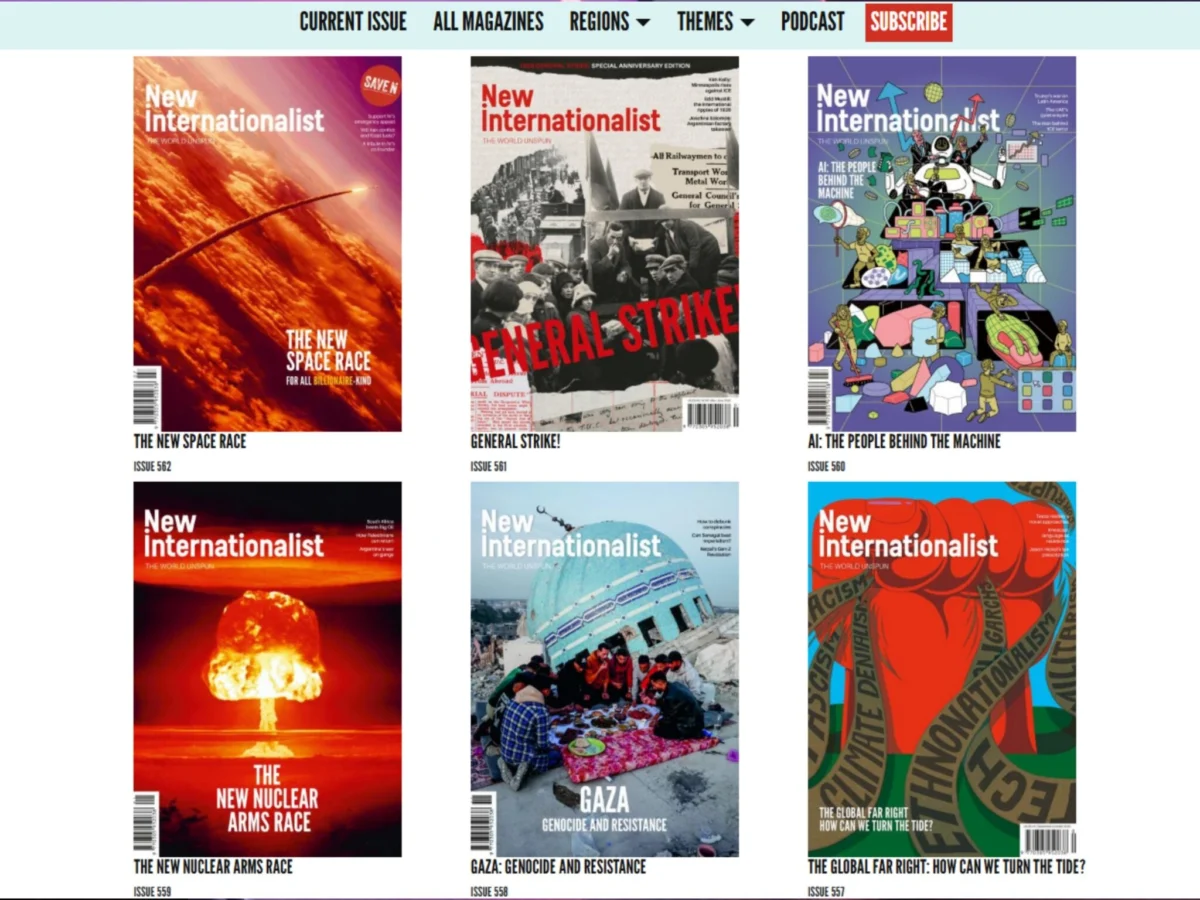
Global affairs magazine New Internationalist has successfully navigated a period of significant financial distress, raising over £160,000 through a crowdfunding campaign to secure its immediate future. The left-leaning publication, renowned for its focus on global, social, and environmental justice since its founding in 1973, faced a confluence of challenges, including escalating operational costs, persistent marketing hurdles, and a marked decline in website traffic attributed to the rise of AI-generated search summaries. The "More than a magazine" campaign, launched in June, surpassed its initial goal of £150,000 within six weeks, drawing support from more than 1,600 individuals worldwide.
Amy Hall, co-editor of New Internationalist, acknowledged the severity of the situation, stating that the magazine had been "pretty close to the edge." This grassroots resurgence underscores the unique, community-driven model of New Internationalist, a multi-stakeholder co-operative owned by approximately 4,600 people, which notably lacks the backing of a major corporation or a billionaire patron, making it inherently vulnerable to economic shifts and industry disruptions.
The Urgent Call to Action and Immediate Relief
The crowdfunding initiative was launched with a clear objective: to raise £150,000 within six weeks to "steer us out of the danger zone" and enable the implementation of crucial changes for a "more secure and sustainable future." The overwhelming response from its readership and supporters not only met but exceeded this target, providing a vital lifeline. This financial injection allowed the magazine to address immediate liquidity issues, ensuring the continued payment of its 13 part-time staff members. Prior to the campaign’s success, a group of dedicated co-owners and a solidarity fund designed to support worker co-operatives had stepped in with additional funds to cover payroll, highlighting the cooperative’s internal resilience.
Despite the successful fundraising, the period leading up to the campaign had necessitated difficult decisions. Payment of some essential bills was delayed, and the July edition of the print magazine saw two of its planned 18 pages cut, reducing it to 16. This austerity measure served as a stark reminder of the financial pressures threatening the publication’s existence, reinforcing Hall’s observation about the vulnerability inherent in their independent structure.
Unpacking the Financial Crisis: A Confluence of Factors
The financial distress experienced by New Internationalist was not attributable to a single cause but rather a convergence of systemic and emerging challenges facing the publishing industry.
- Soaring Operational Costs: A primary driver of the crisis was "unexpected price rises," as detailed by Amy Hall. Print costs alone surged by 10%, a significant burden for a publication that produces a bi-monthly physical magazine. This increase reflects broader inflationary pressures on raw materials like paper and energy, impacting print media globally.
- Persistent Marketing Challenges: The magazine traditionally relied heavily on face-to-face engagement, particularly through university stalls, to acquire new subscribers. This effective marketing channel was severely disrupted by the COVID-19 pandemic and has not returned to its previous efficacy. Hall noted, "Losing that has been quite a big blow for us… while we’ve been trying to do other forms of marketing, we’ve not yet really replaced anything with the level that we were getting from that." This highlights the difficulty for niche publications to adapt their subscriber acquisition strategies in a rapidly changing digital landscape.
- The Alarming Impact of AI Search Summaries: Perhaps the most contemporary and concerning threat cited by New Internationalist is the impact of AI-generated search summaries on website traffic and, consequently, revenue. The publication recorded 17.7 million search impressions in 2026 so far, yet these translated into a mere 101,000 Google clickthroughs, resulting in an exceptionally low overall clickthrough rate of 0.57%. This phenomenon, where AI provides answers directly in search results, diminishes the incentive for users to click through to original content sources, severely undermining the digital traffic publishers rely on for advertising and subscription conversions. This trend is a growing concern across the media industry, with some analyses suggesting that Google search traffic to leading UK publishers could halve by Q3 2027, painting a bleak picture for content creators if current trends continue unchecked.
A Detailed Look at Financial Performance (2024-2026)
New Internationalist’s financial reports illustrate the extent of its struggles, showing consecutive years of losses.
- 2024/25 Financial Year (ending March 2025): The magazine was not profitable, recording a "higher than expected" net loss of over £100,683. Revenue for this period stood at £989,474, while costs escalated to £1.1 million.
- 2025/26 Financial Year (ending March 2026): Unfinalised figures indicated an even greater loss. Revenue dropped significantly to £756,372, against costs exceeding £906,000, resulting in an overall loss of £149,791.
This nearly quarter-million-pound drop in revenue between the two financial years was largely driven by challenges within New Internationalist’s "Ethical Shop" venture. Losses from this retail arm accounted for approximately £175,000 of the £233,102 total revenue difference, a consequence of strategic decisions to reduce product lines, staff, and marketing expenditures in an attempt to streamline operations.
Revenue Streams and Their Vulnerabilities
The magazine’s revenue model is diverse but has shown vulnerabilities across its components:
- Subscriptions and Newsstand Sales: This remains the primary income source, accounting for 53.1% of revenue last year, totalling £401,770. However, this income stream experienced a significant 20.7% decline in 2025/26, despite a base of 10,000 paying subscribers. This drop underscores the challenges of subscriber retention and acquisition in a competitive media landscape.
- Other Products and Editions: Contributed roughly 28% of revenue, amounting to £211,000.
- Fundraising and Contracts: Provided 15.5% of income, or £117,668. The magazine noted "less favourable changes in the grant fundraising landscape" in its 2024/25 report, with Hall confirming that grants are now "harder to come by" due to shifting donor priorities.
- Advertising: A smaller component, making up 3.4% of total revenue, or £21,576 in 2025/26. The magazine maintains a principled stance against programmatic advertising for "ethical reasons," aiming to avoid gambling and diet-related advertisements. Print advertising (including inserts) accounts for the largest share (45% for print, 40% for loose inserts), with digital ads (website and podcast) contributing 15%. This ethical approach, while commendable, limits potential revenue streams in an industry increasingly reliant on digital ad spend.
Evolving Content Strategies and Reader Engagement
In response to the evolving media consumption habits and financial pressures, New Internationalist has been adapting its content and access strategies:
- Subscription Tiers: The magazine offers various subscription options: digital-only at £2.74 a month, print and digital for £4.99, and print-only for £4.58.
- Paywall Experimentation: While the main website is not fully paywalled, print and digital subscribers gain access to exclusive content. Recognizing the need to convert casual readers into subscribers, New Internationalist is now experimenting with a metered paywall. This model allows users to access a limited number of articles for free before being prompted to subscribe, a common strategy in the digital publishing world to balance accessibility with revenue generation.
- Podcast Success: The launch of "The World Unspun" podcast in November 2024 proved to be a positive development, directly resulting in new subscriptions. This highlights the potential for audio content to engage new audiences and drive reader revenue, serving as a testament to the importance of diversified content formats.
A History of Community-Powered Survival
New Internationalist’s recent crowdfunding success is not an anomaly but rather a continuation of its "people-powered" history. The publisher has a remarkable track record, having launched five crowdfunding campaigns since 2015, all of which have not only met but exceeded their targets.
- 2017 Transformative Campaign: A pivotal moment occurred in 2017 when a fundraising campaign successfully raised over £700,000. This monumental effort not only secured the magazine’s future but also enabled its conversion into a multi-stakeholder co-operative, a model that embeds community ownership and democratic governance at its core. This structural change is a defining feature of New Internationalist, distinguishing it from most commercial media outlets.
- Previous Appeals: Last year, a campaign raised approximately £60,000, specifically aimed at funding an issue "exposing the far right" and providing general support for the title’s operations.
- Celebrity Endorsements: The magazine’s mission and independent spirit have consistently attracted high-profile support. In 2017, actress Emma Thompson and musicians Jarvis Cocker and Billy Bragg contributed to its campaign. More recently, folk singer Peggy Seeger and Hollywood director Judd Apatow lent their backing, demonstrating the broad appeal and perceived importance of New Internationalist’s unique journalistic voice. These endorsements provide a significant boost in visibility and credibility, reinforcing the idea that the publication serves a vital role in the media landscape.
Charting a Sustainable Future: Avoiding Future Emergencies
Looking ahead, New Internationalist aims to leverage this latest success to build a more resilient and sustainable operational model, explicitly seeking to avoid future emergency appeals. Amy Hall outlined a strategic direction focused on enhancing internal processes and strengthening reader relationships.
"Like most publications in some form these days, we are going to need to turn to our readers for donations, and I don’t think that’s going to change," Hall stated, indicating a shift towards cultivating a stable base of regular donors rather than relying solely on crisis-driven campaigns. This strategy reflects a broader trend in independent media, where reader contributions are becoming an increasingly critical component of financial stability.
Furthermore, the magazine is undertaking a comprehensive review of its "internal processes" to proactively prevent future financial crises. This involves assessing operational efficiencies and strategic planning to ensure that the organization does not "get to that point of emergency so quickly." Parallel to this, there is a commitment to "reviewing the magazine and our journalism more broadly to try and refresh it and potentially change some of the ways that we produce the journalism." This signals an ongoing evolution of its editorial approach to remain relevant and engaging for its audience.
Hall emphasized that the magazine’s consistent survival is a testament to its "people-powered nature," which has repeatedly brought it "back from the brink of financial disaster." The recent campaign, she noted, "has shown just how strong the support is out there for what we do and for internationalist and independent media more broadly." This enduring support, driven by a perceived hunger for alternative narratives, is a powerful force. "People are often looking for independent sources that aren’t funded by billionaires, that don’t have massive corporations behind them… that feeling just feels like it’s only getting stronger."
Broader Implications for Independent Media and the AI Landscape
The experience of New Internationalist is emblematic of the profound challenges confronting independent and mission-driven media outlets worldwide. Beyond the specific financial metrics, its struggle and subsequent rescue illuminate several critical trends:
- The Fragility of Niche Publications: In an era dominated by large media conglomerates and platform giants, smaller, independent publications often operate on thin margins, making them highly susceptible to economic shocks and technological shifts. Their survival often hinges on strong community bonds and the willingness of their audience to directly support their work.
- The AI Imperative: The documented impact of AI search summaries on New Internationalist’s traffic serves as a stark warning to the entire publishing industry. As AI models become more sophisticated, the risk of content summarization reducing direct engagement with original sources poses an existential threat to business models reliant on advertising or subscription conversions from web traffic. This necessitates urgent industry-wide discussions and potential regulatory frameworks to ensure fair compensation and attribution for content creators.
- The Power of the Cooperative Model: New Internationalist’s cooperative structure has proven to be both a vulnerability and its greatest strength. While it lacks the deep pockets of corporate owners, it cultivates a deep sense of ownership and loyalty among its stakeholders, leading to collective action in times of crisis. This model offers a potential blueprint for media organizations seeking to prioritize mission over pure profit and build resilient, community-supported operations.
- The Demand for Ethical Journalism: The magazine’s commitment to "ethical" advertising and its focus on social and environmental justice resonate with a growing segment of the public disillusioned with mainstream media. The consistent crowdfunding success suggests a strong, albeit financially challenged, market for independent, values-driven journalism that is perceived as unbiased by corporate interests.
The successful crowdfunding campaign has provided New Internationalist with vital breathing room, but the underlying challenges persist. Its journey serves as a powerful case study for the evolving dynamics of media, underscoring the critical importance of diversified revenue streams, adaptable marketing strategies, a keen awareness of technological impacts, and, above all, a deeply engaged and supportive readership in an increasingly complex and competitive landscape. The magazine’s ability to not only survive but potentially thrive will depend on its capacity to innovate while staying true to its founding principles.