Online publishers are grappling with a substantial and accelerating decline in referral traffic from Google Search, a trend directly linked to the increasing integration of artificial intelligence (AI) features within the search engine. This alarming development, long suspected by industry observers, has now been substantiated by concrete data presented in the newly launched "Artificial Intelligence Publisher Impact Study" by the Association of Online Publishers (AOP). The comprehensive report highlights a critical juncture for the digital publishing industry, revealing how Google’s strategic transformation from a content gateway to a self-contained information destination is fundamentally reshaping the online ecosystem and threatening the traditional revenue models of news organizations and other content creators.
Unveiling the Data: A Deep Dive into Declining Referrals
As fervent advocates for premium online publishers, the AOP commissioned DJB Strategies to meticulously investigate the phenomenon, aiming not only to identify the root causes of this decline but also to offer actionable insights for mitigation. The study, robust in its methodology, comprises two core components: a six-month traffic analysis spanning eight major UK publishing groups, encompassing a staggering 10.8 billion pageviews (representing approximately 80% of total traffic after excluding long-tail URLs), and a parallel consumer survey conducted by Ipsos, assessing public awareness and usage of AI tools. This inaugural article, the first in a three-part series, focuses specifically on the critical findings derived from the extensive traffic analysis.
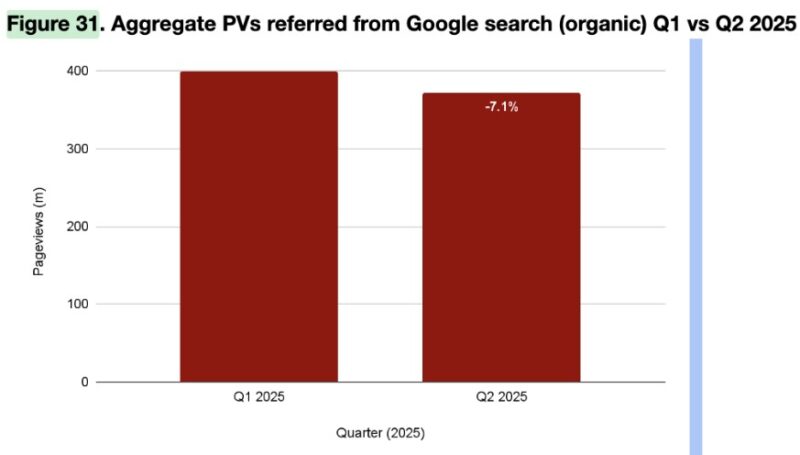
The data paints a stark picture: in the second quarter of 2025 (Q2 2025), a period during which Google publicly reported a 12% growth in its Search revenue, the very publishers whose content fuels the information ecosystem experienced a precipitous drop in referral traffic from the platform. Organic Google Search referrals plummeted by an average of 7.1% across all participating publishers between Q1 and Q2 2025. This trajectory, if sustained without intervention, portends a dire future where pageviews delivered by Google could be halved by Q3 2027. This projection, moreover, does not even account for the compounding effects that habitual AI use might exert on user return traffic, suggesting that the actual decline could be even more severe. Given Google’s explicitly stated intention to make its "zero-click AI Mode" a central pillar of its future search experience, industry experts widely anticipate an acceleration of these declines. The implications are profound, suggesting a fundamental re-evaluation of content creation and distribution strategies for publishers globally.
Google’s Evolving Search Paradigm and the ‘Zero-Click’ Future
The shift observed in the AOP study aligns with Google’s broader strategic moves towards an AI-centric search experience. For years, Google Search has served as the primary conduit for users to discover and access information across the web, directing billions of clicks to publishers annually. This symbiotic relationship, while often fraught with tensions over advertising revenue and content indexing, has been the bedrock of the digital publishing economy. However, the introduction and subsequent expansion of features like AI Overviews and the forthcoming "AI Mode" fundamentally alter this dynamic.

These AI-powered features are designed to provide direct, synthesized answers to user queries within the search results page itself, significantly reducing the need for users to click through to external websites. While Google argues these innovations enhance user experience by delivering information more efficiently, publishers increasingly view them as a direct threat to their business models. The "zero-click" paradigm, where a user’s information need is satisfied without ever leaving Google’s platform, means fewer pageviews, less advertising inventory, and ultimately, diminished revenue for content creators. This internal capture of traffic and value raises serious questions about the sustainability of an open web reliant on ad-supported journalism and content. Google’s reported 12% growth in Search revenue during Q2 2025, juxtaposed with publishers’ declining traffic, underscores the diverging fortunes within the digital information landscape.
Uneven Impacts: Disparities Across Content Types and Topics
While the overall trend of declining referrals is clear, the AOP study meticulously reveals that these impacts are not uniformly distributed. The analysis segmented participant traffic by topic and content type across 147 domains, allowing for a precise identification of categories most vulnerable to AI substitution and, conversely, those demonstrating resilience. This granular insight is crucial for publishers looking to adapt their strategies.
Content Type Vulnerabilities:
A significant discrepancy emerged between different types of publishers. News publishers, for instance, fared comparatively better, experiencing an average quarterly decline of approximately 5%. This contrasts sharply with the consumer/B2B segment, which saw an alarming 18% quarterly decline. This divergence is likely attributable to the tighter "guardrails" and editorial scrutiny that Google and other AI developers tend to place around news content within AI Overviews, compared to more easily aggregated evergreen or factual content. The inherent need for timeliness, attribution, and human judgment in reporting current events makes news less amenable to full AI summarization without external clicks.
Topic-Specific Trends:
When sessions were further categorized by topic, the nuances became even clearer. News content, despite the overall decline, registered a modest increase of 2% in Google referral traffic. Other areas demonstrated surprising resilience or even growth: Sports saw a substantial 37% increase, Travel recorded a 22% rise, and Health & Wellness experienced a 7% boost. These categories often involve dynamic updates, highly specific recommendations, or nuanced personal experiences that AI summaries may struggle to fully capture or users may still prefer human-curated content.
Conversely, several topics were severely impacted. Politics saw a 7% fall, Finance & Business experienced a significant 23% decline, and Technology content rounded out the worst affected, plummeting by 28%. These topics often feature factual data, analytical breakdowns, or "how-to" guides that are prime candidates for AI summarization, as users seek quick, distilled information rather than in-depth editorial pieces.
The Role of Content Presentation: Expertise vs. Expediency
The study also highlighted that how content is presented is as critical as what it is about. The data clearly reflects the types of queries users are increasingly turning to AI to answer. For instance, Google referral traffic for guide/how-to content saw declines exceeding 20%. This sharp drop indicates a strong user preference for the speed and convenience of an AI-generated answer over navigating to an editorial guide, even if the latter offers deeper expertise. Users seeking direct instructions or quick solutions are effectively being diverted by AI summaries.

In stark contrast, content imbued with an explicit point of view or requiring deep human insight demonstrated remarkable resistance to AI substitution. Opinion and commentary pieces saw a 4% increase in referral traffic, while interviews remained relatively stable with a 1% increase. Product reviews, which often rely on subjective experience, detailed comparisons, and trust in a human reviewer, saw only a marginal 1% decline. These content types inherently offer value beyond mere information retrieval, providing unique perspectives, human connection, and authenticated experiences that AI currently struggles to replicate convincingly.
Synergistic Impacts: Overlapping Content and Topic Resilience
By overlaying content type with topic, the study precisely identified the most acute areas of referral growth and decline. Notably, news interviews experienced an impressive 63% quarterly increase in sessions prompted by Google search referrals, and health & wellness analysis saw a 46% increase. These combinations leverage both the timeliness of news and the expertise of analysis, delivered through a human-centric format like interviews, which are highly valued by users and difficult for AI to fully abstract.
On the other end of the spectrum, finance & business how-tos declined by a staggering 52%, and food & drink how-tos plummeted by 54%. These categories represent the "perfect storm" for AI substitution: practical, instructional content within domains where users often seek quick, factual advice or recipes, making them highly susceptible to AI summarization.
Strategic Imperatives for Publishers: Adapting to a New Reality
The findings present a clear call to action for publishers, forcing a strategic re-evaluation of their content creation and revenue models. While it is certainly not trivial for publishers to pivot their entire output to satisfy an evolving algorithm, adaptation is imperative. The study noted that the vast majority of sessions (accounting for more traffic than all other types combined) were reportage content, which saw a 4% reduction in referral traffic. This suggests a need to inject more of a "human touch" or unique perspective into traditional reportage to enhance its resilience against AI summarization. This could mean greater emphasis on investigative journalism, exclusive interviews, local reporting, or narrative storytelling that provides a richer context than an AI summary.
The economic implications of these referral declines are also unevenly distributed. Publishers primarily funded through high-volume programmatic advertising are most vulnerable, as their business models are intrinsically tied to transient search traffic. These organizations rely on generating vast numbers of pageviews to monetize through automated ad placements. Conversely, publishers with more diversified or reader-funded revenue models, such as subscriptions, memberships, or direct sponsorships, will likely prove more resilient. Their value proposition extends beyond simple information delivery, fostering direct relationships with their audience.
The AOP study’s participants, being from the premium end of the industry, are likely better equipped to absorb these shocks than the "long tail" of smaller publishers. These smaller entities are often almost entirely reliant on programmatic advertising and lack the diverse revenue streams or brand recognition to weather significant traffic reductions. This could lead to a further consolidation of the digital publishing landscape, where smaller, ad-dependent outlets struggle to survive.
A critical warning from the study is for publishers to avoid the "trap of expanding URL output in affected areas to defend their traffic levels." This strategy, often employed in the past to chase search algorithms, would likely result in weakening views-per-page and diluting editorial quality. Doubling down on declining content types only accelerates losses. Publishers can no longer rely on sheer traffic volume driven by audiences seeking basic information retrieval; the future demands a focus on quality, uniqueness, and a distinct value proposition that AI cannot easily replicate.
Broader Industry Context and Future Outlook
The AOP study confirms what many have feared: the digital publishing industry is at a crossroads. For decades, Google has been an indispensable partner, albeit a dominant one, in the distribution of online content. The company’s shift towards an AI-first search paradigm marks a fundamental recalibration of this relationship, potentially diminishing the value of external websites in favor of an integrated, "zero-click" experience.
This development is likely to intensify calls for greater transparency from Google regarding how AI Overviews source and attribute information, and whether content creators are adequately compensated for their intellectual property when it is synthesized and presented directly within search results. Industry bodies and regulatory authorities may face increased pressure to scrutinize Google’s market power and its impact on competition and the diversity of information online.
For publishers, the path forward involves a multi-pronged approach:
- Content Strategy Refinement: Prioritizing unique, expert-driven, opinionated, and human-centric content that resists AI summarization.
- Revenue Model Diversification: Shifting focus towards reader-funded models (subscriptions, memberships), direct advertising, events, and other revenue streams less reliant on transient search traffic.
- Direct Audience Engagement: Building stronger, direct relationships with readers through newsletters, apps, social media, and community platforms to reduce dependence on intermediaries.
- Technological Adaptation: Exploring how AI tools can be integrated into their own workflows to enhance content creation, personalization, and efficiency, rather than solely viewing AI as a competitive threat.
- Advocacy and Collaboration: Engaging with industry groups like the AOP to collectively advocate for fair terms with platforms and influence policy decisions that safeguard the future of journalism and content creation.
The "Artificial Intelligence Publisher Impact Study" serves as a stark reminder that the digital landscape is in constant flux. The era of abundant, free referral traffic from search engines, particularly for easily summarized content, appears to be drawing to a close. Publishers who can adapt, innovate, and re-emphasize their unique human value will be best positioned to navigate this transformative period and secure their place in the evolving information ecosystem. The next articles in this series are expected to delve deeper into consumer behavior and offer more prescriptive solutions, but the initial findings unequivocally signal that the time for strategic change is now.