Germany Pledges Thousands of AI-Guided Autonomous Strike Systems for Ukraine in Landmark Production Deal

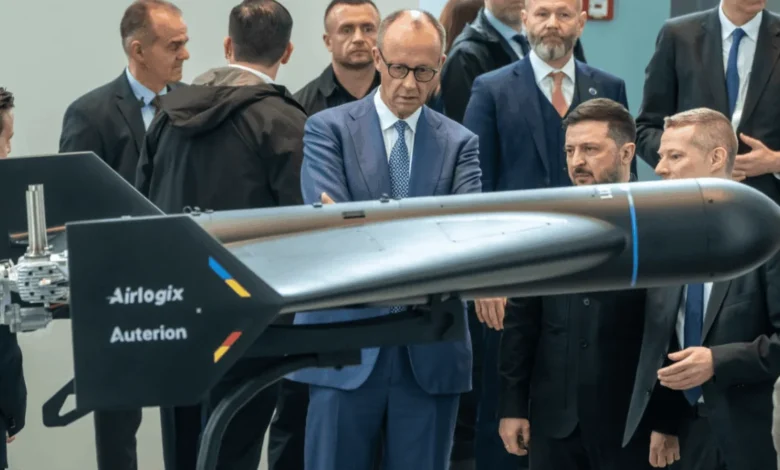
Germany has today solidified its commitment to supporting Ukraine’s defense capabilities with the signing of a comprehensive cooperation agreement. This pivotal pact will enable the Auterion Airlogix Joint Venture GmbH to commence the large-scale production of thousands of mid-range, heavy AI-guided autonomous strike systems. The contract effectively transforms a strategic announcement made at the Munich Security Conference in February 2026 into a fully funded, tangible manufacturing initiative, marking the largest German production order for heavy autonomous strike drones to date. Production is slated to commence on German soil, leveraging the nation’s industrial capacity to deliver thousands of these advanced systems annually.
From Announcement to Assembly Line: A Swift Transition
The ink is barely dry on the agreement, yet its genesis traces back to a significant diplomatic and strategic gathering earlier this year. The February 2026 Munich Security Conference served as the initial platform where the concept of a joint venture for producing advanced Ukrainian drone technology in Germany was first articulated. This announcement, initially met with considerable interest and anticipation within defense circles, has now transitioned from a forward-looking declaration to a concrete, operational reality. The speed at which this agreement has moved from announcement to a fully funded, large-scale production contract underscores a shared urgency and a robust collaborative spirit between Germany, Ukraine, and the involved technology partners.
The establishment of Auterion Airlogix Joint Venture GmbH signifies a crucial step in ensuring a consistent and substantial supply of sophisticated defense equipment. This partnership harnesses the unique strengths of its constituent entities: Airlogix, a Ukrainian firm with battlefield-tested expertise, and Auterion, a global leader in open drone operating systems. The joint venture’s mandate is clear: to rapidly scale production of AI-guided autonomous strike systems, a capability increasingly vital in modern asymmetric warfare.
Airlogix: Battle-Hardened Innovation from Ukraine
Airlogix, a Ukrainian defense technology company specializing in the development and production of unmanned aerial vehicles (UAVs) for military applications, stands as a testament to the nation’s burgeoning defense industry. Founded in 2020, the company pivoted to a defense-focused operational model in 2022, a move that coincided with the escalation of the conflict. Since then, Airlogix has rapidly ascended to become a leading supplier to the Ukrainian Armed Forces and its elite special operations units. Its combat-proven systems have been deployed extensively across the front lines, accumulating invaluable real-world operational data and demonstrating remarkable resilience and effectiveness in challenging combat environments.
The company’s product suite is characterized by its adaptability and focus on delivering solutions that address the evolving demands of modern warfare. Airlogix’s expertise lies in integrating cutting-edge avionics, robust airframes, and sophisticated mission payloads to create versatile UAVs capable of a wide range of operational tasks, from reconnaissance and surveillance to precision strike missions. The systems being produced under the new German contract are built upon this foundation of combat-proven designs.
Auterion: The Open Architecture Backbone for Autonomous Systems
Auterion, a Swiss-based company, plays a critical role in this collaborative effort by providing the essential open, vendor-agnostic operating systems for autonomous drones and robotic systems. Their technology serves as the digital nervous system for a diverse array of unmanned platforms, enabling advanced functionalities such as AI-guided navigation, autonomous decision-making, and robust electronic warfare resilience. Auterion’s client roster reads like a who’s who of global defense, including the U.S. Department of Defense, the United Kingdom’s Ministry of Defence, the German Bundeswehr, and crucially, the Armed Forces of Ukraine.
The company’s commitment to open standards and interoperability is a significant advantage. It allows for seamless integration of various hardware components and facilitates rapid software updates and adaptations, crucial for staying ahead in the fast-paced realm of defense technology. Auterion’s Skynode flight computer and Nemyx autonomy stack, specifically mentioned in relation to the German production, are key components that will ensure these new strike systems can integrate effectively into existing Western command and control architectures from the outset.
The Strategic Imperative: Scale, Cost Reduction, and Battlefield Advantage
The profound implication of this mass production initiative is the significant reduction in per-unit costs. As production volumes increase, the economies of scale will drive down manufacturing expenses, making these advanced autonomous strike systems more accessible and sustainable for long-term deployment. This is particularly crucial for Ukraine, which requires a continuous and substantial supply of munitions to sustain its defense efforts.
The contract ensures the production of "rate munitions," a term suggesting a focus on rapid manufacturing and deployment of disposable or semi-disposable strike systems designed for high-intensity conflict. These systems are engineered for contested, GPS-denied environments, a common characteristic of modern battlefields where reliable navigation and targeting can be severely hampered. The combination of combat-tested Ukrainian airframes, embodying practical battlefield experience, with Auterion’s sophisticated AI guidance, autonomous navigation, and electronic warfare resilience software, creates a formidable and highly effective weapon system.
For Ukraine, this agreement guarantees a reliable, European-manufactured supply chain for these critical autonomous strike systems, coordinated under the auspices of the German Federal Ministry of Defence. This infusion of German industrial capacity behind every unit produced represents a significant strengthening of Ukraine’s defense posture.
For the German Bundeswehr, the contract represents the most expedient pathway to fielding autonomous strike capabilities at scale. By leveraging combat-proven systems developed by Airlogix and integrated with Auterion’s advanced autonomy software, Germany can rapidly equip its forces with sophisticated technology that is already validated on the battlefield. The immediate integration into Western command architectures is a key benefit, minimizing logistical and operational hurdles.
Furthermore, the production line established by Auterion Airlogix Joint Venture GmbH is not solely for the benefit of Germany and Ukraine. The agreement explicitly states that the production line is "open for scale-up beyond Germany," presenting an opportunity for allied nations to procure these advanced autonomous strike systems. This creates a potential for a broader European defense industrial cooperation, enhancing collective security and interoperability among NATO members.
Voices from the Partnership: Expertise Forged in Conflict, Amplified by Industry
The significance of this collaboration is underscored by the powerful statements from the leaders of both Airlogix and Auterion.
Vitalii Kolesnichenko, CEO of Airlogix, articulated the profound connection between the system’s development and the realities of conflict: "Our engineers built these systems under fire. Now, German industry is producing them at a scale that changes the equation on the battlefield. Every unit that rolls off this line carries years of real combat learning." This statement highlights the direct transfer of battle-tested knowledge and experience from the Ukrainian front lines into a large-scale manufacturing process. The "real combat learning" embedded in each system represents an invaluable asset, ensuring that the deployed technology is not theoretical but has proven its worth in the crucible of war.
Dr. Lorenz Meier, CEO of Auterion, emphasized the broader implications for European defense industrial capability and cooperation: "This contract proves that Europe can move at scale. We are enabling Airlogix to manufacture thousands of autonomous systems on German soil, drawing on Ukrainian combat expertise and the best autonomy software in the world. This is what allied defence industrial cooperation looks like." Dr. Meier’s statement frames the agreement as a landmark achievement for European defense, demonstrating the continent’s capacity to rapidly mobilize its industrial and technological resources to meet critical security needs. The synergy between Ukrainian operational experience and European technological prowess is presented as the model for future allied defense initiatives.
A Chronology of Collaboration and Production
- 2020: Airlogix is founded, initially focusing on broader drone applications.
- 2022: Airlogix pivots to a defense-focused operational model, intensifying its work on military UAVs in response to evolving geopolitical events.
- February 2026: During the Munich Security Conference, an announcement is made regarding a potential partnership for the large-scale production of Ukrainian-designed autonomous strike systems in Germany. This sets the stage for the subsequent formalization of the joint venture.
- Present Day: Germany signs a cooperation agreement with Ukraine, enabling Auterion Airlogix Joint Venture GmbH to begin full-scale production of thousands of mid-range, heavy AI-guided autonomous strike systems annually. This marks the transition from announcement to funded, large-scale manufacturing.
Supporting Data and Context: The Rise of Autonomous Warfare
The increasing reliance on autonomous systems, particularly in drone warfare, is a defining characteristic of contemporary military operations. Global defense spending on unmanned systems has seen a steady rise, with projections indicating continued growth. According to various defense industry analyses, the market for military drones is expected to reach tens of billions of dollars annually within the next decade.
The conflict in Ukraine has been a significant proving ground for drone technology, showcasing the effectiveness of various platforms, from small reconnaissance drones to more sophisticated strike systems. The battlefield has demonstrated that autonomous capabilities can provide significant advantages in terms of force protection, intelligence gathering, and precision strike, often at a lower cost and risk compared to traditional manned platforms.
The specific capabilities of the systems being produced under this contract – AI-guided targeting, autonomous navigation in GPS-denied environments, and electronic warfare resilience – are critical for operating in contested airspace and against sophisticated adversary defenses. These are not merely incremental improvements but represent a leap forward in the operational effectiveness of unmanned systems.
Broader Impact and Future Implications
This German-Ukrainian agreement has far-reaching implications beyond the immediate supply of weapons systems.
For Ukraine: It signifies a deepening of security ties with a major European power and a crucial step towards long-term defense industrial sustainability. The access to large-scale, European-manufactured advanced weaponry is vital for its ongoing defense efforts.
For Germany: It positions Germany as a key player in the European defense industrial landscape, demonstrating its commitment to collective security and its capacity to support allies with advanced manufacturing capabilities. It also provides the Bundeswehr with a rapid path to acquiring cutting-edge autonomous capabilities.
For Europe: The agreement serves as a powerful signal of European unity and resolve in the face of external threats. It showcases the potential for a more integrated and effective European defense industrial base, capable of responding swiftly and decisively to security challenges. The open nature of the production line suggests a model for future pan-European defense procurement and manufacturing initiatives.
For NATO: The interoperability of the systems being produced, facilitated by Auterion’s open architecture, enhances the overall readiness and effectiveness of the alliance. It promotes standardization and seamless integration of capabilities across allied forces.
The successful implementation of this large-scale production contract will undoubtedly influence future defense procurement decisions across the globe, potentially accelerating the adoption of AI-guided autonomous strike systems as a standard component of modern military arsenals. The collaboration between Airlogix and Auterion, amplified by German industrial might, sets a precedent for how nations can pool their strengths to address complex security challenges in an increasingly volatile world. The presence of an "Auterion Airlogix Joint Venture GmbH" on German soil, producing thousands of advanced autonomous strike systems annually, is a clear indication of a new era in defense manufacturing and international cooperation.