The rapid evolution of generative artificial intelligence has fundamentally altered the digital media landscape, creating a critical divergence in how traffic and value are exchanged between search platforms and news publishers. According to a comprehensive new industry report titled From Search Risk to Agentic Risk, authored by DJB Strategies in collaboration with Ipsos for the Association of Online Publishers (AOP), users remain significantly more likely to click through to original news sources via Google’s AI-powered search interfaces than through closed conversational systems like ChatGPT. However, media analysts warn that this remaining referral traffic serves merely as a temporary buffer, giving publishers a narrow window to reduce their long-term structural reliance on search giants before agentic AI further disintermediates the web.
The shifting dynamics of search and discovery come at a time of existential strain for the publishing industry. For decades, the foundational pact of the internet relied on a permissive value exchange: publishers permitted search engines to crawl, index, and display snippets of their journalism free of charge in exchange for referral traffic, which publishers subsequently monetized through programmatic display advertising, direct sponsorships, and digital subscriptions. Today, that delicate equilibrium is fracturing as tech platforms race to keep users inside their own proprietary interfaces by synthesizing information directly on the search results page.
A Tale of Two Search Models: Google Versus Conversational AI
The DJB Strategies report highlights a stark strategic divide between traditional search engines pivoting to generative artificial intelligence, such as Google’s AI Mode and AI Overviews, and closed application ecosystems like OpenAI’s ChatGPT.
Google’s business model remains tethered, albeit tenuously, to the historic web traffic economy. Because Google’s vast advertising architecture relies heavily on users browsing the broader open web, its generative search features continue to direct a meaningful proportion of queries onward to publisher websites. By contrast, conversational AI agents like ChatGPT are engineered to satisfy user intent entirely within the confines of their own applications. These platforms rarely incentivize outbound clicks, operating instead on a closed-loop discovery model where summaries replace links, and the original creator of the information is sidelined.
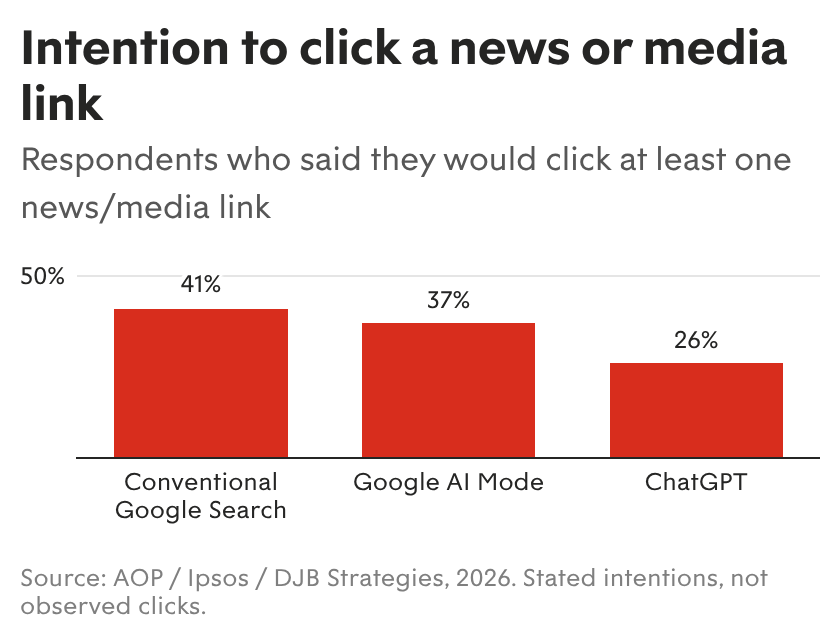
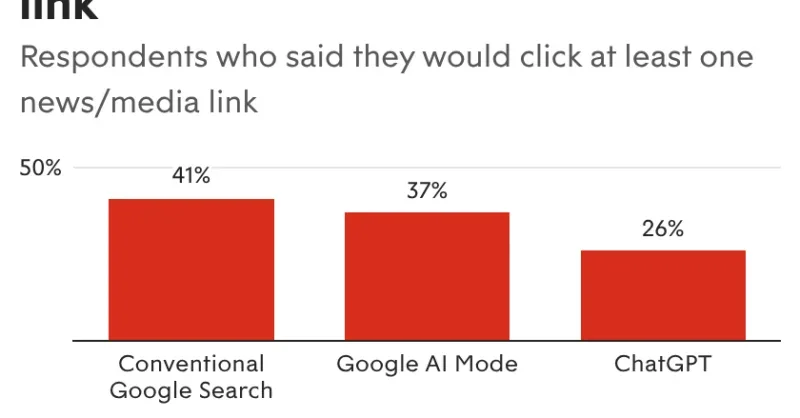
Data from the AOP study illustrates the immediate commercial stakes of this architectural divide. When presented with traditional, non-AI Google search results, 41% of surveyed UK consumers indicated an intention to click on at least one news or media link. That figure drops to 37% when users encounter Google’s AI Mode—a noticeable reduction, yet one that still preserves a vital conduit of audience acquisition. Conversely, when interacting with ChatGPT, only 26% of users expressed an intention to click through to an external news or media link.
Furthermore, consumer behavior varies distinctly depending on the platform and the topical vertical. The AOP findings reveal that users interacting with ChatGPT are disproportionately inclined to seek out image galleries and self-contained visual media, whereas audiences utilizing Google’s AI features exhibit a higher demand for breaking political updates, investigative reporting, and celebrity news sourced directly from trusted journalistic outlets.
Regulatory Pressures and the Google Discover Dilemma
The friction between search platforms and content creators has increasingly attracted the scrutiny of antitrust regulators and competition authorities. Earlier this year, the United Kingdom’s Competition and Markets Authority (CMA) implemented stringent regulatory measures requiring Google to establish effective controls over its commercial use of artificial intelligence without unfairly penalizing publishers within standard, organic search rankings.
Google’s response to these regulatory mandates has added a new layer of complexity for digital publishers. The tech giant bundled its AI Overviews, AI Mode, and Google Discover generative functionalities into a unified "AI opt-out" framework, while simultaneously expanding automated summaries aggressively across the Google Discover feed.
This bundling strategy carries profound commercial implications. While Google Discover itself generates relatively modest direct revenue for the search conglomerate, it serves as an indispensable lifeline for many digital publishers. Recent traffic attribution data from analytics firm Chartbeat indicates that Google Discover routinely delivers more than twice the volume of referral traffic to publisher networks compared to conventional Google Search. By weaving generative AI features deeply into the Discover feed, Google effectively leverages its dominance in content distribution to protect its core search model, forcing publishers into a difficult binary choice: accept the integration of AI summaries that erode direct readership, or opt out entirely and risk forfeiting the bulk of their Discover traffic.
The Long-Term Threat of Agentic Risk
Industry observers note that while Google’s current model continues to supply critical referral traffic, this arrangement may prove fleeting. As generative AI models grow more sophisticated, the economic incentive for search platforms to retain user engagement indefinitely within their own ecosystems intensifies.
The trajectory of search over the past decade provides a cautionary blueprint. Over successive iterations, search engines have progressively absorbed simpler queries through rich results, knowledge graphs, and featured snippets, gradually diminishing the necessity for users to visit destination websites. If publishers allow themselves to become similarly dependent on platforms for AI-driven distribution, they risk eroding their negotiating power entirely, leaving them vulnerable to unilateral reductions in traffic referral as platforms consolidate their market dominance.
Strategic Imperatives for Modern Newsrooms
Faced with what the report defines as "agentic risk"—the hazard of being entirely bypassed by autonomous AI agents acting on behalf of consumers—publishing executives are being forced to rethink their digital strategies from the ground up.
Experts emphasize that the time bought by Google’s continued referral traffic must be utilized to build resilient, diversified business models that are fundamentally independent of search engine whims. This requires a strategic reallocation of editorial and financial resources toward destination content: unique, deeply reported investigative journalism, specialized niche analysis, and multimedia offerings such as podcasts and video series anchored by distinct human personalities and proprietary expertise that automated AI summaries cannot easily replicate.
Concurrently, media organizations are accelerating efforts to cultivate direct, unmediated relationships with their audiences. By prioritizing owned channels—including personalized newsletters, native mobile applications, subscriber-only communities, and direct-to-consumer digital products—publishers can foster loyal reading habits that insulate them from algorithmic volatility.
While search engines will undoubtedly remain an influential component of the digital traffic ecosystem for the foreseeable future, the consensus among industry strategists is clear. The era of passive reliance on organic search is drawing to a close, compelling newsrooms worldwide to build sustainable enterprises that thrive on direct audience engagement and undeniable editorial distinction.