
The affiliate marketing landscape experienced a historic shift in mid-January when PayPal Honey—the ubiquitous browser extension and shopping coupon tool acquired by digital payments giant PayPal for $4 billion in 2020—was systematically removed or suspended from the United States’ premier affiliate marketing networks. Following targeted public investigations by independent experts and researchers, including prominent tech analyst Ben Edelman and digital watchdog content creator MegaLag, both Rakuten Advertising and impact.com took swift punitive action against the multi-billion-dollar platform.
The enforcement actions highlight a growing intolerance within the digital partnership economy for opaque traffic routing practices, specifically concerning conversion misattribution and the evasion of standardized browser extension protocols. As brands and networks increasingly scrutinize the mechanics behind the traditional "last-click-wins" attribution model, the downfall of a dominant publisher like Honey serves as a watershed moment for affiliate program management, compliance enforcement, and strategic diversification.
A Chronology of Enforcement: The January Crackdown
The sequence of events leading to PayPal Honey’s removal unfolded rapidly over a single business week in January, coinciding strategically with the kickoff of Affiliate Summit West, the largest annual gathering of performance marketing professionals in the United States.
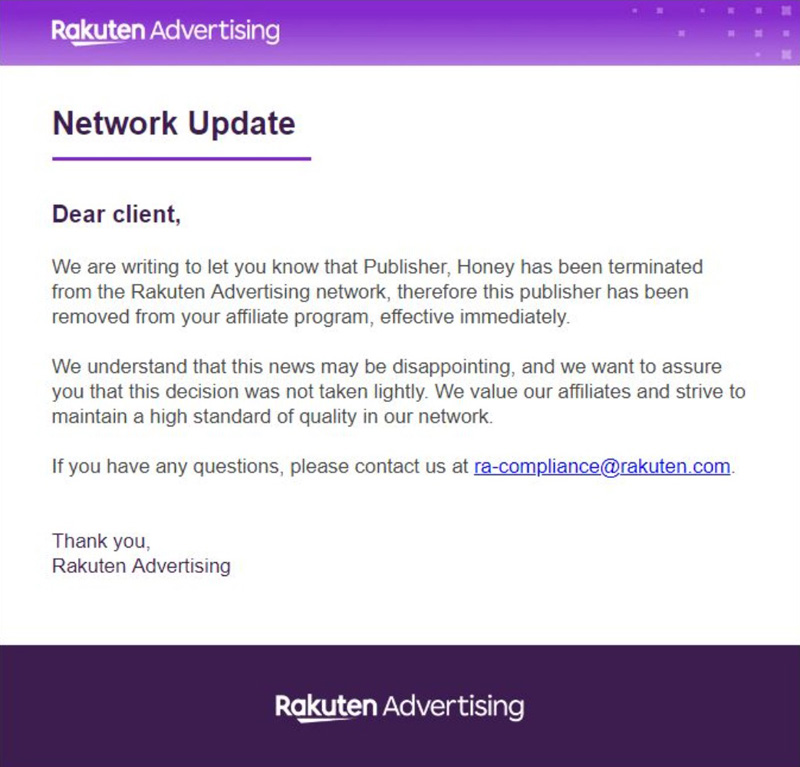
On Monday, January 12, Rakuten Advertising issued an official statement announcing that Honey had been permanently terminated from its network. The network justified the unprecedented exclusion by noting that the termination was a necessary measure to maintain rigorous standards of platform quality and integrity. Industry insiders noted the timing of the announcement—arriving precisely on the opening day of Affiliate Summit West—sent shockwaves through the convention center floor, making the policy enforcement the primary subject of discussion across social media channels and panel discussions alike.
Days later, on Friday, January 16, additional disciplinary measures materialized when impact.com confirmed that PayPal Honey was found to be out of compliance with its foundational platform policies. Rather than a permanent ban, impact.com imposed a formal suspension, removing Honey from its Discovery Marketplace. Leadership at impact.com explicitly cited "attribution manipulation" as the primary catalyst for the suspension, pointing directly to practices that undermine systemic trust in the partnership economy.
Technical Anatomy of the Violation: Stand-Down Rules and Link Hijacking
To understand the gravity of the networks’ actions, one must examine the operational mechanics of downloadable software publishers (DSPs) and browser extensions within modern affiliate marketing architectures. The vast majority of contemporary affiliate programs operate on a last-touch attribution framework. Under this model, the financial commission for a consumer transaction is awarded entirely to the affiliate partner whose tracking link or cookie was registered immediately prior to the final checkout.

Historically, this framework has created fertile ground for aggressive digital positioning. Browser extensions designed to supply discount codes or cash-back incentives at checkout frequently interact with consumers late in the conversion funnel. To prevent unfair displacement of upstream publishers—such as content creators, review sites, and early-funnel influencers who introduced the consumer to the product—networks enforce strict "stand-down" rules. These protocols dictate that a browser extension must remain inactive and abstain from overwriting existing cookies if another affiliate link was detected earlier in the user’s clickstream.
Investigations conducted by Ben Edelman revealed that PayPal Honey allegedly engaged in systematic, intentional violations of these stand-down rules, paired with sophisticated concealment tactics. By purportedly injecting affiliate tracking mechanisms at checkout despite prior upstream attribution, the extension effectively hijacked commissions from competing partners, violating both network guidelines and fair-play industry standards.
Industry Studies and Regulatory Frameworks
The enforcement actions against PayPal Honey do not exist in a vacuum; they follow years of escalating friction regarding attribution transparency within performance marketing. The Performance Marketing Association (PMA) and the UK-based Affiliate & Partner Marketing Association (APMA) have both dedicated substantial research to auditing how downloadable software and browser utilities handle user journeys.
A recent independent audit conducted by the APMA examined thirty major brands across ten distinct affiliate networks, analyzing the behavioral disparities between early-funnel content publishers and late-funnel conversion tools. The resulting 24-page report detailed the complexities of soft-click methodologies versus mandatory stand-down rules, yielding seven core recommendations for systemic reform. Among these insights was the stark reality that third-party software tools have frequently operated outside the bounds of traditional monitoring, necessitating independent audits by brands rather than passive reliance on network-level compliance departments.
Key Implications for Affiliate Program Managers
The expulsion of a tier-one affiliate from dominant networks offers critical takeaways for merchants, brand managers, and digital marketers seeking to safeguard their direct-to-consumer revenues. Industry analysts emphasize five fundamental strategic pivots required in the wake of the Honey controversy.
1. The Risk of Program Contamination
Rule-abiding, high-quality affiliates perform extensive due diligence before committing promotional inventory to a brand’s program. When merchants knowingly harbor aggressive or non-compliant publishers that utilize aggressive last-cookie displacement tactics, reputable content creators and influencers routinely refuse to participate. Consequently, accommodating a single bad actor can alienate an entire segment of quality partners, suffocating organic growth.
2. Proactive Policing Over Network Reliance
While comprehensive Terms and Conditions (T&Cs) are essential, they do not inherently deter non-compliance. Furthermore, reliance on affiliate networks to police individual program guidelines is often insufficient. Network compliance divisions primarily monitor violations of overarching network policies rather than brand-specific nuances. Because corporate brand equity and revenue streams are at stake, program managers must implement internal auditing protocols rather than waiting for network intervention.
3. Mastery of Technical Complexities
Effective compliance management requires a granular understanding of digital publishing technologies. Whether evaluating browser extensions, coupon aggregators, card-linked offers, or closed-user-group rewards, managers must understand the technical distinctions between permitted interactions and prohibited attribution manipulation. Utilizing comparative frameworks published by industry associations like the PMA provides necessary baseline knowledge for intelligent enforcement.
4. Avoiding Broad Generalizations
A common pitfall in affiliate governance is the blanket categorization and banning of entire publisher classes—such as automatically disqualifying all browser extensions or loyalty platforms due to the infractions of a few. Program managers are urged to evaluate partners on an individual, merit-based foundation rather than applying broad strokes that stifle legitimate technological innovation and consumer convenience.
5. Rigorous Revenue Diversification
Perhaps the most critical lesson centers on financial resilience. Programs that experienced catastrophic revenue declines following the removal of PayPal Honey demonstrate a severe structural vulnerability: over-concentration. Relying on a single publisher type—or worse, a single dominant publisher—to drive the majority of performance-based sales contradicts foundational risk management. Modern enterprise programs should cultivate a diverse ecosystem spanning multiple publisher models.
Expanding the Publisher Horizon
To mitigate concentration risk, industry veterans recommend casting a wide net across a multitude of distinct partnership categories. Rather than depending exclusively on coupon and loyalty traffic, robust programs actively recruit and diversify across an expanded roster of 28 distinct affiliate verticals:
- Affinity groups
- Card-linked offers
- Charities and fundraisers
- Content producers
- Complementary brands
- Co-registration affiliates
- Coupons and deals
- Connected TV (CTV) publishers
- Consultants and service providers
- Datafeed-driven websites
- Domainers
- Educators
- Email marketers
- Existing customers and brand advocates
- Loyalty affiliates (including direct-to-consumer websites and closed user group solutions)
- Mass media opportunities
- Mobile-oriented affiliates
- Online communities and forums
- Paid search affiliates
- Pay-per-call publishers
- Podcasters
- Post-checkout solutions
- Ranking and review sites
- Retargeting and cart abandonment solutions
- Social media influencers
- Sub-affiliate networks
- Software and browser extensions
- Video marketers
Broader Outlook for the Partnership Economy
The decisive actions taken by Rakuten Advertising and impact.com against PayPal Honey signal a mature evolution within the digital marketing industry. As regulatory scrutiny increases and brands demand absolute transparency regarding attribution paths, accountability is becoming a non-negotiable prerequisite for enterprise growth.
For brand managers and affiliate networks alike, the episode closes the door on an era of passive compliance oversight. By enforcing strict adherence to attribution rules, fostering diversified publisher ecosystems, and prioritizing long-term brand equity over short-term conversion volume, the partnership economy is establishing a more equitable, transparent foundation for the future.