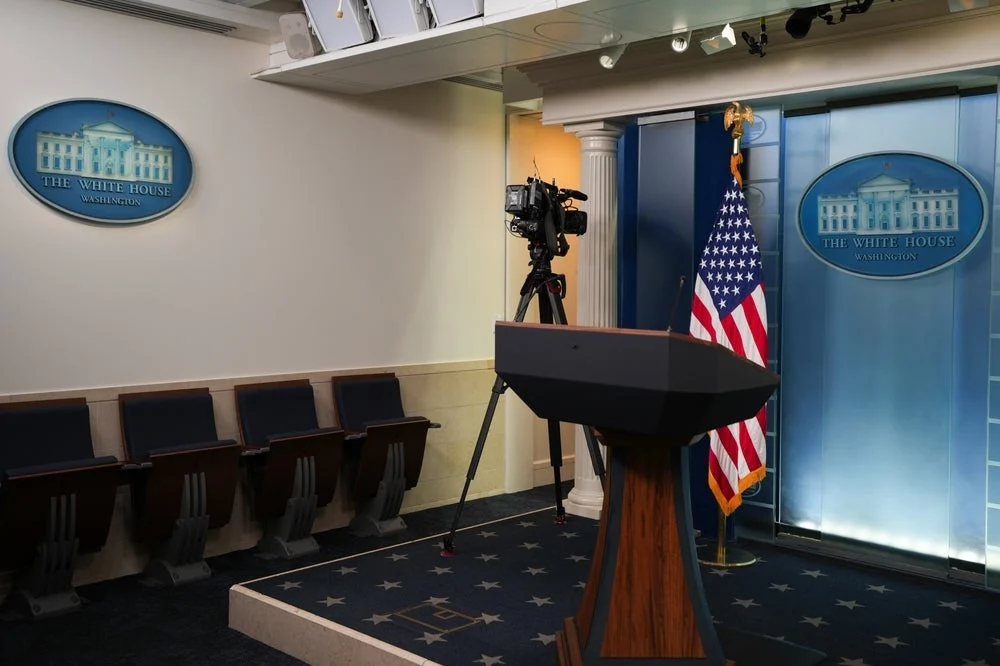
The high-pressure world of political and corporate communications was reminded of an unforgiving truth last week when White House Press Secretary Katie Zacharia’s inaugural briefing ended not just in a swift 15 minutes of guarded exchanges, but in her departure from office days later. Marking one of the shortest tenures in modern executive branch history, the incident has reignited global discourse on crisis management, media relations, and the absolute necessity of rigorous executive preparation. While the White House initially defended the performance as commanding, the intersection of unvetted credentials, predictable questioning, and unprepared answers created a cascading communications failure.
You do not need to manage the West Wing press pool to face the blistering lights of a high-stakes media briefing. Whether addressing an anxious public during an active corporate crisis, announcing sweeping operational pivots for a healthcare network, or representing a high-profile client in a complex legal proceeding, the podium remains an unforgiving equalizer. Briefings succeed only when the underlying information is urgent, profoundly complex, or directly impacts public welfare. For communication professionals and organizational leaders alike, stepping up to the microphone requires a meticulous framework designed to control the narrative rather than chase it.
Evaluating the Format: When to Hold a Briefing
A live, in-person press briefing is not a catch-all solution for public relations challenges. It is a specialized instrument deployment best reserved for specific operational thresholds. Communications teams must first evaluate whether a live Q&A format is genuinely warranted. A briefing makes strategic sense when numerous independent media outlets demand simultaneous access, when complex issues require interactive clarification, and when consistency of message across a broad spectrum of reporting is paramount.
Conversely, if a comprehensive written statement, a carefully orchestrated digital press release, or a singular, exclusive interview can effectively convey the necessary information, leadership should bypass the podium entirely. Opening the floor to unscripted inquiries without a unifying operational need invites unnecessary friction, dilutes core messages, and exposes organizations to avoidable vulnerabilities.
Establishing Core Messages and Single-Voice Discipline
Before a single word is spoken publicly, leadership must distill the narrative into no more than three foundational messages. These pillars must be clear, concise, and compelling enough to be directly quoted by journalists. Every answer provided during the grueling Q&A session must ultimately tie back to one of these three strategic anchors, creating a disciplined narrative loop that resists media redirection.
Equally critical is the selection of a single spokesperson. Mixed voices invariably produce mixed headlines, sowing confusion among the public and stakeholders alike. Organizations must designate one authoritative voice, ensuring that the executive board, internal communications teams, and operational staff are fully aligned. Crucially, the ideal spokesperson is rarely the highest-ranking executive by default, nor is they the individual newest to the operational material. The role demands an individual who is fundamentally credible, unflappably calm, and capable of translating technical jargon into plainspoken truth—and, above all, someone who has been granted adequate time to prepare thoroughly.
Anticipating the Toughest Questions and the Cost of Unreadiness
The dividing line between a successful briefing and a catastrophic public relations disaster invariably lies within predictable questioning. Communications teams must systematically catalog every difficult query they desperately hope no one will ask, subsequently drafting, refining, and rehearsing rigorous responses. This preparation must cover operational failures, individual accountability lines, the spokesperson’s personal and professional background, and complex data points involving budgets, timelines, and financial metrics. Furthermore, organizations should conduct rigorous mock briefings where colleagues aggressively role-play hostile reporters, running simulations at least twice under simulated live-broadcast conditions.
The cost of failing to prepare for predictable inquiries was acutely demonstrated during Zacharia’s brief tenure. When pressed by a reporter from Fox News regarding whether the United States had altered or ceased intelligence-sharing operations with Ukraine, Zacharia demurred, stating she would have to "get back to you on that." The evasion immediately signaled a lack of command over vital foreign policy dossiers.
Worse still was the handling of inquiries concerning her professional background. Media outlets quickly surfaced discrepancies regarding her credentials, specifically her prior representations of holding legal qualifications despite not having passed the bar exam. Confronted by reporters on the South Lawn, her response—which bafflingly meandered into an unrelated anecdote about moving to China, largely obscured by marine helicopter noise—crystallized a broader crisis of credibility. By the following Thursday, she acknowledged that she had not passed the bar. The question had been entirely predictable; the failure to secure a definitive, polished response transformed her personal background into the dominant national news cycle.
Contrasting Crisis Execution: The NTSB Model
A starkly contrasting standard of crisis communication was displayed by the National Transportation Safety Board (NTSB) following the harrowing structural failure of an Alaska Airlines Boeing 737 MAX 9 door plug in January 2024. NTSB Chair Jennifer Homendy hosted consecutive, highly technical press briefings on January 6 and January 7, navigating a storm of intense public anxiety and aggressive journalistic questioning with methodical precision.
When pressed by reporters for granular investigative conclusions while investigators were still combing through the wreckage in suburban Portland, Homendy established an unshakeable boundary: investigators would not offer speculative findings or premature conclusions while active on the scene. When specifically queried about the exact material composition and manufacturing history of the failed door plug, Homendy calmly acknowledged that the agency did not yet possess verified data, committing explicitly to providing the information at the subsequent scheduled briefing.
Both Zacharia and Homendy, in essence, told reporters that they did not know the immediate answers. However, the execution diverged fundamentally. Homendy contextualized the knowledge gap, meticulously described ongoing investigative processes, and established a definitive, time-stamped commitment for future disclosure. In crisis communications, saying "I will get back to you" functions merely as a fragile hope, whereas committing to a specific update at a designated time transforms a vulnerability into an anchor of reliability.
Logistical Rigor and Delivery Mechanics
Executing a successful briefing requires meticulous control over operational logistics. Communications teams should provide accredited media outlets with at least a few hours of advance notice, intentionally avoiding late Friday afternoon dumps unless mandated by overriding safety emergencies. Venues must be chosen for acoustic clarity, physical accessibility, and controlled atmosphere. Establishing clear ground rules regarding the total number of questions the spokesperson will entertain—and explicitly stating those parameters at the outset—prevents chaotic adjournments. Furthermore, providing robust dial-in options and reliable livestreams ensures that remote or regional outlets are not disenfranchised. Abruptly cutting off a briefing without warning creates an immediate perception of institutional evasion.
Beyond factual content, reporters and audiences evaluate non-verbal delivery with exacting scrutiny. Shaky vocal cadence, defensive posturing, and evasive body language can swiftly undermine an otherwise accurate factual presentation. Spokespersons must project calm authority through steady eye contact, measured pacing, and an absence of defensive verbal tics.
Establishing Boundaries: What Not to Say
A comprehensive briefing strategy necessitates explicit agreement on immutable boundaries before stepping to the podium. Legal teams and communication directors must delineate off-limits domains, including pending litigation, sensitive personal identification data, and unconfirmed third-party speculations. Under no circumstances should a spokesperson resort to speculative reasoning or utter the toxic phrase "no comment," which modern audiences universally interpret as an admission of guilt or concealment. Instead, utilizing a definitive framing—such as "I do not have that verified information at this moment, and here is the exact timeline when we will"—serves as a complete, authoritative answer that maintains journalistic respect.
The Imperative of Post-Briefing Follow-Up and Pre-Podium Vetting
The responsibilities of the communications team do not terminate when the microphone is switched off. A comprehensive follow-up protocol must immediately deploy curated statements and factual briefing packets to all registered media outlets, including those unable to attend in person. Communications teams must actively track real-time coverage, rapidly correct factual errors reported by outlets, and fulfill all pending informational promises well within the committed time window.
Ultimately, the downfall of Zacharia underscores the indispensable nature of rigorous internal vetting. Organizations must audit their spokesperson’s complete public record, professional credentials, biographical resume lines, and historical media appearances long before any public-facing engagement. Past statements or credential discrepancies can be weaponized by adversarial media outlets overnight. Uncovering these vulnerabilities internally allows teams to correct inaccuracies proactively and prepare transparent, defensible narratives.
The modern press briefing room operates without a grading curve and offers no quarter to the unprepared. By strictly defining core narrative messages, enforcing single-voice discipline, rehearsing feared vulnerabilities, and maintaining absolute transparency regarding informational gaps, organizations can master the podium and regain definitive control over their public narrative.