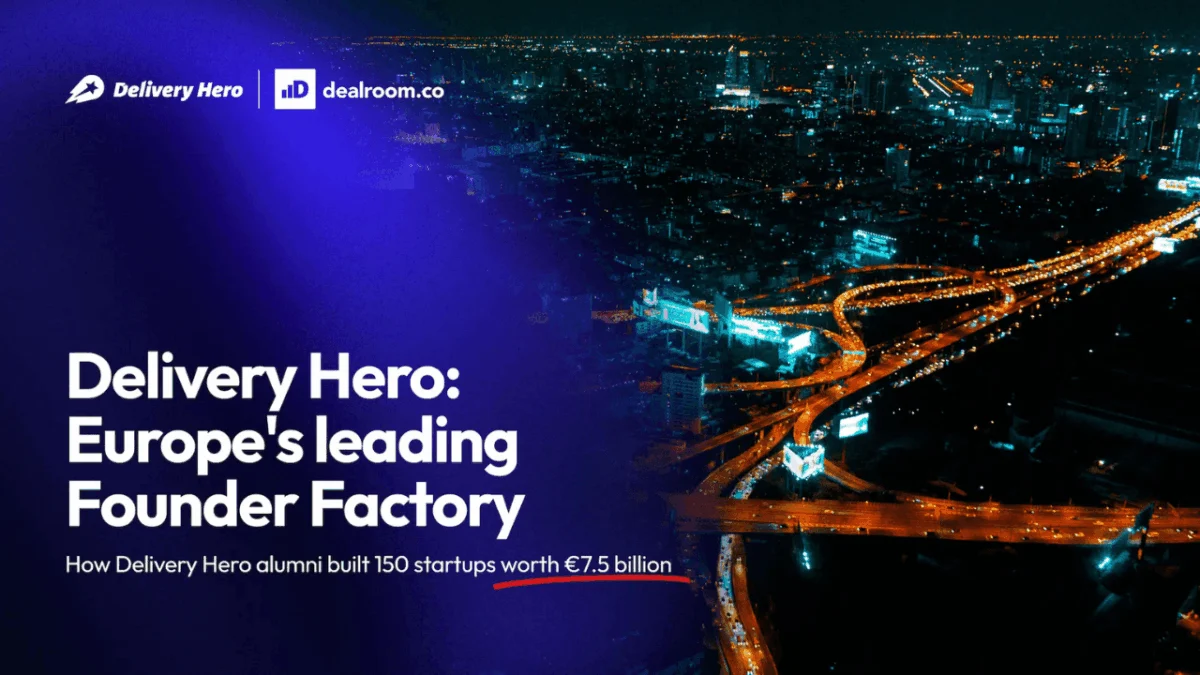
The European technology landscape has a new benchmark for entrepreneurial output, with delivery and quick-commerce giant Delivery Hero officially recognized as the continent’s leading founder factory. According to a comprehensive new analysis published today by startup data platform Dealroom.co, the Berlin-headquartered multinational has surpassed all regional peers in generating alumni-founded startups, cementing its status as an invaluable crucible for tech talent, venture capital, and economic growth.
The report reveals that former employees of Delivery Hero and its sprawling network of European brands have launched 150 distinct startups. These enterprises command a staggering combined enterprise value of €7.5 billion and collectively employ 11,000 people globally. Furthermore, the alumni network has successfully attracted €4.4 billion in venture capital funding, putting Delivery Hero at the very top of Dealroom’s metrics for VC capital raised by alumni-backed ventures. Notably, the collective enterprise value of these spin-off companies has expanded fourfold since 2020, illustrating an accelerating trajectory of growth and value creation.
Dealroom’s analytical scope encompasses not only the central Berlin headquarters but also a vast portfolio of prominent European brands under the Delivery Hero umbrella. These include efood, foodora, foodpanda’s European divisions, foody, Glovo, and Yemeksepeti. The data set even accounts for entrepreneurs who departed these regional entities prior to their formal acquisition by Delivery Hero, highlighting the expansive footprint of the company’s corporate lineage.
Anchored in Germany: The Epicentre of Alumni Impact
While Delivery Hero’s influence is felt across multiple international markets, Germany remains the geographic and economic anchor of this entrepreneurial phenomenon. Berlin-based startups originating from the Delivery Hero ecosystem account for €4.9 billion of the network’s €7.5 billion total enterprise value. Additionally, roughly 3,700 of the 11,000 global jobs created by these alumni companies are located within Germany.
The Berlin headquarters alone has functioned as an exceptional incubator, spawning 42 next-generation startups. These ventures represent a combined enterprise value of €4.4 billion, have secured €3.5 billion in venture capital, and sustain a global workforce of approximately 6,800 individuals.
When measured against broader European benchmarks, Delivery Hero’s standing fluctuates depending on the metric evaluated. While it claims the number one spot in Germany and across Europe for the sheer volume of alumni-founded startups and venture capital raised, it ranks fifth in terms of combined enterprise value and fourth for total jobs created.
The ripple effect is equally pronounced across the company’s regional acquisitions. The foodora brand alone accounts for 49 startups founded across France, Spain, Scandinavia, and Central Europe, amassing a collective valuation of €2.3 billion. Meanwhile, alumni of the Spanish quick-commerce pioneer Glovo have established 35 startups valued at a combined €461 million.
Beyond Food Delivery: Diversification into Enterprise Software and Beyond
Although food and quick-commerce remain the foundational sectors for the network—accounting for 33 alumni-founded companies—the scope of industries has diversified significantly. Enterprise software is rapidly closing the gap with 32 startups, while boasting the strongest early-stage pipeline among emerging sectors. Health tech and transportation follow closely, with 19 startups each. Alumni have also ventured into fintech, marketing, real estate, and energy, demonstrating that the operational discipline forged in logistics scales effectively across complex technology verticals.
This multidisciplinary expansion reflects the multifaceted nature of running a global operations-heavy enterprise. Modern delivery platforms require sophisticated route optimization, complex supply chain management, high-volume transactional infrastructure, and robust customer relationship management systems. Consequently, employees acquire a versatile toolkit that translates seamlessly into diverse market segments.
From Corporate Employee to Rapid-Fire Founder
The Dealroom analysis provides a granular look at the demographic and behavioral profiles of those who leave Delivery Hero to build their own enterprises. The data shows that alumni founders spend a median tenure of approximately three years within the company before taking the entrepreneurial leap. In fact, 53 percent of founders launched their ventures after logging between one and three years at the firm.
Interestingly, institutional hierarchy did not dictate entrepreneurial success. Only 29 percent of these founders held executive C-suite, director, or vice president titles prior to launching their companies. Instead, the transition from corporate employee to independent founder is characterized by remarkable speed: one-third of alumni founded their startups within six months of leaving Delivery Hero, and 43 percent did so within a single year. Operational and technical teams proved to be the most fertile ground for producing this new wave of founders.
These startups also demonstrate superior performance through traditional funding funnels. Among Delivery Hero alumni companies that secured standardized Seed rounds between 2010 and 2020, an impressive 47 percent subsequently raised a Series A round. This conversion rate significantly outpaces the broader European startup average of approximately 30 percent. Furthermore, 28 percent successfully advanced to a Series B stage, and 11 percent progressed to Series C or later rounds.
A Multi-Tiered Ecosystem: Second-Generation Founders and Venture Capital
The transformative impact of Delivery Hero on the European technology ecosystem extends well beyond its direct alumni. The network has successfully catalyzed a second generation of entrepreneurship. Individuals who previously worked at companies founded by Delivery Hero alumni—such as Gorillas, Kaia Health, and Zenjob—have gone on to launch approximately 80 additional second-generation startups. High-growth enterprises like Gorillas and Circ have emerged as significant secondary sources of fresh entrepreneurial talent.
Simultaneously, Delivery Hero alumni are actively reinvesting their capital and acquired expertise back into the ecosystem. More than 30 former employees have transitioned into the venture capital sector, either by founding or joining over 35 investment firms. Since 2020, these alumni-led funds have raised €7.3 billion in fresh capital and participated in more than 2,300 funding rounds, representing an aggregate deal volume exceeding €79 billion. Furthermore, since 2017, startups founded by Delivery Hero alumni have maintained a steady exit cadence, averaging two exits per year.
Industry Leaders Reflect on the Milestone
Reflecting on the milestone, Niklas Östberg, Co-Founder and CEO of Delivery Hero, emphasized the company’s long-term commitment to nurturing European innovation:
"In the fifteen years since we founded Delivery Hero, we have proudly emerged as the leading network that feeds capital, founders, operators, and experience back into the European ecosystem," Östberg stated. "I love to see that impact continue to grow. And I want to see the next generation of European founders have the same opportunity to build and scale here—Europe just needs to keep creating the conditions for that to happen."
Yoram Wijngaarde, Founder and CEO of Dealroom.co, underscored the broader structural significance of the report’s findings:
"The accumulation of talent in the European ecosystem is accelerating, as more founders and investors have experienced from the inside what it means to scale a globally leading company," Wijngaarde noted. "Delivery Hero stands out as a central anchor in this network, which spans all over Europe."
Strategic Implications for the European Tech Economy
As Europe continues to vie for global technological sovereignty, the phenomenon of corporate "founder factories" like Delivery Hero provides crucial structural support. By systematically developing top-tier operational talent, generating substantial secondary wealth, and recycling capital back into early-stage ventures, these corporate anchors mitigate Europe’s traditional structural disadvantage against Silicon Valley: a lack of interconnected, experienced scale-up operators.
With multi-billion-dollar exits, robust second-generation spin-offs, and an expanding network of alumni-led venture funds, Delivery Hero’s legacy is increasingly defined not just by its market capitalization or delivery fleets, but by the indelible blueprint it has provided for the next generation of European enterprise.