The landscape of paid social media marketing is undergoing a notable shift as digital advertisers navigate evolving platform algorithms and macroeconomic pressures. According to comprehensive new benchmark data published by WordStream by LocaliQ, Facebook advertisers are experiencing significantly cheaper clicks and stronger audience engagement in 2026, while the cost per lead (CPL) has remained remarkably flat across multiple sectors.
The report, which analyzed nearly 1,800 distinct Facebook advertising campaigns spanning a wide array of industries, provides a granular look at core performance metrics. Specifically, researchers evaluated click-through rates (CTR), cost per click (CPC), conversion rates (CVR), and cost per lead (CPL) for both traffic-driven and lead-generation initiatives. The findings offer a welcome relief for marketers who have spent recent years grappling with rising customer acquisition costs and tightening ad budgets across major digital channels.
A Detailed Look at 2026 Traffic Campaigns
Traffic campaigns on Meta’s flagship platform delivered a remarkably strong performance cycle, characterized by rising user engagement paired with declining click acquisition costs. Overall data indicates that traffic clicks became approximately 14% cheaper year over year, while average click-through rates improved by nearly 13%. This dual trend signals that users are not only seeing Facebook ads more favorably—or at least responding to them at higher rates—but advertisers are also paying less for each visitor driven to their landing pages.
However, performance varied significantly by industry sector. The vast majority of verticals enjoyed downward pressure on their traffic CPCs, but a select few bucked the trend. Only two industries recorded year-over-year increases in traffic CPCs: Shopping, Collectibles, and Gifts, which saw costs surge by 73.53%, and Sports and Recreation, which experienced a 43.90% increase in traffic click costs.
Conversely, several sectors experienced massive relief in traffic acquisition expenses. Real Estate led the market with the most dramatic CPC improvement, plummeting by 39.56%. This was closely followed by the Restaurants and Food industry, which saw traffic CPCs drop by 37.50%, and the Industrial and Commercial sector, which recorded a 37.21% decrease in click costs. Industry analysts attribute these shifts to changing consumer search behaviors, seasonal demand rebalancing, and enhanced machine-learning optimization deployed by Meta’s ad delivery systems.
Lead Generation Campaigns and Cost-per-Click Winners
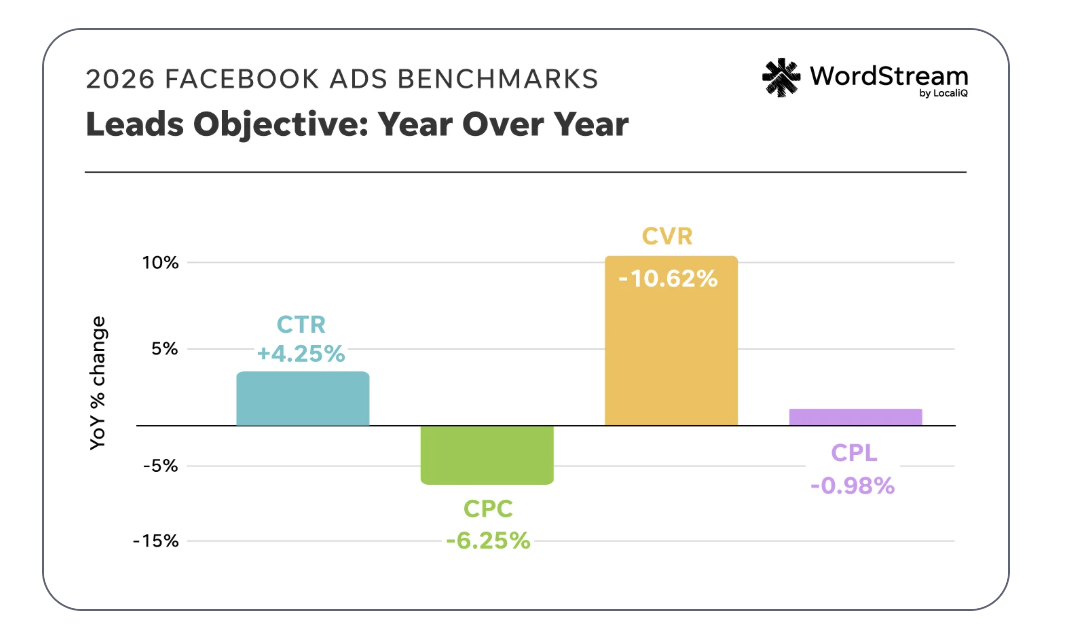
For brands focused primarily on capturing customer information and generating qualified leads, the 2026 outlook proved broadly positive. While overall CPL remained relatively flat, the cost to secure a click within lead campaigns dropped across nearly all evaluated sectors.
Automotive campaigns—specifically those categorized under "For Sale" listings—saw lead campaign CPCs tumble by an impressive 44.17%. Dentists and Dental Services followed closely with a 41.72% drop in CPC, while Health and Fitness brands experienced a 30.30% reduction in click costs.

In contrast, only a tiny fraction of industries faced inflationary pressures on lead campaign clicks. Education and Instruction saw a modest 4.24% increase in lead campaign CPCs, while Sports and Recreation recorded a marginal 0.93% uptick.
When examining the absolute cost per lead, however, the financial reality varied wildly depending on the specific niche. Lowest CPL figures were traditionally found in high-volume, lower-intent categories, whereas specialized B2B or high-ticket consumer services commanded significantly higher price tags per converted lead. Despite these absolute cost differences, the general stability of CPL metrics indicates that conversion rates are scaling proportionally with traffic volume, preventing runaway acquisition budgets for most brands.
The Broader Context: Paid Search vs. Paid Social
To fully understand the significance of the 2026 WordStream benchmarks, industry experts emphasize the need to look at the broader digital advertising ecosystem, particularly the ongoing balancing act between paid search (such as Google Ads) and paid social (Meta, TikTok, and LinkedIn).
Historically, paid search has commanded higher intent because users actively type queries into search engines with immediate transactional goals in mind. Paid social, by interruption-based contrast, targets users based on demographics, interests, and behavioral profiles while they browse their feeds.

However, the cost disparity between these channels has widened notably. According to WordStream’s observations, Google Ads CPC currently stands at more than double Meta’s average CPC. While Google Search continues to capture users at the bottom of the marketing funnel with razor-sharp intent, the efficiency gains on Facebook—where traffic clicks are roughly 14% cheaper and engagement is up—mean that advertisers can stretch their social budgets much further. Marketers are increasingly utilizing Facebook not just for top-of-funnel brand awareness, but as a cost-effective mid-funnel conversion driver that complements their high-intent search campaigns.
Under the Hood: Meta’s Algorithmic Efficiency
The underlying catalyst for these favorable 2026 metrics points directly to platform-level advancements. Meta has continuously refined its ad delivery algorithms, leveraging advanced machine learning and automated bidding models to match ads with the most receptive audiences.
Industry analysts suggest that these algorithmic improvements have directly contributed to stronger conversion performance and suppressed cost inflation. Features like Advantage+ shopping and lead campaigns have automated much of the heavy lifting for advertisers, reducing human error, optimizing audience targeting in real-time, and pruning wasted ad spend.
Consequently, the 2026 data dispels the long-standing compromise digital marketers often had to make: the notion that they must choose between cheaper traffic quality or better campaign performance. On Facebook, current macroeconomic and platform dynamics are delivering both simultaneously.
Implications for Marketers and Future Outlook
For marketing departments mapping out their annual expenditures, the 2026 benchmark report provides actionable intelligence. With lead costs holding steady and click expenses dropping, brands have a unique window of opportunity to scale their acquisition efforts without proportionately inflating their media budgets.
As competition intensifies in certain volatile sectors like retail shopping and specialized recreation, general advertisers across real estate, automotive, health, and local services stand to benefit immensely from Meta’s improved cost efficiencies. The overarching takeaway is clear: Facebook advertising has successfully entered a phase of heightened efficiency, offering a high-yield environment for brands willing to refine their creative strategies and lean into platform automation.