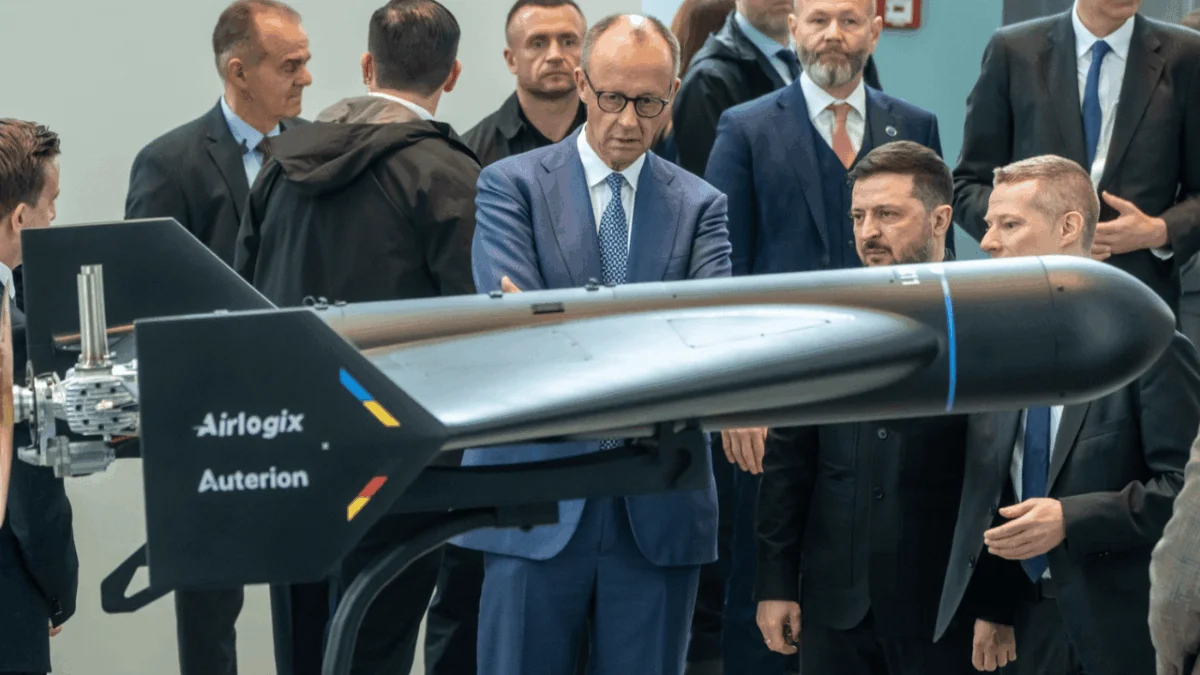
Germany today solidified its commitment to bolstering European defence capabilities and supporting Ukraine with the signing of a pivotal cooperation agreement. This landmark accord empowers the Auterion Airlogix Joint Venture GmbH to commence full-scale production of thousands of mid-range, heavy AI-guided autonomous strike systems. The contract, a significant advancement from a February 2026 announcement at the Munich Security Conference, effectively transforms a strategic intention into a fully funded, tangible manufacturing operation on German soil. This agreement represents the largest German production order to date for heavy autonomous strike drones, signaling a new era of collaborative defence industrial output within Europe.
The genesis of this ambitious project lies in the synergy between two prominent defence technology entities: Airlogix, a Ukrainian scale-up, and Auterion, a Swiss-founded company with a global reach in drone operating systems. Airlogix, established in 2020 and with a dedicated defence focus since 2022, has rapidly ascended to become a leading supplier of combat-proven unmanned aerial vehicles (UAVs) to the Ukrainian Armed Forces and special operations units. Its systems have been actively deployed and tested on the front lines of the ongoing conflict, providing invaluable real-world operational experience.
Auterion, on the other hand, specializes in developing open, vendor-agnostic operating systems for autonomous drones and robotic systems. Its technology has garnered significant trust and adoption among major defence organizations, including the U.S. Department of Defense, the UK Ministry of Defence, the German Bundeswehr, and, crucially, the Armed Forces of Ukraine. This dual expertise – Airlogix’s battle-hardened airframe design and Auterion’s advanced autonomy software – forms the technological bedrock of the new joint venture.
From Concept to Mass Production: A Strategic Leap
The newly signed contract represents a dramatic acceleration from initial discussions and demonstrations. The February 2026 announcement at the Munich Security Conference, often a venue for showcasing future defence technologies and forging international partnerships, has now culminated in immediate, large-scale industrial production. The commitment to producing thousands of systems annually from German production lines underscores the urgency and strategic importance attached to this initiative by both nations. This move is not merely about fulfilling an order; it is about establishing a robust, sustainable European manufacturing base for critical autonomous defence capabilities.
The economic implications of such large-scale production are substantial. Mass production inherently drives down per-unit costs, making advanced autonomous strike systems more accessible and deployable. This cost-efficiency is particularly vital for developing "production-rate munitions" – a term suggesting the ability to replenish stocks rapidly in response to battlefield attrition. These systems are specifically designed to operate effectively in contested, GPS-denied environments, a critical capability in modern warfare where electronic warfare and jamming are prevalent. The integration of combat-tested Ukrainian airframes with Auterion’s battle-proven AI guidance, autonomous navigation, and electronic warfare resilience software ensures that the deployed systems are not only numerous but also highly capable and reliable.
A Dual Benefit for Ukraine and Germany
For Ukraine, this agreement signifies a vital step towards securing a consistent, European-manufactured supply of autonomous strike capabilities. The coordination of this supply through the German Federal Ministry of Defence provides a framework of stability and reliability, reducing Ukraine’s dependence on ad-hoc or geographically distant sourcing. The backing of German industrial depth behind each manufactured unit offers assurance of quality, support, and long-term availability, crucial elements for sustained defence operations.
From the German perspective, this initiative represents the fastest and most effective path to fielding autonomous strike capabilities at scale within the Bundeswehr. The deployment of combat-proven systems, equipped with Auterion’s Skynode flight computer and Nemyx autonomy stack, promises seamless integration into existing Western command architectures from day one. This interoperability is a key tenet of NATO and allied defence strategies, ensuring that newly acquired capabilities can be immediately utilized within multinational operational frameworks. The presence of Ukrainian combat expertise embedded in the design and production process further enhances the relevance and effectiveness of these systems for modern conflict scenarios.
Expanding the European Defence Industrial Landscape
Beyond the immediate beneficiaries, the establishment of this production line opens doors for allied nations. The invitation for scale-up beyond Germany suggests a broader vision for a pan-European defence industrial ecosystem, capable of responding to evolving security challenges. This collaborative model could serve as a blueprint for future defence production initiatives, fostering greater interdependence and strengthening the collective security of European partners.
The leadership of both companies has expressed strong optimism and conviction regarding the significance of this partnership. Vitalii Kolesnichenko, CEO of Airlogix, highlighted the unique origins of the technology: "Our engineers built these systems under fire. Now, German industry is producing them at a scale that changes the equation on the battlefield. Every unit that rolls off this line carries years of real combat learning." This statement underscores the critical advantage of having systems developed and refined through actual combat experience, translating battlefield insights into production-ready hardware.
Dr. Lorenz Meier, CEO of Auterion, emphasized the broader implications for European defence: "This contract proves that Europe can move at scale. We are enabling Airlogix to manufacture thousands of autonomous systems on German soil, drawing on Ukrainian combat expertise and the best autonomy software in the world. This is what allied defence industrial cooperation looks like." His remarks frame the agreement not just as a commercial transaction, but as a tangible demonstration of Europe’s capacity for collective action and technological advancement in the defence sector.
Historical Context and Timeline
The path to this momentous agreement can be traced through several key milestones. The initial conceptualization and development of Airlogix’s combat-proven systems likely began in the early stages of the conflict in Ukraine, with a significant acceleration in their deployment and refinement occurring throughout 2022 and 2023. Auterion’s involvement as a technology provider has been ongoing, with its systems being integrated into various drone platforms for different military applications by multiple international partners.
The strategic importance of autonomous systems was widely acknowledged at major defence forums, with the Munich Security Conference in February 2026 serving as a prominent platform. It was at this event that the initial announcement of a potential joint venture and production agreement was made, signaling the intent to move from concept to industrial reality. This announcement likely involved preliminary discussions and agreements, paving the way for the detailed negotiations and contractual frameworks that have now been finalized.
The signing of today’s cooperation agreement marks the formal commencement of large-scale production. This involves the establishment or expansion of manufacturing facilities in Germany, the sourcing of components, the training of personnel, and the implementation of rigorous quality control processes. The target of producing thousands of systems per year suggests a significant ramp-up, requiring substantial investment and logistical coordination. The integration of Auterion’s Skynode flight computer and Nemyx autonomy stack into these systems will be a critical phase, ensuring that the advanced software capabilities are seamlessly incorporated into the hardware.
Supporting Data and Technological Underpinnings
While specific details on the exact specifications of the "mid-range, heavy AI-guided autonomous strike systems" are not fully disclosed, the description points to a sophisticated class of UAVs. Mid-range typically implies operational radii of several hundred kilometers, while "heavy" suggests a significant payload capacity, potentially for kinetic effectors or advanced sensor packages. The AI-guidance and autonomous navigation capabilities are central to their functionality, enabling them to operate with a high degree of autonomy, identify targets, and execute missions with minimal human intervention, especially in complex and contested environments.
Auterion’s Skynode flight computer is a well-established platform in the autonomous systems market, known for its robustness and versatility. It provides the processing power and connectivity required for advanced AI algorithms, sensor fusion, and communication. The Nemyx autonomy stack, developed by Auterion, likely incorporates sophisticated algorithms for path planning, object recognition, target tracking, and electronic warfare countermeasures, all crucial for operation in contested airspace.
The emphasis on "production-rate munitions" and "combat-proven airframes" from Airlogix suggests that these drones are designed for mass deployment and attrition warfare, where rapid replenishment and reliability are paramount. The integration of these elements into a European production framework is a significant achievement, addressing a critical gap in the continent’s defence industrial capabilities.
Broader Implications and Future Outlook
The implications of this German-Ukrainian defence production agreement extend far beyond the immediate supply of drones.
Enhanced European Deterrence: By establishing a robust domestic production capability for advanced autonomous strike systems, Germany and its partners are strengthening European deterrence. This reduces reliance on external suppliers and enhances the continent’s ability to respond to threats independently.
Technological Advancement: The collaboration fosters innovation by combining Ukrainian battlefield expertise with European engineering and manufacturing prowess. This cross-pollination of knowledge can accelerate the development of next-generation defence technologies.
Economic Growth and Job Creation: The large-scale production initiative is expected to stimulate economic activity in Germany, creating skilled jobs in manufacturing, engineering, and logistics. It also reinforces the competitiveness of European defence industries on the global stage.
Strengthened Alliance Cohesion: The agreement exemplifies effective allied defence industrial cooperation, a key objective for NATO and the European Union. It demonstrates a shared commitment to addressing common security challenges through tangible joint action.
A Model for Future Partnerships: The success of the Auterion Airlogix Joint Venture GmbH could serve as a compelling model for future collaborative defence production ventures within Europe, encouraging similar partnerships to address other critical capability gaps.
Potential for Export Markets: As mentioned, the production line is open for scale-up beyond Germany, suggesting that these systems could eventually be offered to other allied nations, further expanding their reach and impact on global security dynamics.
The images accompanying the contract signing ceremony, depicting Auterion CEO Dr. Lorenz Meier, Airlogix CEO Vitalii Kolesnichenko, Ukrainian President Volodymyr Zelenskyy, and German Chancellor Friedrich Merz alongside an Airlogix autonomous strike system, serve as powerful visual testament to the significance of this milestone. This collaborative effort represents a strategic investment in European security, a testament to the power of international partnership, and a significant step forward in the evolution of autonomous defence capabilities. The "years of real combat learning" embedded within each system produced are poised to fundamentally alter the strategic landscape for European defence and international security.