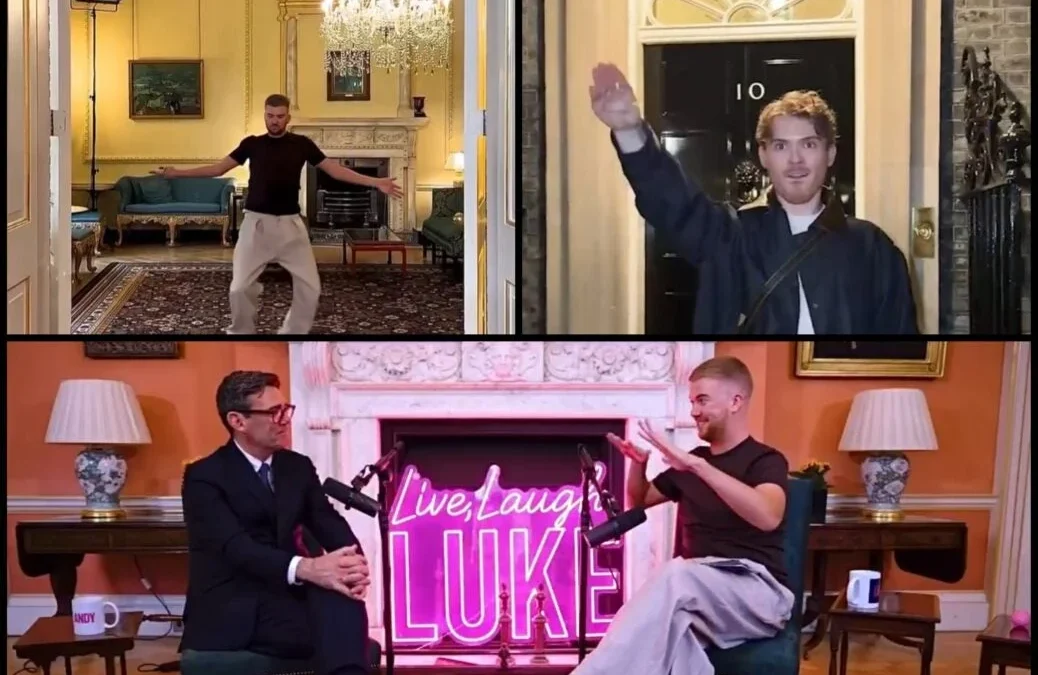
The hallowed black door of Number 10 Downing Street has historically served as the ultimate threshold for the British press, a place where hardened political correspondents wait hours in the rain to hold prime ministers to account. Yet, a recent shift in government communication strategy has upended decades of media protocol. Prime Minister Andy Burnham’s administration recently invited a cohort of roughly 60 social media influencers into the heart of British executive power, granting them unprecedented access, exclusive receptions, and one-on-one interview opportunities.
While the maneuver successfully bypassed legacy media filters to target millions of digitally native voters, it simultaneously ignited a fierce national controversy. Professional journalists, media unions, and press freedom organizations have sharply condemned the move, arguing that substituting rigorous scrutiny with softball content creation threatens the foundations of democratic accountability. As the boundaries between entertainment and governance blur, the incident has laid bare an existential crisis for the news industry: how traditional journalism can survive an era where political leaders increasingly prefer viral clout over rigorous questioning.
The Chronology of the Downing Street Creator Summit
The roots of this modern media collision trace back to Andy Burnham’s ascent to the premiership four months prior. From the outset of his tenure, Burnham’s administration signaled a decisive pivot away from traditional Westminster lobby reporting, favoring direct-to-consumer digital channels. The friction culminated in November when Downing Street opened its doors to approximately 60 high-profile content creators, TikTokers, and YouTubers for an exclusive reception.
Among those invited were digital personalities boasting immense followings. Luke Hamnett, a creator with more than 1.3 million TikTok followers, filmed himself dancing through the historic corridors of power. Max Balegde—performing under his real name, Max Trobe—shared content featuring a satirical salute and a performance outside the iconic front door. Another attendee produced an AI-generated song containing misogynistic profanities, which was later deleted following public outcry.
Critics were quick to contrast this red-carpet treatment with the diminishing access afforded to accredited journalists. Laura Webster, editor of Scotland’s The National newspaper, highlighted a stark statistical disparity on social media. She noted that in Scotland, Burnham had granted local journalists a single press conference featuring a strictly limited number of questions for broadcast and print, while simultaneously gifting creators hours of unobstructed, fawning engagement.
Faced with mounting criticism in the House of Commons during Prime Minister’s Questions (PMQs), Burnham defended his administration’s outreach, arguing that engaging with younger, disengaged demographics is a modern democratic necessity. However, the defense did little to quell the storm brewing across the British media landscape.
The Economic Imperative: Why Politicians and Brands Are Fleeing Traditional Media
To understand why Number 10 rolled out the red carpet for influencers, one must examine the broader economic and technological shifts reshaping the consumption of both news and advertising. Trust in legacy print and television journalism has evolved, while artificial intelligence-generated search answers have severely dented traditional website traffic referral models. Consequently, major publishers and multinational corporations alike are scrambling to adapt to a video-first ecosystem dominated by platforms like TikTok, YouTube, and Instagram.
The financial metrics driving this migration are staggering. According to data from the Internet Advertising Bureau UK (IAB UK), the nation’s digital ad market reached £40.5 billion, with social media ad spend surging 21% in the first half of 2026 alone to hit £11.5 billion—accounting for nearly 28% of the entire digital advertising pie.
Major consumer brands are voting with their wallets. Unilever, the corporate giant behind household names like Dove and Knorr, announced it has slashed its UK television advertising spend by more than half, redirecting those funds heavily toward social media influencers. Industry analyses suggest that influencer-generated marketing delivers a return on investment roughly 1.5 times higher than traditional branded content.
News publishers are forced to follow the money. In a historic first for the British media industry, news outlets such as the Daily Mail and Metro recently signed up for TikTok Premiere, a program designed to serve advertisements directly alongside publisher video content on the platform. Yet, while commercial entities successfully monetize this shift, the intersection of political news and algorithmic entertainment remains deeply contentious.
Industry Backlash: Distinguishing Journalism from Content Creation
The core objection raised by media professionals is not the desire of politicians to reach younger audiences, but rather the erosion of journalistic standards masquerading as political communication. Prominent figures within the British press have vocally drawn a hard line between independent journalism and entertainment-driven content creation.
Appearing on Times Radio, experienced political journalist and former Parliamentary Press Gallery chair Kate McCann pulled no punches regarding the Downing Street antics. While conceding that creators are entirely within their rights to conduct lighthearted, uncritical interviews, she emphasized a fundamental philosophical divide.
"You don’t have to stand outside Downing Street and sing that stupid song to be able to cater to your audience and talk about politics—that doesn’t have to happen, and in my view shouldn’t happen," McCann stated. "We have to be clear about the difference between journalism, podcasting, and social media content creation; they’re not the same thing."
Her co-presenter, Stig Abell, the former editor of the Times Literary Supplement, underscored the inequality of access, noting that an established political editor would rarely, if ever, be granted the generous, uncritical windows of time afforded to viral sensations.
This sentiment was echoed across journalistic bodies, including the National Union of Journalists (NUJ), the Society of Editors, and the News Media Association (NMA), all of which issued scathing critiques of Downing Street’s media strategy.
Official Responses from Media Defense Organizations
The organized response from press freedom advocates highlights a unified fear: that bypassing institutional journalism starves the public of vital oversight.
Laura Davison, General Secretary of the NUJ, stressed the indispensable nature of professional newsgatherers. "It is essential that bona fide newsgatherers who are trained to probe politicians and hold those in power to account have access to the workings of government," Davison said. She urged the government to demonstrate an unequivocal commitment to press freedom by legally or practically guaranteeing accredited journalists equal access to future governmental receptions.
Dawn Alford, Chief Executive of the Society of Editors, trained her sights directly on the logistics of the Downing Street reception, raising troubling questions about state involvement in content production.
"If Downing Street can make time for 60 social media creators at a reception, it can also make time that day for journalists to question the Prime Minister," Alford remarked. She pointedly questioned reports that Number 10 supplied recording devices for filming inside the building and subsequently distributed raw footage to creators, demanding transparency regarding the government’s editorial role in shaping influencer narratives.
"Established news organisations are already successfully reaching younger audiences on TikTok, Instagram, and YouTube," Alford added. "That work is backed by trained reporters and experienced editors who check facts, and challenge claims… When No 10 makes special arrangements to help creators produce content, it should be just as willing to give independent journalists the access they need to ask difficult questions and follow up when they don’t get an answer."
Theo Bamber, Chief Executive of the News Media Association, echoed these concerns, emphasizing that an influencer’s primary currency is the sheer size of their digital following rather than their investigative acumen.
"Professional journalists build their careers on asking difficult questions, holding power to account and telling the stories that people need to hear," Bamber noted. "At a time when audiences and advertising are increasingly moving to social platforms, denying professional journalists access while opening the doors to influencers risks further undermining the sustainability of journalism."
The Creator Perspective and the Path Forward
Amid the heavy crossfire between Westminster and the legacy press, digital creators themselves have offered nuanced reflections on the evolving media landscape. Sophia Smith Galer, a former BBC journalist who successfully transitioned into a prominent TikTok content creator, argued that traditional journalists often harbor a fundamental misunderstanding of the digital creator economy.
Writing and speaking on the discourse, Smith Galer noted that critics incorrectly assume creators possess the exact same institutional and ethical duties as traditional reporters. "Content creation was born in the entertainment economy, not the news industry," she explained. "Some creators do journalism, many don’t, and that’s fine."
However, Smith Galer did not give the creator ecosystem a complete pass. She criticized the legacy news media for failing to collaborate with digital creators, arguing that a lack of partnership and cross-pollination has allowed political spin doctors and government communications teams to seize total control of the digital narrative. By refusing to bridge the gap, traditional outlets have inadvertently empowered political offices to curate unchallenging environments free from genuine friction.
Implications for Democratic Discourse
The friction at Downing Street is symptomatic of a global transformation in political communication. Across Western democracies, leaders from various political alignments are increasingly bypassing traditional gatekeepers—newspapers, broadcast networks, and political editors—to speak directly to constituents through podcasts, livestreams, and algorithmic platforms.
While democratization of access has its merits, the trade-off is profound. Traditional journalism relies on institutional memory, institutional skepticism, and the tenacity to follow up on unfulfilled political promises weeks or months after a press conference ends. Influencer-driven engagement, by contrast, operates on the currencies of speed, visual spectacle, and algorithmic reward, where controversy often trumps context.
As ad revenues continue their structural migration away from print and digital journalism toward social media giants, publishers face a severe economic squeeze. If governments systematically favor viral personalities over trained watchdogs, the public runs the risk of entering an era where access is bartered for applause, and democratic scrutiny is traded for digital likes. For both politicians and publishers, the central challenge of the coming decade will be finding a sustainable equilibrium that respects the digital habits of modern audiences without sacrificing the foundational accountability upon which a healthy democracy depends.