Four years after NASA initiated a high-stakes kinetic impact test to determine if humanity could successfully deflect a potential extinction-level asteroid, the European Space Agency’s (ESA) Hera mission has arrived at the site of the collision to document the transformation of the Dimorphos asteroid. In September 2022, NASA’s Double Asteroid Redirection Test (DART) probe performed a deliberate, high-speed suicide maneuver, striking the asteroid Dimorphos at approximately 13,700 mph (6.14 kilometers per second). The resulting kinetic energy—roughly 10 billion joules—did more than merely nudge the celestial body; it permanently altered its orbit around its parent asteroid, Didymos, by roughly 33 minutes. While the initial success was confirmed via terrestrial and space-based telescopes, the true physical extent of the damage remained a subject of intense scientific inquiry until the arrival of the Hera spacecraft this month.
The Hera mission represents the critical "forensic" phase of the planetary defense initiative. By providing a close-up, high-resolution assessment of the impact site, Hera is enabling researchers to transition from theoretical modeling to empirical analysis. The preliminary data transmitted by the spacecraft has already challenged several foundational assumptions about asteroid composition and structural integrity, revealing a surface that has been fundamentally reshaped by the violent encounter.
A Chronology of the Deflection Experiment
The saga of the Didymos-Dimorphos system began in earnest with the November 2021 launch of the DART spacecraft from Vandenberg Space Force Base in California. The objective was to demonstrate the feasibility of the kinetic impactor technique—a method for planetary defense that relies on transferring momentum from a spacecraft to an asteroid to shift its trajectory.
On September 26, 2022, DART successfully intercepted Dimorphos, a 500-foot-wide moonlet orbiting the larger, 2,500-foot-wide asteroid Didymos. The collision, which occurred 6.8 million miles from Earth, was recorded by the Italian Space Agency’s LICIACube, a small satellite deployed by DART days before the impact. Telescopic observations following the event confirmed a significant orbital contraction; the 11-hour and 55-minute orbital period of Dimorphos was reduced by 33 minutes, far exceeding the mission’s minimum success criteria of a 73-second change.
Following this triumph, the focus shifted to the European Space Agency. Hera, launched in October 2024, embarked on a two-year journey to rendezvous with the binary system. Its primary directive is to characterize the mass, structure, and chemical composition of the impact site, providing the necessary data to extrapolate the results of the DART experiment to other asteroid populations.
Structural Transformation and the Crater Conundrum
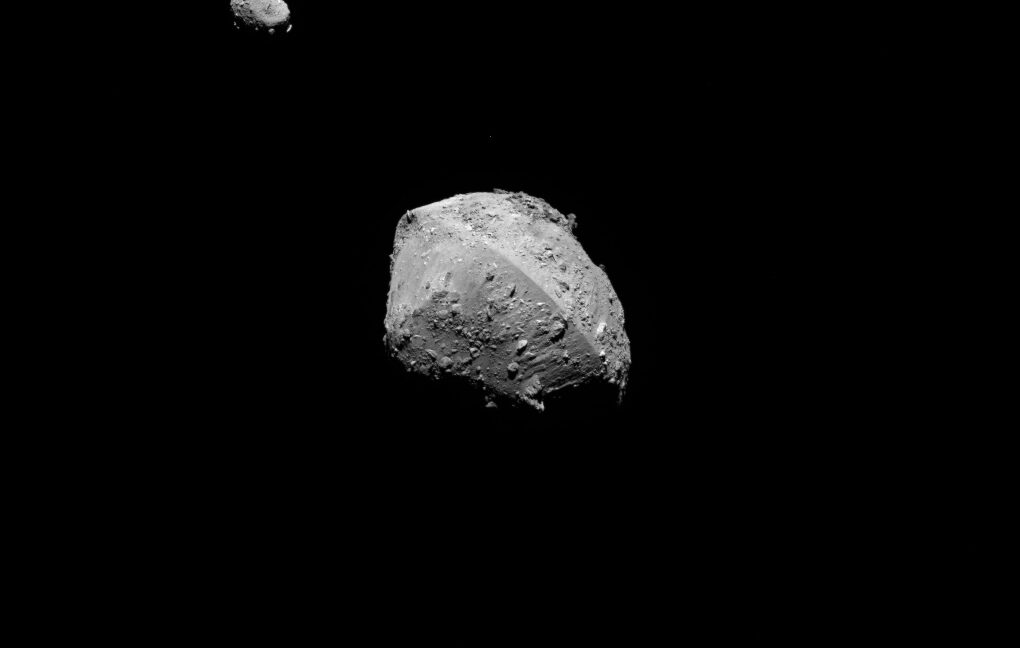
When Hera reached its destination, the images transmitted back to Earth provided a startling look at the aftermath. Scientists had formulated two primary hypotheses regarding the impact: either the DART probe would create a localized crater, or it would cause a wholesale deformation of the asteroid’s structure. As Dr. Patrick Michel, principal investigator for the Hera mission, noted, the reality appears to be a hybrid of both.
The impact site features a massive crater that spans a significant portion of the asteroid’s diameter. The sheer scale of this cavity suggests that Dimorphos—a "rubble pile" asteroid—is far less cohesive than a solid rock. This observation is critical for planetary defense, as it implies that the mechanical response of an asteroid to an impact depends heavily on its internal porosity and the gravitational binding energy of its constituent parts.
Furthermore, the stability of the system has been compromised. While Didymos remains consistent in its rotation, Dimorphos is currently exhibiting a wild, unpredictable tumble. This erratic rotation suggests that the internal distribution of mass has been shifted, and the structural integrity of the moonlet may have been compromised to the point of near-disintegration.
The Debris Swarm: An Unexpected Discovery
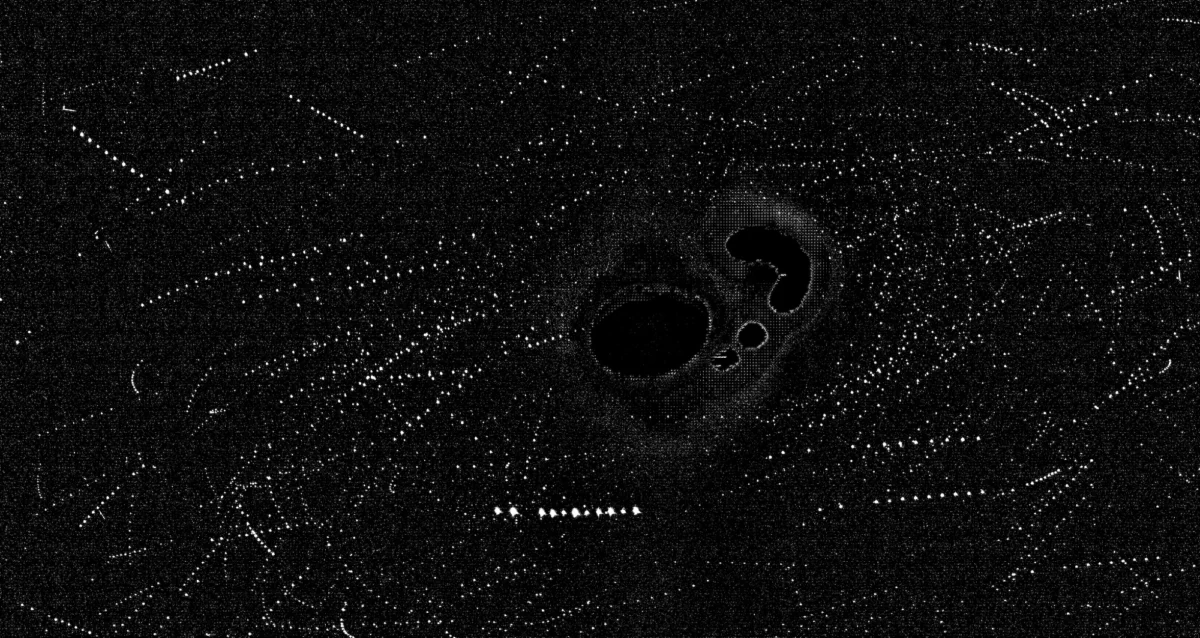
Perhaps the most significant finding from the early reconnaissance phase of the Hera mission is the vast cloud of debris surrounding the binary system. Previous observations by the Hubble Space Telescope and the James Webb Space Telescope had captured a trail of dust and ejecta in the immediate aftermath of the DART impact. However, Hera’s long-exposure imaging has revealed that the system is surrounded by hundreds of distinct, drifting boulders.
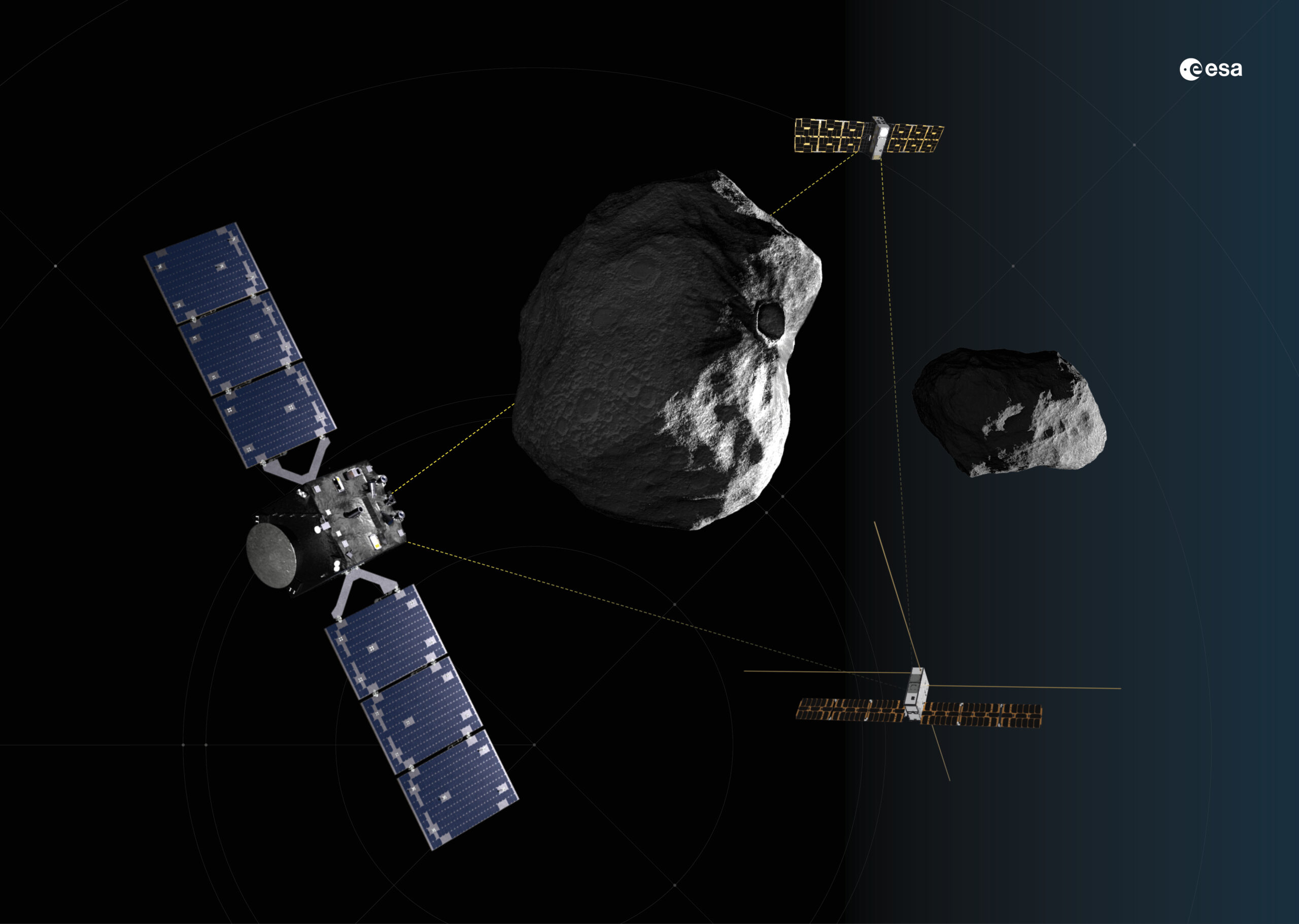
These fragments, ranging in size from footballs to large household appliances, represent a "company" of debris that had not been fully accounted for in post-impact models. Dr. Naomi Murdoch, a planetary scientist involved in the mission, highlighted the complexity of this discovery, noting that while the DART impact certainly generated a significant amount of this material, it is possible that some of these rocks are ancient remnants of the system’s formation. Distinguishing between fresh impact debris and pre-existing geological features is a primary task for the Hera team as they prepare to deploy two smaller CubeSats, Juventas and Milani, to conduct a more granular investigation of the surface.
Implications for Planetary Defense
The data gathered by Hera is not merely for academic interest; it is the cornerstone of future planetary defense strategies. The primary challenge in diverting an asteroid is that no two objects are identical. Some are dense, metallic cores, while others are loose, gravitationally bound aggregates of rock and dust. By measuring the mass and internal structure of Dimorphos, Hera will allow scientists to refine their computer models.
"Once we understand, we have a breakthrough, which really solves planetary defense," Dr. Michel stated. The goal is to move beyond "trial and error" and toward a predictive science where, if a hazardous object is detected, mission planners can calculate exactly how much force is required to achieve the necessary orbital shift based on the object’s specific physical characteristics.
The international cooperation between NASA and the European Space Agency underscores the global nature of this threat. The DART mission proved the capability of human technology to move an asteroid; the Hera mission is ensuring that we understand the physics behind that movement. By documenting the crater morphology, the debris field, and the changes in orbital dynamics, the scientific community is building a comprehensive library of data that will serve as the foundation for protecting Earth from future near-Earth object (NEO) impacts.
Technical Challenges and Future Objectives
Over the next six months, the Hera spacecraft will perform a series of close flybys, gradually tightening its orbit around the binary system. The deployment of the Juventas and Milani CubeSats will provide high-fidelity data that the mother ship cannot gather alone. These sub-satellites will perform radar tomography on the interior of Dimorphos and perform spectral analysis of its surface composition.
These missions are vital because they bridge the gap between remote observation and physical contact. Understanding the porosity and shear strength of the asteroid is essential for calculating the "momentum enhancement factor"—a key variable in kinetic impact modeling that determines how much additional energy is provided by the ejecta blasted off the surface during an impact. If an asteroid is essentially a pile of loose rocks, the ejecta acts as a thruster, potentially increasing the efficiency of the deflection.
As Hera continues its mission, the scientific community remains cautiously optimistic. The success of the DART-Hera mission sequence marks a historic transition in humanity’s relationship with the cosmos. For the first time, we are not merely passive observers of the celestial landscape; we are active participants, capable of identifying, analyzing, and potentially neutralizing threats from the void. The "mess" left by DART is, for planetary scientists, the most valuable data set ever collected, providing a blueprint for the survival of the biosphere in the face of an unpredictable and often volatile solar system. The ongoing analysis of this binary system will ensure that the lessons learned from this small, rugged moonlet are codified into a robust, global defense strategy for generations to come.