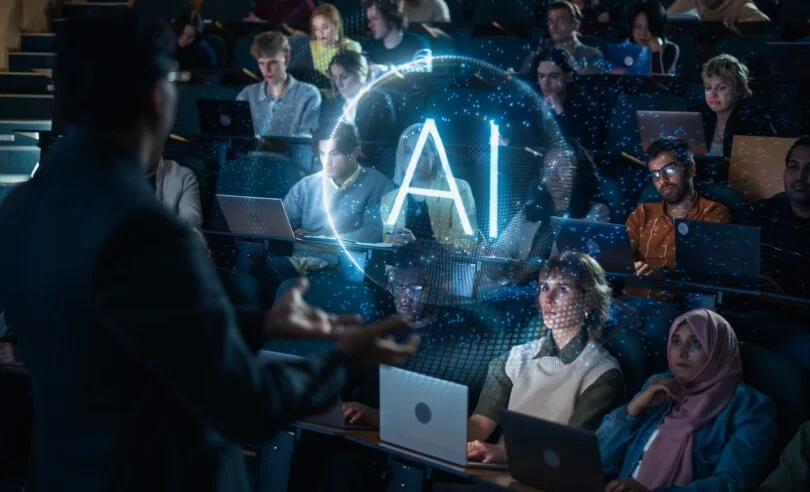
The rapid ascent of generative artificial intelligence has fundamentally altered the landscape of professional communications, forcing a shift in how industry veterans and emerging practitioners approach strategy, content creation, and ethical responsibility. On the second Monday of every month, the Public Relations Society of America (PRSA) hosts "AI Pulse," a briefing series led by Ray Day, APR, designed to navigate these shifting technological tides. During the November 9 session, Day, the immediate past chair of PRSA and executive chair of Allison Worldwide, convened a panel of academic leaders and students to examine how higher education institutions are integrating these tools into their curricula. The discussion underscored a critical reality: the future of public relations is not merely about using AI, but about mastering it as a strategic partner while maintaining the human-centric judgment that defines the profession.
The Evolution of the AI-Integrated Classroom
The pedagogical approach to AI in communications schools has shifted from skepticism to proactive integration. At Syracuse University’s Newhouse School of Public Communications, assistant professor Erika Schneider is at the forefront of this movement. Rather than banning AI tools, the department is embedding them into the fabric of daily coursework.
"We are integrating it either within individual classes or within topics in our classes," Schneider noted during the session. "We’re trying to reflect the industry demand, so we go through different simulations and workshops to figure out how we should best be using the tools."
This approach reflects a broader trend in communication studies. According to data from the Association for Education in Journalism and Mass Communication (AEJMC), nearly 70% of accredited public relations programs in the United States have modified their syllabi within the last 18 months to include modules on machine learning, generative AI, and prompt engineering. This transition is driven by a necessity to align academic training with the competitive pressures of the modern job market, where entry-level roles now frequently require baseline proficiency in AI-driven analytics and content generation.
The Credibility Crisis and Ethical Considerations
Despite the enthusiasm for increased efficiency, the panel highlighted significant friction points regarding the public’s perception of AI-generated content. Schneider’s own research into journalism students—the future gatekeepers of media relations—reveals a profound skepticism toward machine-assisted work. Her studies found that journalists who identified press releases as being written by AI viewed both the content and the sender as significantly less credible.
This finding presents a paradox for PR professionals: while AI can increase speed, it may simultaneously decrease influence if used indiscriminately. The industry implication is clear: transparency and human oversight are no longer optional. As AI-generated content becomes more prevalent, the value of the human "voice" and the verification of facts become the primary differentiators for credible communication.
The Student Perspective: AI as a Thought Partner
Contrary to the narrative that students are merely looking for ways to automate their way out of work, the sentiment among the next generation of practitioners is nuanced. Sophie Chaitovitz, a senior at Syracuse and director of development at the student-run firm Hill Communications, argues that the junior-career perspective is fundamentally about augmentation, not replacement.
"The student and junior-career perspective is a lot more positive than you would think," Chaitovitz stated. "The most important takeaway is using AI as a thought partner instead of a mindless tool that’s replacing our strategic thinking as PR professionals."
This "thought partner" framework is gaining traction in academic circles. It involves using LLMs to brainstorm angles, perform sentiment analysis, and organize research, while reserving the creative synthesis and emotional resonance for human decision-makers. This shift suggests that the next generation of PR talent is prioritizing critical thinking as a shield against the homogenization of content that AI models can sometimes produce.
The Rise of Synthetic Audiences and Advanced Workflows
At the University of Southern California (USC), the Annenberg School for Communication and Journalism has moved toward full-scale adoption. Fred Cook, director of the school’s Center for Public Relations, believes that proficiency in AI is now a prerequisite for professional success.
"We’re all-in on AI," Cook remarked. "We’re embracing it big-time, and teaching it in every class."
One of the most significant breakthroughs highlighted by Cook is the concept of the "synthetic audience." By using AI to simulate focus groups or predict how a specific message will land with a targeted demographic, firms can now test strategies in minutes rather than days. This capability is particularly transformative during crisis communications or high-stakes product launches, where time is the most valuable commodity.
However, the technology is not without its pitfalls. Ada Li, a junior at USC and research associate, warned that the quality of AI output is entirely dependent on the quality of the input. "Using AI to create your first draft is not the greatest idea," Li said. "And if you don’t feed it a certain amount of data, it’ll come up with generic answers that limit your creativity." She likened the process to managing an intern: without clear constraints, context, and expectations, the AI will default to the lowest common denominator of information.
Operational Efficiency in Student Agencies
The practical application of these theories is perhaps most visible in specialized creative agencies. Robert Judin, founder of "Two Bits Creative" at the University of Florida, emphasizes that for his students, AI is a tool for facilitation rather than a substitute for creativity.
"We are very pro-AI here," Judin stated. "For us, it’s more about AI facilitating creativity in content and comms than it is being the creativity and being the content and the comms."
Tyler Cohen, a junior at UF who leads AI and analytics at the agency, has taken this further by building custom CRM systems that automate administrative workflows. By leveraging AI for data tracking and project management, students are learning to scale their agencies in ways that were previously impossible without significant overhead. This operational agility is a skill set that directly translates to the high-pressure environment of top-tier PR agencies.
Analysis: The Path Forward
The consensus from the "AI Pulse" panel indicates that the public relations industry is at a crossroads. As companies face increasing scrutiny over the use of automated systems and the environmental impact of large-scale data centers, the role of the communicator is expanding to include that of a technological ethicist.
The implications for the industry are threefold:
- Standardization of Ethics: As the "synthetic audience" becomes more common, the industry will likely need to establish ethical guidelines regarding the disclosure of AI involvement in content creation to maintain trust with journalists and the public.
- Redefining Value: The value proposition of PR is shifting away from the speed of drafting and toward the quality of strategy and relationships—areas where AI currently struggles to compete.
- Educational Alignment: The gap between traditional communication curricula and the technological demands of the workforce is closing, but the pace of AI development requires a culture of continuous learning that extends far beyond graduation.
Ray Day’s observation that the best innovation often emerges from those unburdened by bureaucracy rings true. Universities are currently serving as the industry’s "R&D labs," testing the boundaries of what is possible with AI. For professionals already in the field, the message from the panel is unambiguous: the time for cautious observation has passed.
"The companies leading this charge have a serious responsibility to investigate and determine the safety of these products before they’re released," Cook concluded. "As far as people in the PR industry are concerned, we need to rev up the engines. The more that students learn about AI, the better off they’re going to be in their careers. Better get on board than be left behind."
As the digital landscape continues to evolve, the integration of AI will not be defined by the tools themselves, but by the professionals who use them to enhance human connection, strategic insight, and ethical storytelling. Whether in a university classroom or a boardroom, the directive remains the same: understand the technology, apply it with purpose, and never lose sight of the human element that makes public relations a vital part of the global economy.