
PayPal Honey Terminated from Major Affiliate Networks Amid Allegations of Attribution Manipulation and Compliance Violations


The affiliate marketing industry has experienced a significant shift following the removal of PayPal Honey, one of the world’s most prominent browser-based coupon tools, from two of the largest affiliate networks in the United States. Within a single week in January 2026, both Rakuten Advertising and Impact.com took decisive action against the publisher, citing noncompliance with platform policies and the manipulation of attribution frameworks. This development follows years of scrutiny regarding the technical operations of browser extensions and their impact on the integrity of the "partnership economy."
The removal of Honey is particularly noteworthy given its corporate pedigree. Acquired by PayPal in 2020 for approximately $4 billion, Honey was positioned as a cornerstone of PayPal’s move into the early-funnel shopping experience. However, recent investigations by independent researchers and tech analysts have raised alarms about the methods the extension uses to claim commissions, leading to its sudden exclusion from major marketing ecosystems.
Chronology of the Disciplinary Actions
The enforcement actions against PayPal Honey unfolded during one of the industry’s most active periods, coinciding with the Affiliate Summit West conference in Las Vegas.
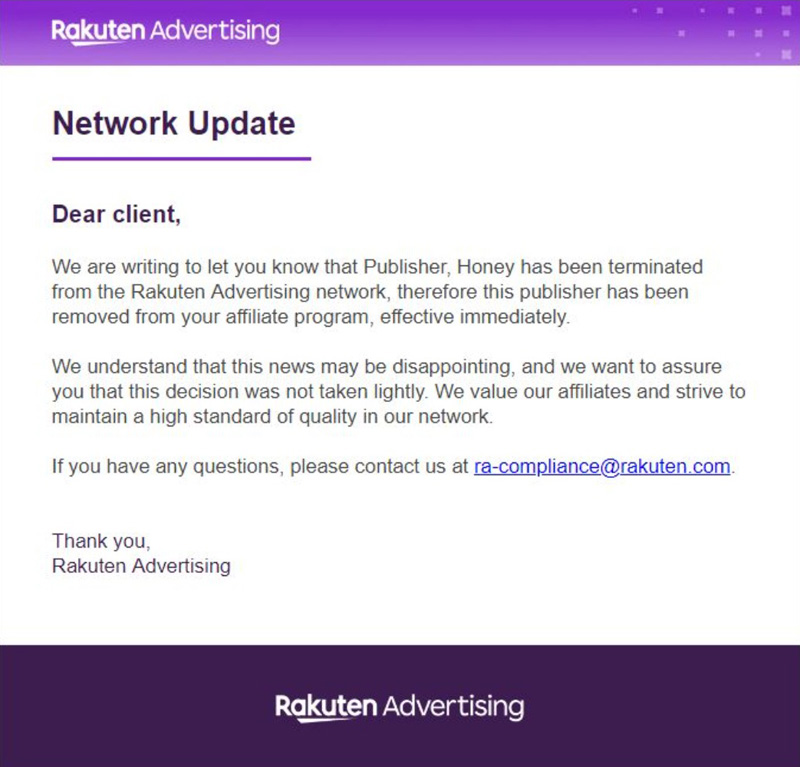
On Monday, January 12, 2026, Rakuten Advertising issued a formal announcement stating that Honey had been "terminated from the network." The network characterized the move as a necessary step to maintain "a high standard of quality" for its advertisers and partners. The use of the word "terminated" suggested a permanent severance of the relationship, a rare move for a publisher of Honey’s scale.
Following Rakuten’s lead, Impact.com took action on Friday, January 16, 2026. The network’s CEO confirmed that Honey had been found "out of compliance" with platform policies. Specifically, the extension was removed from Impact.com’s "Discovery Marketplace," a move that effectively hides the publisher from new brand partnerships and suspends its active status. While Impact.com’s initial communication suggested a "temporary suspension" pending further review, the grounds for the action—"attribution manipulation"—pointed to deep-seated technical violations.
The Catalysts: Investigative Findings and Technical Violations
The industry-wide crackdown was largely precipitated by two major investigations that gained significant traction in the weeks leading up to the terminations. The first was a detailed video exposé by the investigative tech YouTuber MegaLag, which visually demonstrated how browser extensions could potentially hijack affiliate links. The second was a rigorous technical investigation by Ben Edelman, a well-known consultant and researcher specializing in online fraud and affiliate compliance.

The core of the allegations centers on "stand-down" rule violations and "attribution manipulation." In the affiliate marketing world, the "stand-down" rule is a standard requirement for Downloadable Software Publishers (DSPs), such as browser extensions. It mandates that an extension must not fire its own affiliate link or drop a cookie if a user has already arrived at a merchant’s site via another affiliate’s link. The purpose of this rule is to prevent "cookie stuffing" or "last-click theft," where a software tool overwrites the credit of a content creator or influencer who actually drove the initial customer interest.
Investigations suggested that PayPal Honey had employed methods to bypass these stand-down requirements, effectively "hijacking" the attribution. By doing so, the extension would claim a commission for a sale that was already in progress, often without providing any incremental value to the merchant. Furthermore, reports indicated that the extension utilized techniques to conceal these violations from standard monitoring tools, making it difficult for affiliate managers to detect the noncompliance without advanced forensic auditing.
The Economic Impact on PayPal and the Industry
The suspension of Honey represents a significant reputational and potentially financial blow to PayPal. When PayPal acquired Honey Science Corp for $4 billion in early 2020, it was the company’s largest acquisition to date. The goal was to integrate Honey’s 17 million monthly active users into the PayPal ecosystem, creating a seamless pipeline from product discovery to checkout.
If Honey remains excluded from major networks like Rakuten and Impact, its ability to generate revenue through affiliate commissions—its primary business model—will be severely hampered. Moreover, the "attribution manipulation" label could deter major retailers from working with Honey directly, as brands increasingly demand transparency and "incremental" growth rather than simply paying commissions for sales that would have happened anyway.
For the broader affiliate industry, the move signals a new era of enforcement. For years, many networks were accused of "looking the other way" regarding the practices of large publishers that generated high volumes of traffic. The termination of a $4 billion entity suggests that the pressure for quality and transparency from advertisers has finally outweighed the benefits of high-volume, potentially non-compliant traffic.
Strategic Implications for Affiliate Managers
The Honey incident serves as a critical case study for affiliate program managers and digital marketers. Industry experts have identified several key lessons that highlight the complexities of managing modern partnership programs.
1. The "Bad Apple" Effect on Program Ecosystems
In affiliate marketing, most programs operate on a "last-touch" attribution model. When a dominant player like Honey engages in link hijacking, it does not just affect the merchant; it actively harms other affiliates. Content creators, bloggers, and influencers who spend resources producing reviews and guides often find their commissions "stolen" at the last second by a browser extension pop-up. If a program is perceived to allow such behavior, high-quality content affiliates will often abandon the program entirely, leading to a decline in authentic brand reach.
2. The Necessity of Independent Policing
While affiliate networks provide the infrastructure for tracking, the Honey case demonstrates that they are not always the first line of defense in compliance. Network compliance teams often focus on network-wide policy violations rather than the specific Terms and Conditions (Ts & Cs) of individual brand programs. Managers are increasingly encouraged to conduct their own audits and use third-party monitoring tools to ensure that publishers are adhering to the specific rules agreed upon during the application process.
3. Understanding the Nuances of DSP Technology
Not all browser extensions or Downloadable Software Publishers are inherently predatory. Many provide significant value through rewards, price comparisons, and loyalty points. However, affiliate managers must understand the technical distinctions between "soft clicks," "hard clicks," and "stand-down" protocols. Organizations like The Affiliate & Partner Marketing Association (APMA) in the UK have recently conducted audits showing that while some extensions follow the rules, the complexity of the technology often hides non-compliant behavior from the untrained eye.
Diversification as a Risk Mitigation Strategy
Perhaps the most significant takeaway from the PayPal Honey controversy is the danger of affiliate base concentration. Audits of many modern affiliate programs reveal a startling lack of diversity; it is not uncommon for 80% of a program’s revenue to be generated by a single type of affiliate, such as coupon extensions or cashback sites.
When a major player like Honey is removed or suspended, programs that rely heavily on that single source face an immediate and catastrophic drop in referred revenue. To combat this, industry leaders are advocating for a more balanced "affiliate mix." A robust program should ideally include a variety of publisher types, including:
- Content and Mass Media: Bloggers, ranking sites, and major news outlets.
- Affinity Groups: Organizations catering to specific demographics or professional groups.
- Social Media Influencers: Creators on platforms like Instagram, TikTok, and YouTube.
- Closed User Groups (CUG): Reward platforms for employees or members that are not accessible to the general public.
- Card-Linked Offers: Rewards tied directly to a consumer’s credit or debit card.
- Technology Partners: Solutions for cart abandonment, retargeting, and post-checkout engagement.
By diversifying across these categories, brand managers can ensure that their programs remain resilient even if a major partner or an entire category of software publishers faces regulatory or network-level challenges.
Conclusion: A Turning Point for the Partnership Economy
The removal of PayPal Honey from Rakuten Advertising and Impact.com marks a pivotal moment in the history of digital marketing. It serves as a reminder that scale and corporate backing do not grant immunity from the fundamental rules of the affiliate ecosystem. As the industry moves toward 2026 and beyond, the focus is clearly shifting toward "clean" attribution and the verification of incremental value.
For PayPal, the challenge will be to re-engineer Honey’s technical approach to satisfy the stringent requirements of affiliate networks and restore trust with merchants. For the rest of the industry, the event is a clarion call to prioritize compliance, invest in independent auditing, and build diverse partner portfolios that can withstand the volatility of the evolving technological landscape. The "partnership economy" relies on trust; without it, the model of performance-based marketing risks losing its appeal to the world’s leading brands.


