The sight of the USS Abraham Lincoln (CVN-72) returning to port in August 2026 blanketed in oxidation served as a stark, public reminder of the relentless battle the United States Navy wages against the marine environment. Saltwater, while essential for naval operations, acts as a highly corrosive catalyst that compromises the structural integrity of steel hulls over time. While surface-level rust is a known and anticipated reality of extended deployments, the deeper concern for naval engineers lies in hidden fatigue, micro-fractures, and thinning hull plates that cannot be detected by the naked eye. To address these systemic maintenance challenges, the Department of the Navy has officially pivoted toward cutting-edge autonomous technology, signing a significant $300 million contract with Gecko Robotics in October 2026.
This strategic investment marks a shift away from labor-intensive, reactive maintenance models toward a proactive, data-driven methodology. By integrating AI-powered climbing robots into the fleet’s maintenance cycle, the Navy aims to drastically reduce the time vessels spend in shipyards, effectively increasing the operational availability of the surface fleet.
The Chronology of Naval Maintenance Evolution
For decades, the standard for assessing a ship’s structural health was a manual, often subjective process. Technicians would systematically scrape paint from randomized sections of the hull, conduct visual inspections, and use handheld ultrasonic gauges to check for plate thinning. This process was not only time-consuming but also prone to human error, as it relied on spot-checks rather than a comprehensive survey of the entire vessel.
The impetus for the transition to robotic inspection intensified following the 2026 deployment cycles, which highlighted the growing strain on the aging surface fleet. In response to these maintenance bottlenecks, the Navy initiated the search for a scalable solution. By October 2026, the partnership with Gecko Robotics was finalized, providing the Navy with an indefinite-delivery, indefinite-quantity (IDIQ) contract. This agreement allows the Navy to rapidly deploy robotic platforms across various shipyards, moving from the pilot testing phase to fleet-wide integration.
Technical Capabilities of the Komodo System
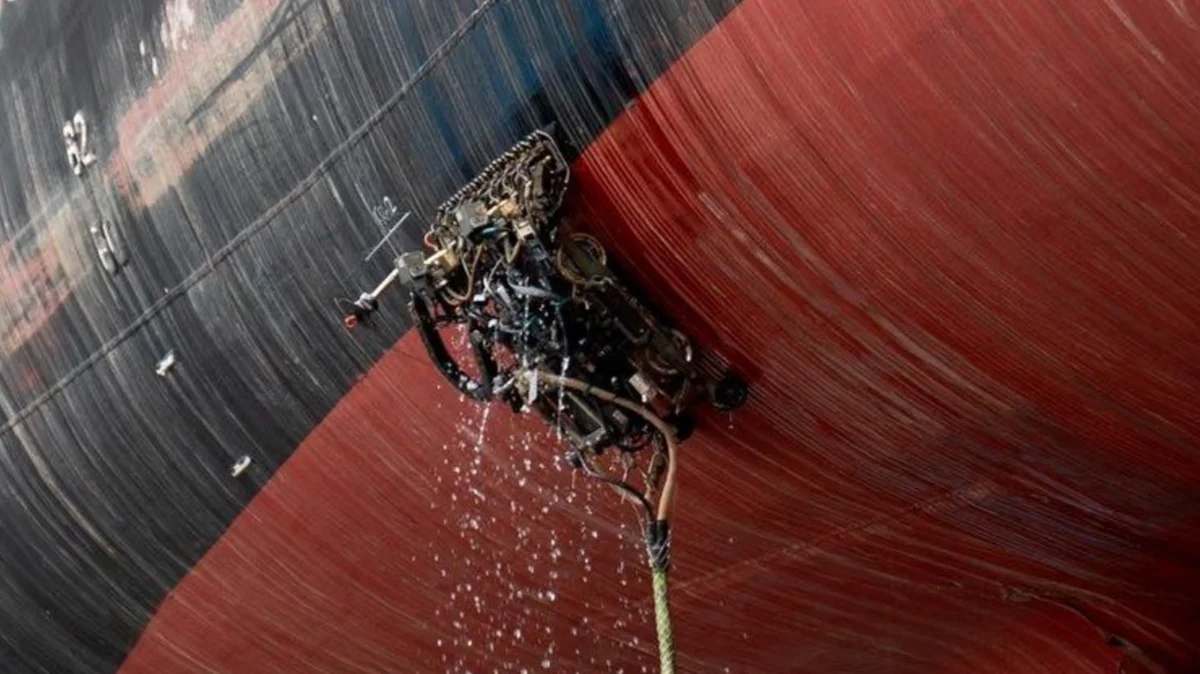
The cornerstone of this new maintenance strategy is the Komodo robotic platform. Unlike traditional inspection drones that hover or float, the Komodo is a wall-climbing robot engineered to adhere to vertical and inverted steel surfaces. Its primary advantage lies in its ability to conduct non-destructive testing (NDT) without the need for intensive surface preparation.
The system utilizes Electromagnetic Acoustic Transducer (EMAT) technology. Traditional ultrasonic sensors require a liquid couplant—such as water or oil—between the sensor and the steel to transmit sound waves. This necessitates the removal of paint and protective coatings. EMAT technology, however, uses electromagnetic induction to generate ultrasonic waves directly within the metal, allowing the robot to scan through thick layers of marine growth, oxidation, and protective coatings.
According to technical specifications provided by the contractor, the EMAT sensors can penetrate up to 150mm of metal plating, providing a high-resolution map of the ship’s internal structural condition. By traversing the hull along specific frames, seams, and weld lines, the Komodo creates a digital twin of the vessel’s hull, recording precise data on material degradation that can be compared against future scans. This longitudinal data allows engineers to predict where and when a crack might occur before it becomes a critical failure point.
Financial and Operational Impact
The fiscal implications of this technology are substantial. The Navy estimates that the implementation of Gecko’s robotic systems can save up to $8 million in repair costs per ship. These savings are realized through the reduction of labor hours, the elimination of unnecessary paint removal and subsequent recoating, and the mitigation of expensive emergency repairs that occur when structural defects are identified late.
Perhaps more critical than the monetary savings is the impact on fleet readiness. Traditional manual inspections of an aircraft carrier or a large-deck amphibious ship can take months, keeping the vessel sidelined in a drydock for extended periods. With the Komodo system, the Navy reports that inspections can be completed in a matter of days. This acceleration of the maintenance cycle ensures that ships spend less time in port and more time executing mission objectives.
Future Developments: The Axolotl Initiative
While the Komodo system has proven effective for drydock operations, the Navy’s long-term objective is to maintain structural health without requiring a ship to be removed from the water. To this end, Gecko Robotics is currently developing the Axolotl, an underwater robotic platform designed to perform similar scanning duties while the ship is pier-side or at anchor.
If successful, the Axolotl will eliminate the need for the Auxiliary Floating Dry Dock Medium (AFDM) or other drydocking facilities for routine inspections. By enabling full-hull integrity assessments during short port visits, the Navy could move toward a continuous maintenance model, effectively ending the reliance on massive, infrequent overhaul periods that have traditionally defined the life cycle of naval vessels.
Analysis of Fleet Implications
The integration of these robotics represents a broader trend in the Department of Defense: the "digitization of the battlefield," which extends into the maintenance bay. By creating a historical database of every scan, the Navy is moving toward predictive maintenance. This is the industrial equivalent of an aircraft’s engine sensors warning a pilot of a pending failure before it occurs.
However, the transition is not without its logistical hurdles. Implementing this technology requires a specialized workforce capable of operating and maintaining the robots, as well as the data scientists necessary to interpret the massive influx of structural data. The Navy is currently training shipyard personnel to work alongside these systems, ensuring that human expertise is augmented—rather than replaced—by AI-driven insights.
Furthermore, the environmental benefits of this shift should not be overlooked. Reducing the frequency of scraping and repainting hulls limits the introduction of micro-plastics and chemical contaminants into the marine environment, aligning with broader Department of Defense initiatives to reduce the environmental footprint of naval operations.
Conclusion
The rust on the USS Abraham Lincoln, while visually jarring, has served as a catalyst for a necessary modernization in how the United States Navy sustains its maritime power. By embracing robotics and AI-enabled diagnostics, the service is effectively moving toward a future where the health of a ship is known in real-time, maintenance is performed with precision, and the operational life of the fleet is extended. As the Navy continues to roll out the Komodo system and develops the underwater capabilities of the Axolotl, the focus remains clear: maximizing the readiness of the fleet in an increasingly challenging global maritime environment. Through the convergence of material science and artificial intelligence, the Navy is ensuring that its ships are not only built to last but are maintained with the highest degree of technological sophistication available.